On The Trail Of Better,
p. 154 · Read in the full issue
Cheaper Stock Feed
From BERYL CATES, in Suva The South Pacific Islands’ only factory producing stock and poultry feed is shortly to increase its size and add extra staff to keep up with the demand. The factory, at Nausori, near Suva, meets all Fiji demands for feed, and also exports to Tonga, the Gilbert and Ellice Islands Colony, the Marshalls, and plans soon to export to Western Samoa.
CREST MILLS (Fiji) Ltd., goes about its job scientifically. Its manager, Suva-born Joe Campbell, was for 17 years with the Fiji Depart ment of Agriculture, the last eight of them as livestock officer at Koronivia Research Station.
He has a Dip. Ag. from New Zea land’s Massey College.
The mill also uses the services of the Sydney parent company’s top nutritionist, Malcolm McDonald, M.AgS., PhD., who recently created interest among Fiji farmers by con firming that the Fiji weed vaivai could be used with advantage as a replacement for imported lucerne meal.
Vaivai has been used in poultry feed for some years in Hawaii, the Philippines and New Guinea.
Vaivai ( Leuceana leucocephala ) is a prolific weed in almost all Pacific Islands territories and it is easily re cognised. It is a small, quick-growing
tree with leaves comprising leaflets, and with white flowers in globose heads. Pods of the weed are clustered together and each pod contains about 20 seeds.
Dr. McDonald, who recently returned from lecturing at the 13th World Poultry Science Congress in Kiev, Russia, carried out trials on Fiji vaivai sent him by Mr. Campbell.
The vaivai was grown by Fiji Department of Agriculture officers at the department’s Sigatoka experi mental farm, and hot air dried. Cut tings dried included leaves, stalks and some small twigs. Hammer-milling followed drying.
The vaivai contained 16.4 per cent, protein, although samples produced on other occasions contained up to 27 per cent. Lucerne used in the com parative trials was a sun-dried Aus tralian lucerne meal, containing 14 per cent, protein.
Experimental diets were produced by diluting a basic mash with in creasing quantities of lucerne meal or vaivai. Each diet was fed to 12 chickens for 14 days, from the seventh day post hatching.
The results are in the accompany ing table.
Since, on the feed/gain ratio, g. per g. represents grammes eaten for gram mes gained, the lower the figure the more efficient the diet is.
There is another interesting point.
It has been established that, as a stock feed, diets containing over five
per cent, vaivai depress growth, owing to the presence of toxic amino acid mimosine. It may also cause shedding of manes and tails of horses.
Dr. McDonald’s own experiments with poultry feed have so far produced no harmful results with 7.5 per cent, vaivai, although tests have yet to be completed. Dr. McDonald wants to find the reasons for his results.
The local poultry food mill pro ducts differ in colour from those manufactured overseas, because many locally produced ingredients are used.
Maize, some sorghum and coconut meal are grown locally by farmers under contract. Lime used in the food is coral lime, bought from the Fiji cement factory, and fish meal is ob tained from the fish factories at Levuka and Pago Pago.
Food produced at the mill incor porates special medicines, and avail able on request are additives for de worming, and for the prevention of many diseases.
The Crest factory was opened in 1965, in what was the former South Pacific Sugar Mills’ Nausori factory.
It has 5,000 square feet of floor space, and plans to add another 6,000 square feet. Present production is 400 tons a month.
One of the reasons for improved business is the recent decision by the Fiji Legislative Council to raise tariffs on imported dressed poultry by 15 per cent, to 25 per cent. This means a boom for local poultry farmers.
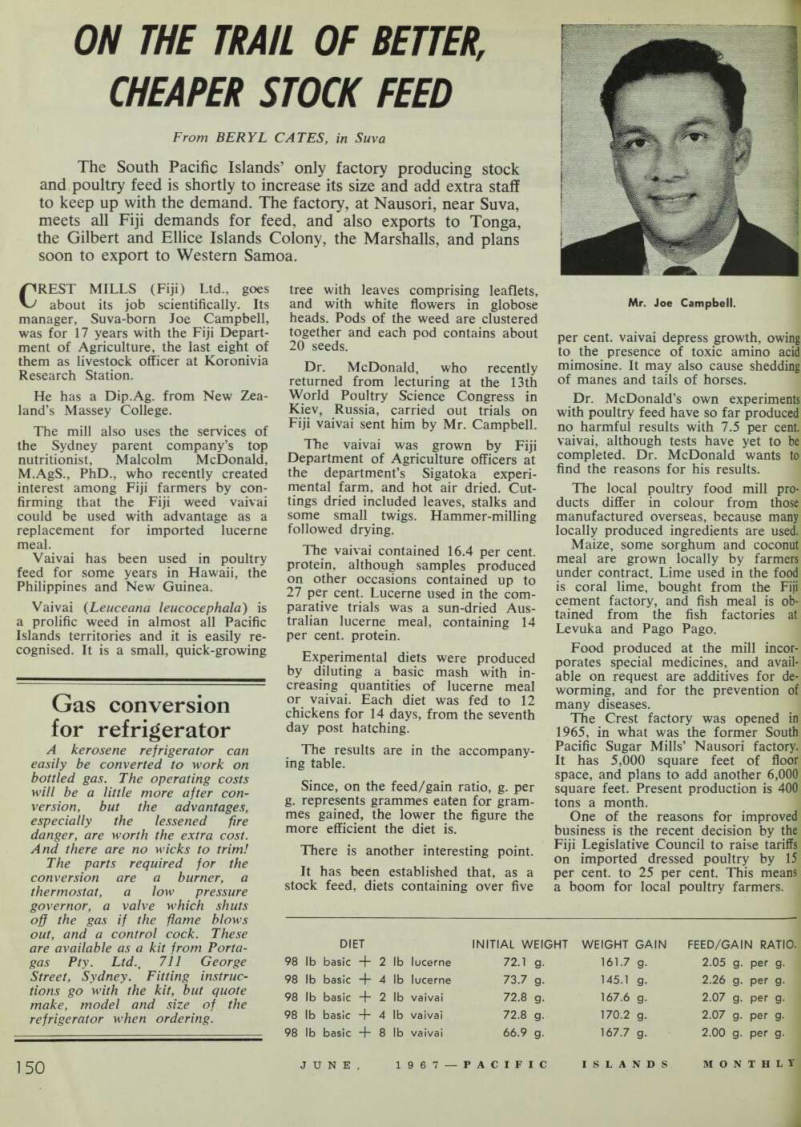
Mr. Joe Campbell.
DIET INITIAL WEIGHT WEIGHT GAIN FEED/GAIN RATIO. 98 lb basic -j- 2 lb lucerne 72.1 g. 161.7 g. 2.05 g. per g. 98 lb basic + 4 lb lucerne 73.7 g. 145.1 g. 2.26 g. per g. 98 lb basic + 2 lb vaivai 72.8 g. 167.6 g. 2.07 g. per g. 98 lb basic + 4 lb vaivai 72.8 g. 170.2 g. 2.07 g. per g. 98 lb basic + 8 lb vaivai 66.9 g. 167.7 g. 2.00 g. per g.