Development
pp. 133-145 · Read in the full issue
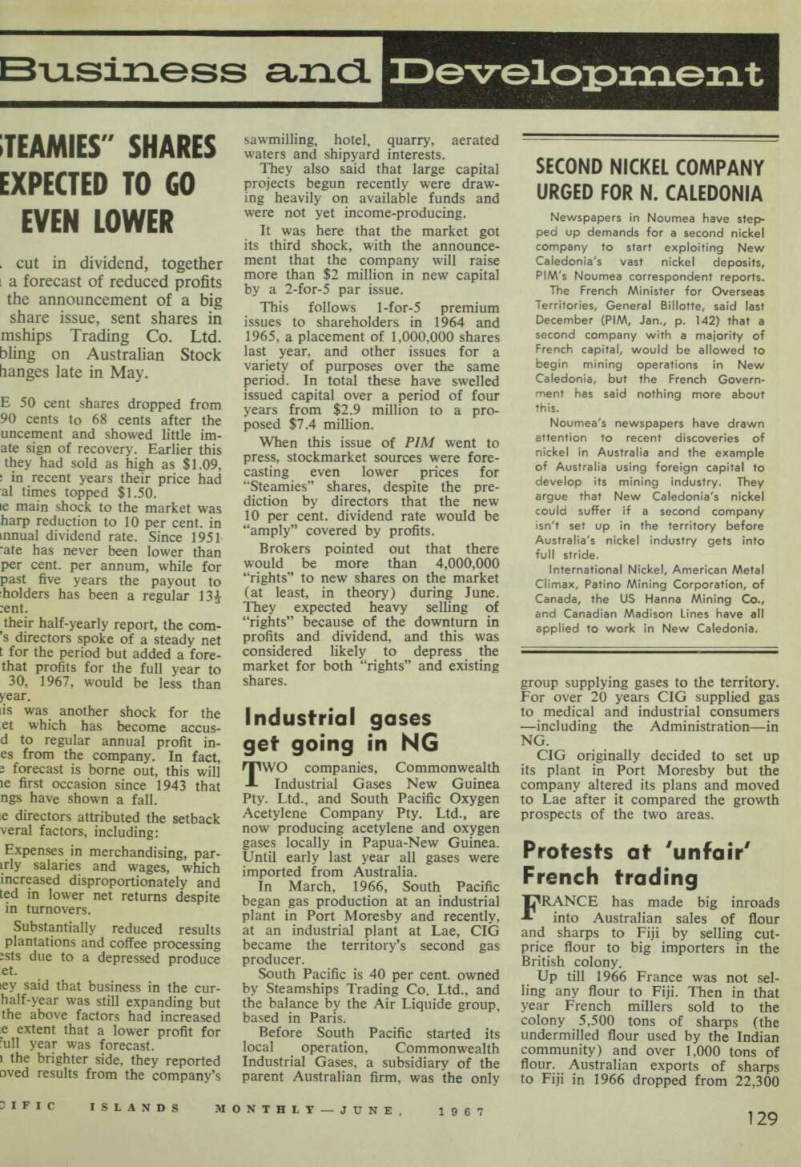
Business and
Steamies" Shares
Expected To Go
Even Lower
. cut in dividend, together
1 a forecast of reduced profits the announcement of a big share issue, sent shares in
mships Trading Cos. Ltd.
bling on Australian Stock
hanges late in May.
E 50 cent shares dropped from 90 cents to 68 cents after the uncement and showed little im ate sign of recovery. Earlier this they had sold as high as $1.09, 5 in recent years their price had al times topped $1.50. le main shock to the market was harp reduction to 10 per cent, in innual dividend rate. Since 1951 •ate has never been lower than per cent, per annum, while for past five years the payout to holders has been a regular 13£ :ent. their half-yearly report, the corn ’s directors spoke of a steady net t for the period but added a fore that profits for the full year to 30, 1967, would be less than year.
Js was another shock for the et which has become accus d to regular annual profit in es from the company. In fact, 2 forecast is borne out, this will le first occasion since 1943 that ngs have shown a fall. e directors attributed the setback veral factors, including: Expenses in merchandising, par tly salaries and wages, which increased disproportionately and ted in lower net returns despite in turnovers.
Substantially reduced results plantations and coffee processing ;sts due to a depressed produce et. icy said that business in the cur half-year was still expanding but the above factors had increased e extent that a lower profit for Till year was forecast, i the brighter side, they reported oved results from the company’s
sawmilling, hotel, quarry, aerated waters and shipyard interests.
They also said that large capital projects begun recently were draw ing heavily on available funds and were not yet income-producing.
It was here that the market got its third shock, with the announce ment that the company will raise more than $2 million in new capital by a 2-for-5 par issue.
This follows l-for-5 premium issues to shareholders in 1964 and 1965, a placement of 1,000,000 shares last year, and other issues for a variety of purposes over the same period. In total these have swelled issued capital over a period of four years from $2.9 million to a pro posed $7.4 million.
When this issue of PIM went to press, stockmarket sources were fore casting even lower prices for “Steamies” shares, despite the pre diction by directors that the new 10 per cent, dividend rate would be “amply” covered by profits.
Brokers pointed out that there would be more than 4,000,000 “rights” to new shares on the market (at least, in theory) during June.
They expected heavy selling of “rights” because of the downturn in profits and dividend, and this was considered likely to depress the market for both “rights” and existing shares.
industrial gases
get going in NG
TWO companies, Commonwealth Industrial Gases New Guinea Pty. Ltd., and South Pacific Oxygen Acetylene Company Pty. Ltd., are now producing acetylene and oxygen gases locally in Papua-New Guinea.
Until early last year all gases were imported from Australia.
In March, 1966, South Pacific began gas production at an industrial plant in Port Moresby and recently, at an industrial plant at Lae, CIG became the territory’s second gas producer.
South Pacific is 40 per cent, owned by Steamships Trading Cos. Ltd., and the balance by the Air Liquide group, based in Paris.
Before South Pacific started its local operation, Commonwealth Industrial Gases, a subsidiary of the parent Australian firm, was the only
group supplying gases to the territory.
For over 20 years CIG supplied gas to medical and industrial consumers —including the Administration—in NG.
CIG originally decided to set up its plant in Port Moresby but the company altered its plans and moved to Lae after it compared the growth prospects of the two areas.
Protests at 'unfair'
French trading
FRANCE has made big inroads into Australian sales of flour and sharps to Fiji by selling cut price flour to big importers in the British colony.
Up till 1966 France was not sel ling any flour to Fiji. Then in that year French millers sold to the colony 5,500 tons of sharps (the undermilled flour used by the Indian community) and over 1,000 tons of flour. Australian exports of sharps to Fiji in 1966 dropped from 22,300
tons to 14,200 tons and flour from 16,000 tons to 10,400 tons.
French flour and sharps sell at about S7O a ton landed in Fiji as against Australian flour at SB3 a ton.
To offset this, Australia is given a small tariff preference of $2 a ton.
Australian millers told PIM they expected the French to sell more flour in 1967 to Fiji because the Fiji Government had so far refused to act.
They claimed that consumers in Fiji were not benefiting from the lower-priced French flour and sharps because it was resold in Fiji at the same prices as Australian flour.
France is able to sell its flour cheaply because the French miller is heavily subsidised by the French Government. He gets $123 a ton for flour in France and can export his flour at cut prices to remove sur pluses.
There is one price in France, a lower price in their own protected markets such as New Caledonia, and a dumping price in markets such as Fiji, where France must compete on the world market.
Fiji’s Chinese bakers do not use French flour—they prefer Australian flour which they say is of better baking quality.
Generally, the French flour is sold on the domestic retail market. Indian consumers buy the sharps to make chapatties and other breads at home.
Australian millers are protesting that the French trading practices are unfair because Australian bulk flour is denied access to New Caledonia and French Polynesia by strict licensing laws. French flour actually costs more than Australian flour would in those territories.
Copra market
fluctuates
THE copra market during April I fluctuated though not widely.
The average price for Philippine copra, at £Stg.63/17/6, was down by £Stg.3/2/6 compared with that for March.
The P-NG Copra Marketing Board reported that market trends were diverse. Both Nigerian groundnuts and US soyabean have dropped lower, whereas laurics and fish oil have been able to recover slightly.
Copra gains appear likely later this year in view of apparently declin ing world export availabilities, although actual world production of oilseeds will be considerably higher than average. However, low prices! in competing and interchangeable oils could restrict any recovery in copra prices to within narrow limits.
itback for new
imoan industry
NE of the most promising of Western Samoa’s small scale elopment projects received a set k in May when a leading food :essing scientist, Mr, L. J. Lynch, gned as head of the recently :ted food processing laboratory Mafua.
Ir. Lynch, a blunt-speaking Aus ian who has won international ignition for his work, minced no ds about his resignation, accord to PlM’s Apia correspondent.
When 1 came here six months , I was full of hope about the iect,” Mr. Lynch said. “I didn’t le here to make a career but to to do something for Western 10a.
But the lack of co-operation I ; received has made these the appiest six months of my life. I ; never come across such bureau :y as I have struck here.”
Ir. Lynch said there was no bt that the food processing in ry in Samoa could have a “rosy re”. espite the present shortage of material, initial work at the iratory in processing pineapples, /as, papaws, bananas, coconuts passionfruit had been very suc ful.
Ir. Lynch said his troubles were restricted to the Agriculture artment, with which he was nly associated,, but extended ughout the public service.
Morale throughout the public ice is appalling,” he said. [r. Lynch claimed the situation a legacy from the New Zealand inistration, under which senior tions were filled with no real ight as to the qualifications and petency of the officials con ed.
Jntil Samoa can break away i this New Zealand influence, it never get ahead,” he said.
i passionfruit
ctory rescued
ITS passionfruit industry, in the doldrums following an April an icement that one of its two fruit essing factories would be closed, anew lease of life in May with urther announcement that the jry would in fact remain open onerate on a different basis i future, Cottees (Fiji) Ltd., will mue operating the factory on a ewhat reduced scale and buy ionfruit from farmers on an open ket instead of at contract rates.
The go-ahead for the industry fol lowed a fact-finding visit by the chair man of Cottees (Australia) Ltd., Mr.
Harold Cottee, Sr,, to Fiji in April and May to confer with government officials and see the Sigatoka factory. {PIM, May, p. 131.) Mr. Cottee had also discussed the pending closure with Mr. D. W.
Brown, Fiji’s Parliamentary Secretary for Natural Resources.
With a view to looking for in creased export markets for the passionfruit, Mr. Cottee made a three week trip to the United States in May and June. He was expected to return to Sydney on June 6.
A company official in Sydney told PIM that Cottees (Fiji) had changed its buying methods. It had paid £F15,000 compensation to 130 farmers who had contracted to grow the passionfruit in the Sigatoka Valley and sell it to the Cottees pro cessing factory.
The money was paid through the Fiji Government to the farmers on behalf of the company on April 28, the spokesman said.
The factory never, in fact, did close down for any period—it operated on a limited scale and would continue to do so until additional export mar kets could be found.
An Australian
fiver now
ANEW Australian $5 banknote went into circulation on May 31 in Australia and all Pacific Islands where Australian currency is used.
The new note is basically mauve in colour with the main features over printed in black.
The front of the note shows a
portrait of Sir Joseph Banks, sur rounded by Australian flora—the reverse side shows a portrait of Mrs.
Caroline Chisholm, an Australian pioneer, against a background of women and children of her time.
There is a watermark portrait of Captain Cook. The new note is ex pected to lessen the demand for $2 and $lO notes.
Career ends for a
company promoter
fpHE extraordinary career of A Leonard Francis McEachern in Papua-New Guinea is ended. He tried to make a fortune in the terri tory by manipulation of companies On May 24, in Port Moresby, he was sentenced by the Supreme Court to gaol for three years, for forging, uttering and falsifying company documents.
The extraordinary and complicated story extends over about 10 years.
For many years, Harvey Trinder (NSW) Ltd., insurance brokers, a branch of the London corporation, have operated in Australia, being agents of Lloyds’ of London. Mr.
Frank McEachern was the highly respected NSW managing-director.
After World War 11, Harvey Trinder did well in P-NG. Frank McEachern’s son Len, then about 30, who also was a director of the Sydney company, directed P-NG business.
Young McEachern was instru mental in forming there a group of local trading companies—Aroana Estates, Ela Services, Eriama Estates, Eriama Shipping, Hotel Cecil, Morobe Hotels, and Wanigela Plantations.
The group was owned by a Mc-
Eachern company, Hamac Holdings Ltd.
Hamac presently appeared to be in financial difficulties. It owed £330,000 to Harvey Trinder interests, and about £IOO,OOO to secured and un secured creditors, mainly in P-NG.
Hamac in trouble
The London board of Harvey Trinder Ltd. took stern action. It was settled by the McEachern interests transferring their HT shares to Harvey Trinder, and receiving in re turn all the HT interests in Hamac.
Naturally, without HT backing, the value of Hamac dropped. Compli cated legal proceedings followed.
Hamac’s unsecured creditors appealed to the Supreme Court which, on April 1, 1960, ordered Hamac into liquidation.
The tireless and clever Len Mc- Eachern then got busy with accoun tants, lawyers and financiers, and they formed the P and NG Develop ment Corporation Ltd. (authorised capital £5 million in 5/- shares), with Lord Lymington as chairman. This peer was associated then with Latec Ltd., which subsequently had a dis tressing history in Australia.
P-NG Development persuaded the Supreme Court to accept its guaran tees that all the unsecured creditors of Hamac (£58,000) would be paid in
full; and liquidation was stayed on October 6, 1961.
In May, 1962, P-NG Development announced that Morobe Hotels Ltd. (Lae, Goroka and Wau) had been sold to Sangara Holdings Ltd. (a plantation company which had ex tended to investments) for £101,185 in cash, and 769 fully-paid Sangara 5/- shares.
In July, 1962, Sandy Creek Gold Sluicing Ltd. (a NG goldmining company turned investor) announced it had taken over 8 per cent, registered mortgage debentures of a nominal value of £150,000 from Sangara, in return for 1,200,000 2/6 shares in Sandy Creek, The deben tures were to be redeemed by San gara in cash—£25,000 in June, 1963, and £10,000 half-yearly thereafter.
Sandy Creek had been acquired in April, 1962, by a syndicate compris ing Len McEachern, his father (F.
N. McEachern) and H. H. Stitt (an accountant). Len McEachern was on the board of Sangara.
It is difficult now to sort out what was going on between Hamac, P-NG Development, Sangara and Sandy Creek ( PIM , Oct., ’62). The group expected substantial finance from P NG Development; but those hopes were dashed by the sensational col lapse in Australia of Latec Ltd.
Values of Sangara and Sandy Creek shares, hitherto good stocks, sagged in 1962.
Nemesis
Hamac’s unsecured creditors (£58,000) were not paid, as stipu lated by the court, and Hamac’s main asset, Morobe Hotels Ltd., were taken over by a receiver (a Burns Philp nominee).
At that period, drink restrictions on New Guineans were lifted, and the profits of Morobe Hotels in 1963-65 liquidated the old debts.
Meanwhile, where was McEachern, the key man in it all?
There had been fighting within Sangara Holdings Ltd. (PIM, March, ’63) and reports indicated that San gara expected to gain control of Morobe Hotels Ltd. when the latter was clear of receivership.
Meanwhile Sangara Holdings got control of the Cosmopolitan Hotel Co., and Len McEachern, under authority from Sangara, settled in there as a manager, in 1962, with a substantial salary (the “Cosmo” was making big profits).
Early in 1964 there came a de velopment which spelled Nemesis for Mr. McEachern. Someone began to buy Sangara Holdings shares on the Australian stock exchanges. At first, the 5/- shares were available at 6d.
(Continued on p. 141)
They moved up slowly, a penny at a time. On March 23, 1964, about 2,400 changed hands at 1/2. On March 24, Sydney Stock Exchange suspended Sangara Holdings shares from trading. PIM of April, 1964, said “the picture is one of singular complexity”.
The picture became clearer in 1964-65. It was disclosed (PIM, Dec., ’64) that the mysterious buyer was Mr. Stanley Eskell, MLC, of Sydney, formerly managing director of South Pacific Post Ltd., Port Moresby, and he had gained control of Sangara Holdings.
Morobe Hotels came out of the receivership early in 1965, and this valuable former asset of Hamac- P-NG Development had to be handed back to the owners.
But who were the owners? Hamac, or P-NG Development, or Sangara, or Sandy Creek? It was the kind of puzzle beloved by lawyers and ac countants. Obviously, McEachern had hoped to take over.
Complex
There was a similarly complex situ ation in Rabaul. Who owned the Cosmopolitan Hotel? The old Cosmo politan Company? Or Sandy Creek?
Or Sangara?
Possession is nine points of the law, they say. McEachern was in there as boss, in charge of the Cosmo’s very comfortable income, and he fought like a legalistic tomcat to stay there.
When Stanley Eskell bought con trol of Sangara, he bought three years of fighting in the territory’s courts before it was finally established that the three Morobe Hotels (Cecil, Goroka and Wau) and the Cosmo politan in Rabaul, are the property of Sangara Holdings Ltd.
It was November, 1965, before Eskell and his associates got a Supreme Court order under which McEachern was summarily removed from control of the Cosmopolitan Hotel, the annual profits of which were said to be some £45,000. The judge’s comments were scathing (PIM, Dec., ’65).
By now, Len McEachern was thoroughly discredited. He first ap peared in court, on charges of grave malpractice, in January, 1966; and from then on, during 1966, there were long-drawn-out proceedings, which culminated in his being charged on 15 counts, with forgery and falsifying company records. He was found guilty of eight of them.—