South Sea
pp. 99-104 · Read in the full issue
An Assorted Trio
On The Great
A book by yachtsman Dr.
David Lewis on his voyage in the catamaran Rehu Moana from England to Auckland; a new opus on Pitcairn that is some thing of an encyclopaedia on its subject; and a frothy travel book are among the latest books on the South Seas to reach PI M's
reviewing department.
Qn Copra Ships And Coral
ISLES is one of those occasional South Seas travel books which makes no impact because it has nothing much to say. New Zealand journalist Rosaline Redwood made a Cook’s tour of Fiji, the Samoas, Tonga and the Cooks a few years ago and gives an island by island description of them.
What topical interest the book may have had is lost by the fact that all the territories have changed radically since Miss Redwood was there.
Sir Guy Powles, for instance, was still New Zealand High Commissioner in pre-independent Western Samoa when she visited Apia.
She will make no friends in most territory governments because of her outdated information on hotels and the tourist picture generally.—Sl.
(On Copra Ships And Coral Isles.
Robert Hale, London. $2.65.) DR. LEWIS, a New Zealander, has figured frequently in PlM’s yachting columns in the past couple of years.
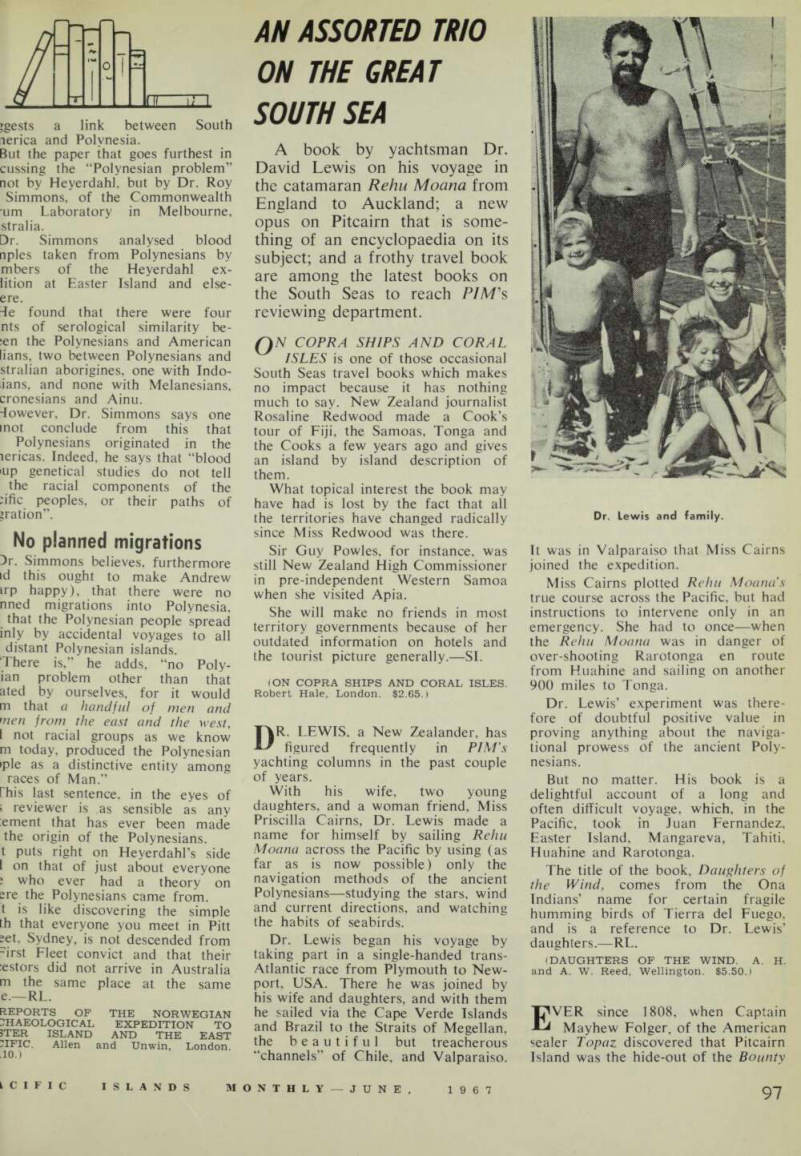
With his wife, two young daughters, and a woman friend, Miss Priscilla Cairns, Dr. Lewis made a name for himself by sailing Rehu Moana across the Pacific by using (as far as is now possible) only the navigation methods of the ancient Polynesians—studying the stars, wind and current directions, and watching the habits of seabirds.
Dr. Lewis began his voyage by taking part in a single-handed trans- Atlantic race from Plymouth to New port, USA. There he was joined by his wife and daughters, and with them he sailed via the Cape Verde Islands and Brazil to the Straits of Megellan, the beautiful but treacherous “channels” of Chile, and Valparaiso.
It was in Valparaiso that Miss Cairns joined the expedition.
Miss Cairns plotted Rehn Moana’s true course across the Pacific, but had instructions to intervene only in an emergency. She had to once—when the Rehu Moana was in danger of over-shooting Rarotonga en route from Huahine and sailing on another 900 miles to Tonga.
Dr. Lewis’ experiment was there fore of doubtful positive value in proving anything about the naviga tional prowess of the ancient Poly nesians.
But no matter. His book is a delightful account of a long and often difficult voyage, which, in the Pacific, took in Juan Fernandez, Easter Island, Mangareva, Tahiti, Huahine and Rarotonga.
The title of the book. Daughters of the Wind, comes from the Ona Indians’ name for certain fragile humming birds of Tierra del Fuego. and is a reference to Dr. Lewis’ daughters.—RL.
(Daughters Of The Wind. A. H.
and A. W. Reed, Wellington. $5.50.) EVER since 1808, when Captain Mayhew Folger, of the American sealer Topaz discovered that Pitcairn Island was the hide-out of the Bounty
Dr. Lewis and family.
mutineers, there has been a constan stream of literature on the subject quite out of proportion to its size o: population.
Because of the diligence of pas authors and the smallness of the sub ject—Pitcairn’s land area is onl; 1,200 acres and its population ha never exceeded the 1937 figure of 23! —it is becoming pretty difficult nov for anyone to find anything startling!] new to say about Pitcairn.
But there are always new ways o presenting the old material—and Mr David Silverman, a lawyer an< businessman of Cleveland, Ohio, ha found one in writing the latest bool on Pitcairn, which is entitled simply Pitcairn Island.
Mr. Silverman, who has made ; hobby of “searching out the trutl about Pitcairn”, has virtually aban doned the usual narrative approacl in his book. Instead, he has madi a close study of the many facets o the Pitcairn story and has writtei short essays about each one.
Well indexed
For example, in writing of the li years between the arrival of th< mutineers on Pitcairn and Mayhev Holger’s discovery, Mr. Silvermai examines what he has been able t< discover about each individual muti neer and each of their Polynesiai companions, and he then discusse such subjects as what happened t( Fletcher Christian, what happened t( the Bounty, Christian’s role on th< island, etc., etc.
Further on, in a section entitlet “The World of Pitcairn”, Mr. Silver man sets down information abou water, climate, fish, livestock anc fauna, trees, plants, salt, tools, boats and the ways in which the Pitcairners make a living, etc.
There is similarly detailed informa tion in sections entitled “Emigrants Immigrants and Visitors”; “Th( Society of Pitcairn”; and “Eugenics Laboratory—the Pitcairn Breed”.
Mr. Silverman’s book has copious bibliographic notes and is well indexed. It is, in short, something oi an encyclopaedia on its subject, and is a most useful reference book.
The author seems to have left few stones unturned in his quest foi material. However, there is one im portant writer whom he did miss— Captain James Henderson, of the ship Hercules, who visited Pitcairn in 1819 (while the last mutineer was still alive) and who wrote a long and interesting account of his visit for the Calcutta Press.—RL, (PITCAIRN ISLAND. The World Pub lishing Co., 2231 West 110th Street, Cleveland, Ohio. US $7.95.)
D