Remote, isolated Easter Island
p. 55 · Read in the full issue
Tahiti may be next stop
Remote, isolated Easter Island gets its air service—at last
After nearly 20 years of thinking about such a service, the Chilean national airline, LAN-Chile, has inaugurated fort nightly flights from Santiago to Easter Island with DC6-B aircraft.
BY the end of the year, the airline hopes to be flying on to Tahiti.
It is currently seeking permission for this from the French Government, whose airline, UTA-Air France, has been serving Chile for some years.
The Santiago-Easter Island service began at the beginning of April. The trip takes about nine hours, and the plane stays on the island for three days to enable tourists to look around.
A motel-style hotel is currently be ing built to accommodate tourists.
Meanwhile, they are being put up in a large marquee.
As there are few motor vehicles on the island at present, a bus is being shipped from Chile so that tourists can see the sights more easily.
Most isolated
Easter Island, a Chilean possession since 1888, is easily the most isolated island in the South Pacific. It is 2,000 miles west of the Chilean coast, and about the same distance south east of Tahiti.
Its 1,000-odd inhabitants are mainly Polynesians, whose ancestors erected several hundred massive stone statues, which have long been a puzzle to European scientists (see, also, p. 94).
Europeans first saw the island in 1722 when the Dutch explorer, Jacob Roggeveen, called there on Easter Sunday on a voyage round the world.
Since then, because of its extreme isolation, Easter Island has seldom seen more than about half a dozen ships a year. In recent times, since it came under the administration of the Chilean Navy, it has had only one supply ship annually.
The idea of linking the island with Chile and the rest of the Pacific has been frequently discussed since the end of the war.
The first proving flight was made as far back as the early weeks of 1951 when a Chilean Air Force Catalina, commanded by Colonel Roberto Parrague, landed at the island.
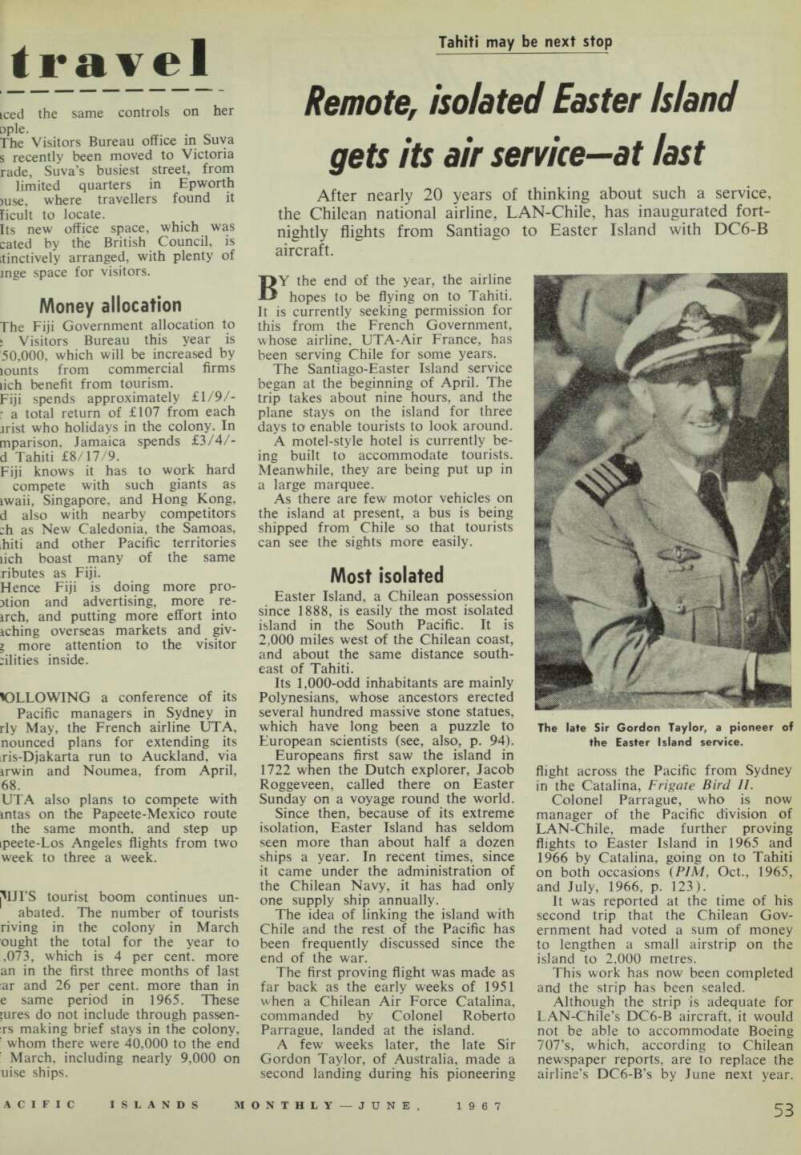
A few weeks later, the late Sir Gordon Taylor, of Australia, made a second landing during his pioneering
flight across the Pacific from Sydney in the Catalina, Frigate Bird 11.
Colonel Parrague, who is now manager of the Pacific division of LAN-Chile, made further proving flights to Easter Island in 1965 and 1966 by Catalina, going on to Tahiti on both occasions ( PIM, Oct., 1965, and July, 1966, p. 123).
It was reported at the time of his second trip that the Chilean Gov ernment had voted a sum of money to lengthen a small airstrip on the island to 2,000 metres.
This work has now been completed and the strip has been sealed.
Although the strip is adequate for LAN-Chile’s DC6-B aircraft, it would not be able to accommodate Boeing 707’s, which, according to Chilean newspaper reports, are to replace the airline’s DC6-B’s by June next year.
The late Sir Gordon Taylor, a pioneer of the Easter Island service.