Royal Tonga, Where The 'Reality
pp. 47-51 · Read in the full issue
Is As Good As The Dream'
By a special correspondent
Ever since I watched Queen Salote’s stoic disregard of the soaking London rain which lasted hroughout that June day of Queen Elizabeth of England’s coronation, Tonga had become the aost desirable of “far-away” places to visit.
IUE, I had to wait 14 years for the dream to become reality but n it did, it was one time when reality was every bit as good he dream. i a world of rapidly spreading dardisation, where Wigan and 3mera are all too likely to eat s. drink alike and think alike i if they bear little geographical mblance to each other, Tonga gem of individuality, hysically, it is much more like South Sea Island of the story ks. I shall never forget my first ipse of the group; just as we flew towards Nukualofa we saw an under our wings shaped like a d-mirror, outlined with a rim of ht yellow beach and surrounded an aquamarine sea.
White, sandy roads
md then, all those coconut palms! we flew low over the town, neat a child’s box of bricks and just colourful, there were the palms, dreds of them, sticking up like her dusters from the ground. >nce past Customs at the pretty, d airfield with its tiny, clapboard dings, the drive into town is
through peaceful countryside along white almost blindingly white sandy roads, past banana and coconut plantations, peanut patches, dreamy villages.
The only hazards were a stray pig or a young foal or the occasional horse pulling a cart with drunken wheels (all the carts I saw in Tonga looked as if their wheels were just on the point of collapse but I never saw one actually do it!) And those people! I doubt if ever I met such an immediately appealing race as the Tongans.
Not only are they a beautiful people . . . and I mean that in the purest sense of the word, which is not one to be used lightly . . . with fine physiques, delicate facial balance, golden skins and exquisitely shaped eyes, hands and feet, but they are intelligent, extrovert and manage to combine dignity with a real readiness to greet the world, now beginning to arrive on its doorstep with, perhaps, almost too great a frequency.
Ever since my arrival in the South Pacific I had heard of various famous
and fruity “characters”. Among those I had been told about was Bella Riechelmann so, when I was planning to visit Tonga, I had, naturally, booked to stay at “Bella’s”, more formally known as The Beach House.
A warm welcome
Alas, by the time I arrived in Nukualofa, Bella was sick in hospital.
Her daughter, Jean Robertson, made a magnificent substitute, however, and although my arrival that first dav was not until after two o’clock in the afternoon, my meal was waiting and, with the overwhelming charm which everyone in Tonga possesses so far as I can see, I wasn’t for one second made to feel the nuisance which I must have been, arriving so late in a small establishment.
There was an instant, genuine friendliness about the staff at the Beach House and you would have to be incredibly shy or hard to please ... or just plain ornery . . . not to feel at home in that warm, unfussy atmosphere.
“Bella’s” may, by the most modern standards, be a little short on air conditioning, fancy catering or even individual privacy, but there are
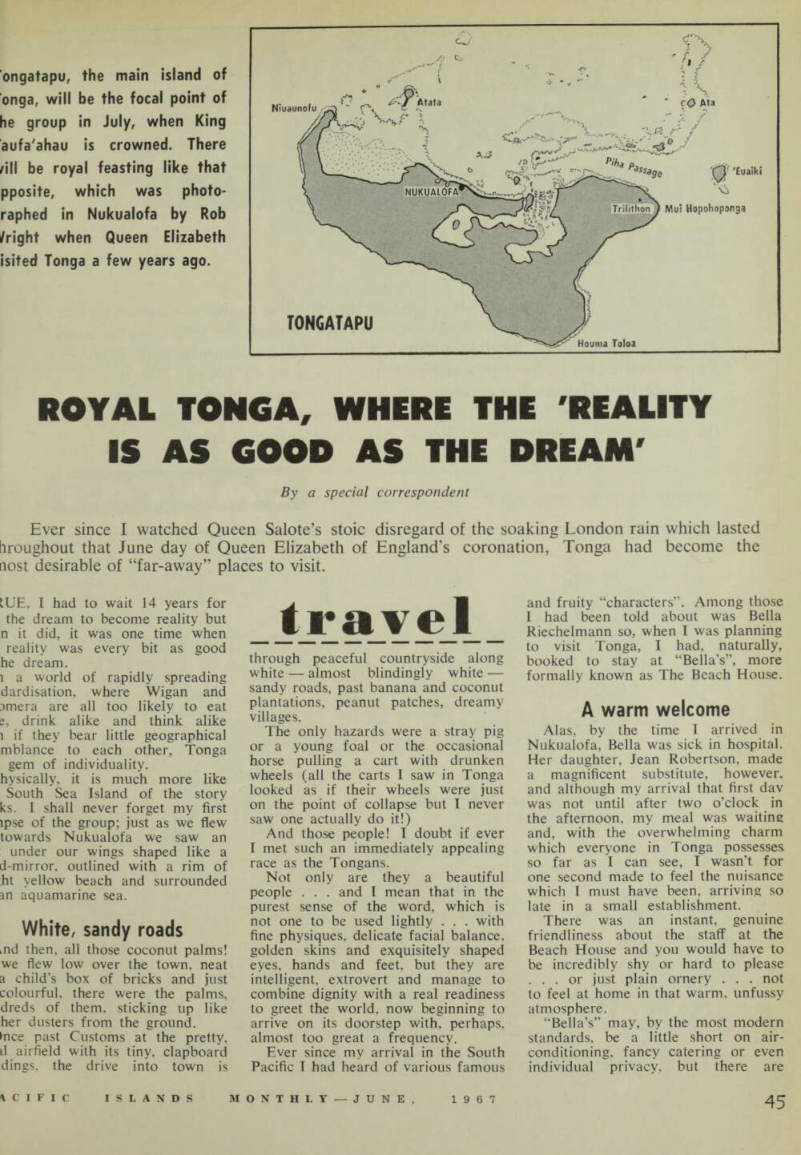
ongatapu, the main island of onga, will be the focal point of he group in July, when King aufa'ahau is crowned. There [?]lil be royal feasting like that pposite, which was photo raphed in Nukualofa by Rob [?]right when Queen Elizabeth isited Tonga a few years ago.
wers, real and man-made, family otos, an impressive shell collection, bies. good home cooking and bak ; that tastes right . . . and a jntiful hand-out of smiles all md.
Some purists claim that a flying it to a country is insufficient to ow one to express opinions about : place. I don’t agree.
Lhe quick, first impression has the ne sort of value as an impressionist inting . . . blurred as to detail, king in hard bone, maybe, but itaining something of the essence. / own. unshakeable impression was s of absolute charm and rare good ling and I doubt if I’ll ever change it judgment, snap though it may [t is a charming picture which ikualofa presents to the traveller.
Nukualofa views
some of the younger Tongans I ked with felt it should be pulled vn and built up again, neat, clean 1 modern. They may be right but, a visitor, its present appearance pure delight. t reminds me of all the Western is I’ve ever seen; I half-expected see Gary Cooper, in sheriff’s ss, lope out from one of the sun ached wooden stores on main ;et. How I loved those shops , . . 1. country general stores, with Is and towels, biscuits and benzine, )-records and cosmetics in a happy •ximity. vly favourite was the newly ;ned. freshly painted shop on a •minent corner-site ... a key site, any town, I’d say; it was clearly kualofa’s version of the smart vnshop and even though all its :k was of “good quality imported ond-hand”, it had that chic of its is counterpart, all right . . . and ic of its gowns were pretty snappy. fou can walk around Nukualofa 15 minutes, I’d say; and as I did that first, golden afternoon, the ice band was practising gaily in octagonal music room right behind Government building, which, like royal chapel and the palace, is doll’s house of a building, fresh I white under its painted, conical roof. rhe whole town has a kind of sical-comedy air, even without the :kground of music to which I was ated. helped by the clear light and natural gaiety of its inhabitants, is as if Noel Coward and Walt
Disney had collaborated to produce a perfect setting for a musical play.
The visitor is, of course, aided by the fact that most Tongans speak excellent English; they are willing to talk and do so fluently and well.
They speak English
For instance, the philosophy of tourism, its pros and cons, were thoughtfully put to me by the man ager of a local travel agency; clearly, he loved his beautiful country and although he realised its need for some tourism as another source of income in an agricultural community with almost no secondary industries, he was also worried by the thought that, with tourism, might come the danger of Tonga losing her identity.
Wise man.
Later, at the new Dateline Hotel during a display of Tongan and Polynesian dances, I talked to a girl wearing a mini-skirt. She, too, was happy with her country and her life in it although, like young people everywhere, she was determined to be up to date—hence her very short skirt worn even in the teeth of un favourable local comment.
Mini-skirt or long, flowered skirt, hair cut short or worn in the traditional neat plait, all the Tongan women dancing that night were dignified and lovely to look at; they
clearly loved having a good time but, even in the comic antics of the newer dances, there was never a hint of vulgarity; not in Tonga.
Those Tongan roosters
By the end of my first day I was glad to get to bed and although, next morning, I might have enjoyed a longer lie-in, who could resent being awakened at 5.30 when the pre-dawn chorus is one made up of bird-song, a slow-tolling church bell and an underlying beat of lali com bined with the crowing of the in defatigable Tongan roosters.
These latter creatures are even pervasive enough, by the way, to be heard sometimes crowing faintly in the background of the Radio Tonga’s early morning news. And I know people who swear that the roosters of Tonga never stop crowing, day or night.
My first call after breakast was on the Honourable Ve’ehala, one of Tonga’s noblemen and an authority on the country’s history and traditions, being Keeper of the Palace Records among other things.
With the courtly manners of a true aristocrat, he gave me a generous amount of his time, answering my many questions and then kindly sent the Palace Keeper to show me the royal chapel and the palace.
Once I stepped out of the bright sunlight into the chapel I was trans ported back to England, for the interior of carved and varnished
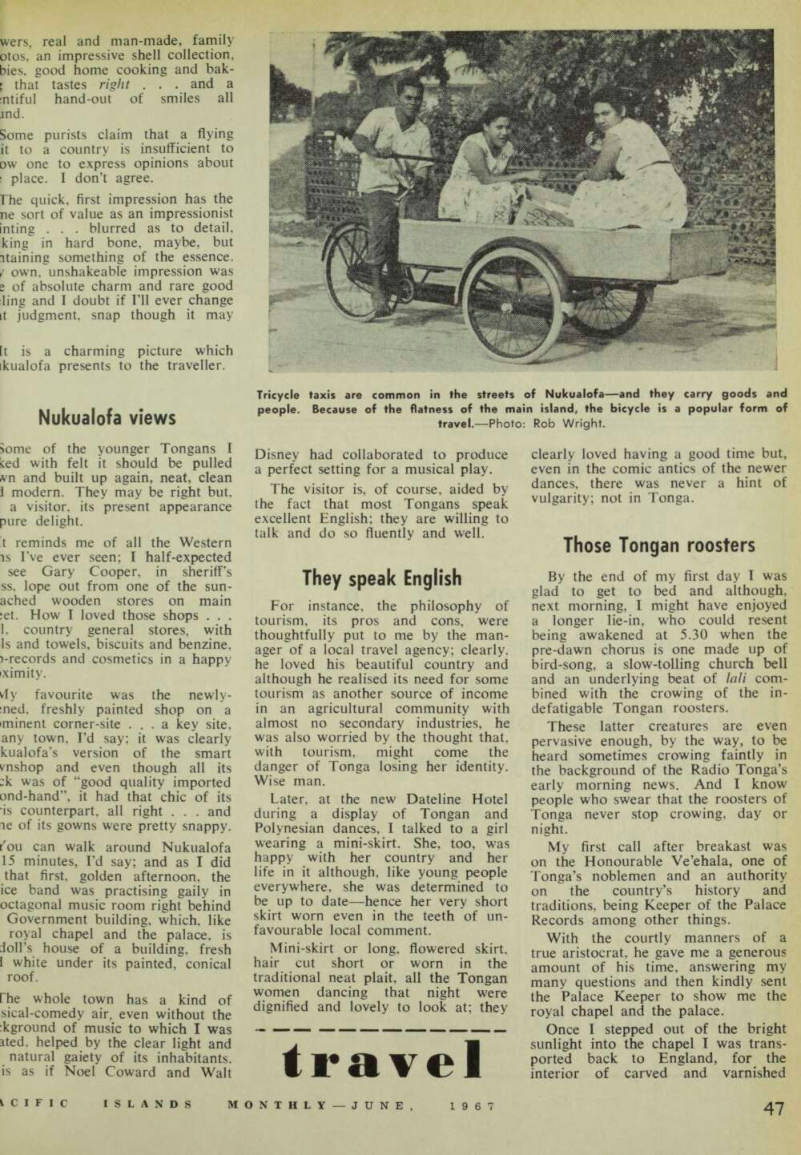
Tricycle taxis are common in the streets of Nukualofa —and they carry goods and people. Because of the flatness of the main island, the bicycle is a popular form of travel. Photo: Rob Wright.
woodwork of a golden-brown coloui was so exactly that of an English country church.
I remembered what I d been told of Tongan piety which is personal and profound and I could readily understand how dearly the chapel was held in respect by the nation.
In it, I saw the thrones of the King and Queen and reflected that, just now and then, the inequality of the sexes works to the advantage of the oft-misused distaff side, for the Queen’s throne is padded with silk while the King must be made of sterner stuff for he apparently sits upon an uncushioned wooden seat. 1
Inside the palace
Tupou Meli Taufa, the Palace Keeper, showed me the reception rooms of the palace and told me endearing stories of the time when he served Queen Elizabeth and Prince Philip during their visit to Tonga. I He showed me the shell pelmets above the drawing-room curtains which the late Queen Salote had worked on with him for the occasion of the Pan Pacific and South-East Asia Women’s Association conference in 1964. They were works of art. 1 As we left the cool, tranquil palace, my guide told me more stories of that royal visit and. as is often the way with Tongans. insisted on giving me a present. It was a cowrie-shell model of the famous Tu’i Malila, the tortoise which tradition has it came to Tonga with Captain Cook. The old chap died last year but there was no sign, that morning, of his young successor; off on a voyage of exploration all his own, no doubt.
Leaving the palace and my hand some guide, I crossed the public square towards the back streets to look at some of the quaint, old] wooden houses like prints from an old book with their blossoming trees! around them, when I saw something which almost made me misjudge Tonga.
Love affair with Tonga
I came face to face with a sign-J board standing beside a small, square! building. The board announced,!
“Development Plan 1965-70. Public i lavatories”.
Well. I thought, in the tropics it’s! wiser not to rush. All the same I was, for a moment, disappointed;! was I wrong?
Were all the energetic, intelligent!
Tongans I’d been meeting really sol laggard? Happily for my love-affair! with Tonga, I turned then to go to the post office and saw another! notice . . . and. later, several morel
. and discovered that Tonga, in t, is planning a positive rash of / buildings in the next few years . not one lonely little toilet, tak five years to build. now made haste to see the famous its of Tonga, There were the w-holes, where the sea dashes in, ;ht blue, against 20 miles or so rocky coastline and explodes into jmns of white spume rising like ntains, or a chorus of giant whales’ uts, as far as the eye can see. here were the flying-foxes, hang like strange fruit from three or r vast trees in the village of ovai; one of these creatures igingly extended his leathery gs as I watched, and then folded m about his body with the gestures a Dracula, although most of his d hung quite motionless.
'hen it was time to see the “Ha’anga-a-Maui”, a square-set arch large grey coral-stones half ered, like the tiered royal graves Langi, by soft green grass and >ht flowers.
'radition has it that the arch was It in the thirteenth century and t the immense blocks of coral le were brought from the Wallis nds. Like much else of the South ific, little is yet authenticated ut the earliest history of Tonga, New Zealand archaeologists who e just finished excavating and lying on Tongatapu have found
pottery remains and shell carvings dating to around the beginning of this century, and are eager to con tinue their work of uncovering in formation on the true beginnings of Tonga.
I found, meanwhile, that the present-day graves had a special, human appeal. They are sandy mounds, brilliantly white in the sharp sun and are decorated most colour fully with lengths of grass-skirting, artificial flowers, stones, shells, tinsel, glittery strips cut from beer cans.
Tonga's graves
I could not at first think what made the handsome, amber-coloured border to one mound; on moving closer it proved to be a row of beer bottles pushed neck downwards into the sand and the rounded bottoms made a most effective decoration, glinting in the sun.
As we started to drive back to town we heard a rhythmic beating and it proved to be made by two girls sitting under a shady tree, beat ing out masi with square, grooved wooden mallets, upon an old tree trunk.
It was fascinating to see the smooth, white, inch-wide strip from the bark of the mulberry-tree grow, under their blows, into a wider piece
which would later be joined to others like it with the glue of the übiquitous tapioca, dried and then painted with ochre and soot to form the tapa cloth which tourists can buy in the Dateline Hotel.
The beloved Queen Salote, I was told, had been particularly insistent that all the handicrafts displayed for sale to visitors should be of a stringently high standard. For this the tourist, who too often in his travels is fobbed off with clumsy work on the excuse that the articles have “local colour”, can pay homage to the regal lady whose dignity, com bined with a warm-hearted and felicitous common touch, and a good measure of commonsense, are still spoken of with great feeling by every Tongan one meets.
Changes come
The picturesque, woven-thatch fales of the villagers are, nowadays, being replaced as they wear out, by more durable wooden homes of nondescript pattern.
But one feature of Tongan villages which seems unlikely to change is the way in which church bells live apart from their churches. Whether tiny or huge, a bell is usually housed under its own, minute “steeple”, looking rather like a sun-hat, which is supported on four massive, rough hewn tree trunks.
I couldn’t discover the origin of this practice but presumably it arises from lack of machinery with which either to construct orthodox steeples or to hoist the bells into position aloft.
In a small, pastoral country such as Tonga, with scarcely a factory as yet, tourism must mean hope of achieving those civic projects which even in Ruritania have to go forward with the times, but I, for one. offer up a prayer that Tonga won’t change too much before I get back again.
Back to see her Victorian-demure women with their high-necked ankle length dresses, her brightly dressed toddlers, her uncrowded beaches and her big, wide, golden smiles; back to share a joke with her hard-work ing, ever-courteous drivers, waiters, clerks, secretaries and sales-girls. . . .
Back to learn the secret, perhaps, of how to be happy though poor.
iga's famous Ha'amonga arch—comprising two uprights and a cross-piece which been morticed into them. Nobody knows when it was built or why. Tradition has it that the arch was built in the 13th century. Photo: Rob Wright.