P-NG wages bomb has a delayed action
p. 41 · Read in the full issue
From a Port Moresby correspondent A long-awaited Public Service wage decision burst on the territory in May, leaving reper cussions that will be felt for a long time. Some of the more printable of the colourful language ised to describe the decision includes “tragic”, “bitter”, “dismaying”, “insupportable”, and “the :nd of arbitration in the territory”.
IE last comment might well be the most accurate, yet even at end of the month there is still much heat in some quarters that 5 impossible to predict what the sion really means. About 10,000 v Guinean public servants, who the people affected by the de m, certainly have been given a lh arbitration deal. But, it’s im iible to believe the results will ; as drastic or revolutionary effect the territory’s future as some of Gloomy Joes of all races claim.
Dr. Gunther's view
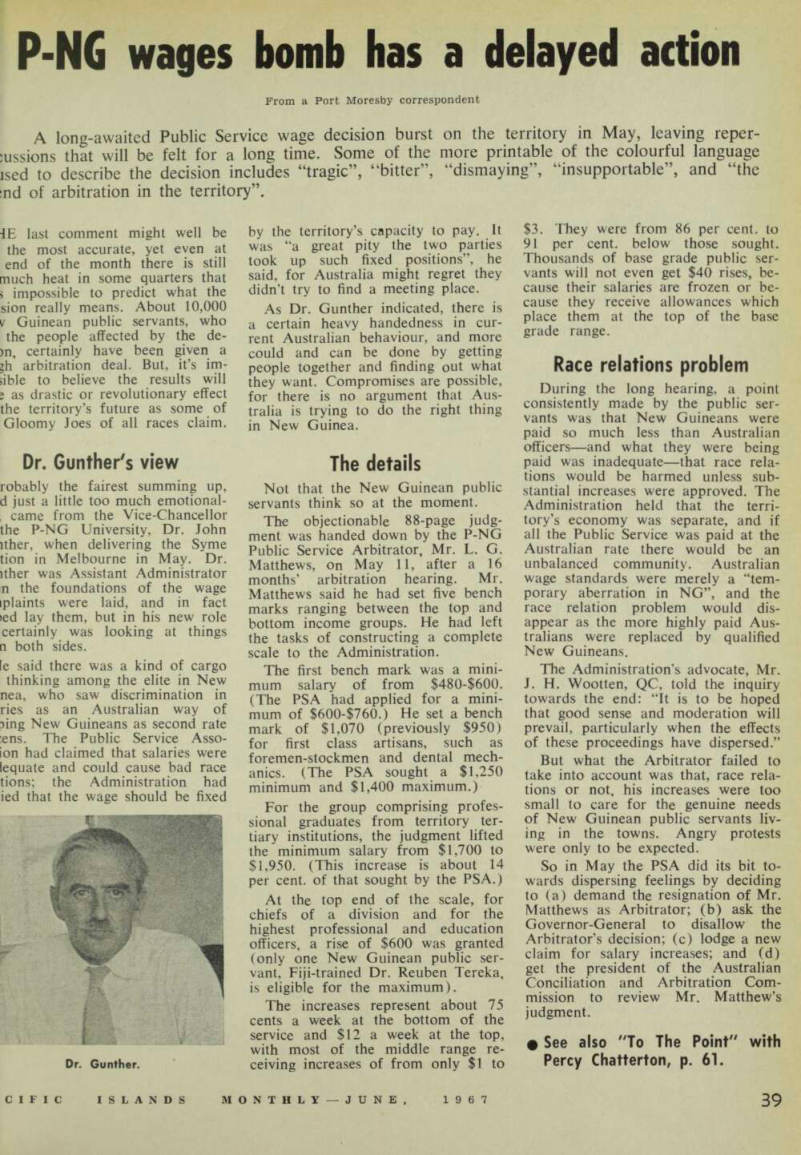
robably the fairest summing up, d just a little too much emotional , came from the Vice-Chancellor the P-NG University, Dr. John ither, when delivering the Syme tion in Melbourne in May. Dr, ither was Assistant Administrator n the foundations of the wage iplaints were laid, and in fact ted lay them, but in his new role certainly was looking at things n both sides. te said there was a kind of cargo thinking among the elite in New nea, who saw discrimination in ries as an Australian way of Ding New Guineans as second rate :ens. The Public Service Asso ion had claimed that salaries were [equate and could cause bad race tions; the Administration had ied that the wage should be fixed
by the territory’s capacity to pay. It was “a great pity the two parties took up such fixed positions”, he said, for Australia might regret they didn’t try to find a meeting place.
As Dr. Gunther indicated, there is a certain heavy handedness in cur rent Australian behaviour, and more could and can be done by getting people together and finding out what they want. Compromises are possible, for there is no argument that Aus tralia is trying to do the right thing in New Guinea.
The details
Not that the New Guinean public servants think so at the moment.
The objectionable 88-page judg ment was handed down by the P-NG Public Service Arbitrator, Mr. L. G.
Matthews, on May 11, after a 16 months’ arbitration hearing. Mr.
Matthews said he had set five bench marks ranging between the top and bottom income groups. He had left the tasks of constructing a complete scale to the Administration.
The first bench mark was a mini mum salary of from $4BO-$6OO. (The PSA had applied for a mini mum of $6OO-$760.) He set a bench mark of $1,070 (previously $950) for first class artisans, such as foremen-stockmen and dental mech anics. (The PSA sought a $1,250 minimum and $1,400 maximum.) For the group comprising profes sional graduates from territory ter tiary institutions, the judgment lifted the minimum salary from $1,700 to $1,950. (This increase is about 14 per cent, of that sought by the PSA.) At the top end of the scale, for chiefs of a division and for the highest professional and education officers, a rise of $6OO was granted (only one New Guinean public ser vant, Fiji-trained Dr. Reuben Tereka, is eligible for the maximum).
The increases represent about 75 cents a week at the bottom of the service and $l2 a week at the top, with most of the middle range re ceiving increases of from only $1 to
$3. They were from 86 per cent, to 91 per cent, below those sought.
Thousands of base grade public ser vants will not even get $4O rises, be cause their salaries are frozen or be cause they receive allowances which place them at the top of the base grade range.
Race relations problem
During the long hearing, a point consistently made by the public ser vants was that New Guineans were paid so much less than Australian officers—and what they were being paid was inadequate—that race rela tions would be harmed unless sub stantial increases were approved. The Administration held that the terri tory’s economy was separate, and if all the Public Service was paid at the Australian rate there would be an unbalanced community. Australian wage standards were merely a “tem porary aberration in NG”, and the race relation problem would dis appear as the more highly paid Aus tralians were replaced by qualified New Guineans.
The Administration’s advocate, Mr.
J. H. Wootten, QC, told the inquiry towards the end: “It is to be hoped that good sense and moderation will prevail, particularly when the effects of these proceedings have dispersed.”
But what the Arbitrator failed to take into account was that, race rela tions or not, his increases were too small to care for the genuine needs of New Guinean public servants liv ing in the towns. Angry protests were only to be expected.
So in May the PSA did its bit to wards dispersing feelings by deciding to (a) demand the resignation of Mr.
Matthews as Arbitrator; (b) ask the Governor-General to disallow the Arbitrator’s decision; (c) lodge a new claim for salary increases; and (d) get the president of the Australian Conciliation and Arbitration Com mission to review Mr, Matthew’s judgment. • See also "To The Point" with
Percy Chatterton, p. 61.
Dr. Gunther.