Tourism Is One Hope For Saipan
p. 32 · Read in the full issue
All former Japanese land, includ ing their big sugar estates on Rota, Saipan and Tinian, is now vested in the Trust Territory. A lot of it is military reserve, kept unused in case of emergency.
Under Japan the ordinary Chamorros appear to have been reasonably content. Only a few generations had passed between their own resettlement of the northern Marianas and the coming of the Japanese. From then on little was required of them other than that they left the Japanese alone to get on, ant-like, with their various enter prises.
For the Chamorros there was sufficient land for their own require ments; there was fish in the lagoon; the few things they needed from shops were cheap and there were usually ways of earning a few yen.
They were not expected to be enter prising. or political economists, or to understand or practise democracy.
To most Americans what the Japanese did was “exploitation”, and as there was no place for a sugar industry with the Japanese market gone, no attempt was made to revive it after the war. As the Saipanese are not natural planters and pretty mediocre gardeners, Saipan now pro duces virtually nothing; so that people
either live at subsistence level more likely, work for wages in eminent jobs or in retail busin< that exist and grow on the fact this is TT headquarters.
According to a lot of theorists Saipanese should be much hap now than they were under Japanese. They have freedom speech, they can vote for Congress of Micronesia and they 1 all the joys and tribulations of n ing decisions in a free enterp society.
No happier perhaps
In fact, a lot of them aren’t happier; they find making decisi a pain in the neck; they would h been quite happy with a degree exploitation; and they quite obvioi took some sort of vicarious pi in the fact that Japan made t] island blossom and bloom with expecting them to do anything ab it.
Without the business of gove ment, Saipan today would economically bereft and alre; there is talk of that panacea for economic ills—tourism.
Saipan is too far off the bea track for most Americans but should imagine that it would be real interest to Japanese tourists whom it still has great significan And it is, these days, within th hours’ jet journey of Tokyo.
But even if you are not Japane Saipan today is a positive gold-mi for the curious and the inquisiti Beneath the encroaching scrub lie ( airfields and roads, barracks, rema; of planes and mysterious encan ments.
Up at the northern tip of the isla and in the hills, where people on weekend fossicking parties, y can come upon live ammunition skeletons still wearing their tin-hj and field-boots. There are plac with juicy names like Kara K Gulch, Death Valley. Purple Het Ridge and Banzai Cliff.
Even the coastal villages and t) shopping centre of Chalan Kano despite some new building wi cement bricks, still have a scratches together, post-blitz look. T 1 Chamorros, for the most part, sti live in houses of scrap material at they scorn paint.
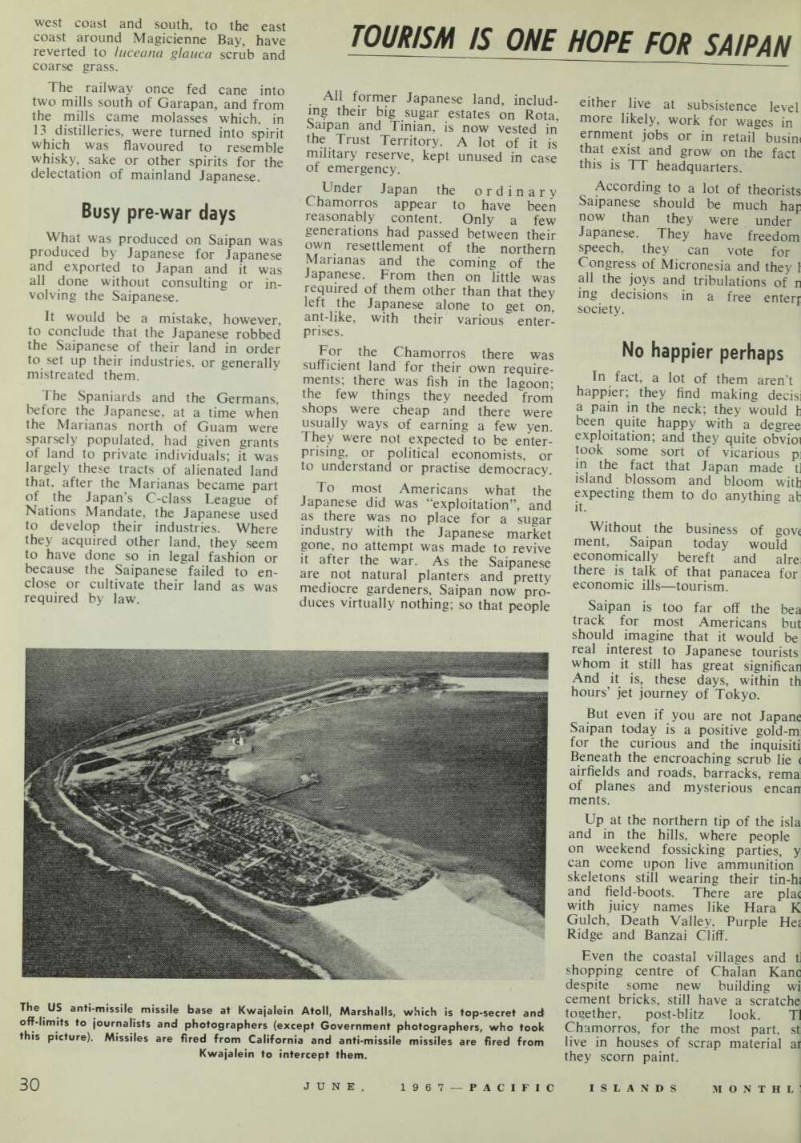
The US anti-missile missile base at Kwajalein Atoll, Marshalls, which is top-secret and off-limits to journalists and photographers (except Government photographers, who took this picture). Missiles are fired from California and anti-missile missiles are fired from Kwajalein to intercept them.