US Saipan: Surprising, refreshing,
pp. 28-32 · Read in the full issue
new, completely fascinating
By Judy Tudor
To get to Saipan or anywhere else in the Trust Territory, you have to pass through fii.am and Guams airport which like a lot of other things in this US territory, ormixed narentaTe exilian and 6 be ° ng *° * e NaVy ’ but the new ternlinal balding, opened this year i
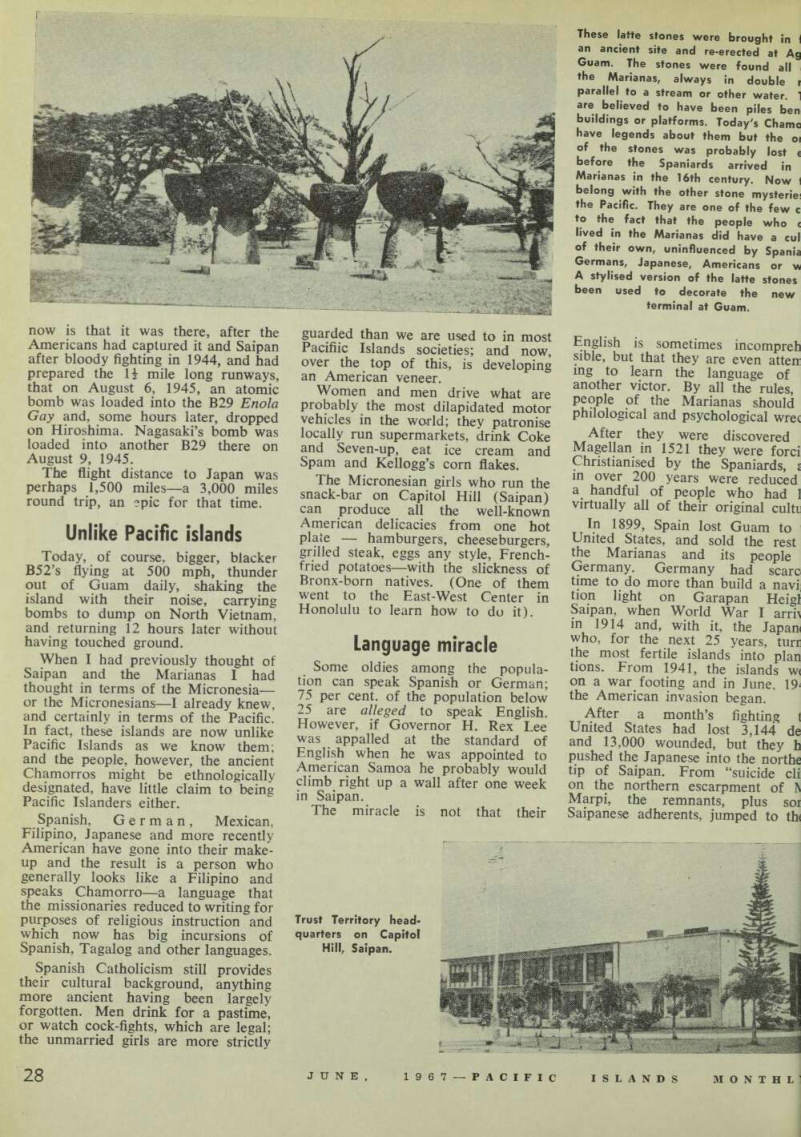
Y°U P ass ou ‘ ™ der a patio roofed • m Stylised latte stones (see H” p - 28) ’ '? aving had y° ur cherLeH d e * ami " ed ’ your P ass Port lnler k .h’ -P rodu “ d ~y our permit-toenter the Trust Territory, and having drunk 10c worth of coffee out of a slot-machine.
A middle-aged DC4 awaits your pleasure—yours, and that of four other “Caucasians” and 50 Micronesians (in the Marianas called Chamorros), their babies, their bags,
their bundles and their chattels. You all find seats, fasten seat-belts; the Micronesian air-hostess, in a Pan-Am pinny, drapes herself nonchalantly over an arm-rest to talk to a friend, a Micronesian purser says a lone, incomprehensible piece through a microphone, and you are off.
This is obviously a commuters’ bus and the Micronesians are obviously pretty enthusiastic commuters to Guam, the Marianas’ bigsmoke. The atmosphere is informal
throughout, because this is the T] Territory Airline and the people \ process your ticket and check 1 on and off the plane are all Ti Territory Micronesians.
If, therefore, like me, you h a seat in the plane where you a see very much and, 25 minutes a] taking off from Guam, the pi; banks, swoops and then runs ah what seems to be the bottom ol creek-bed, you might, like me, out as soon as the plane door ope curious to see who comes out of flight deck.
Like a creek bed!
I was more interested than reliev to find that they were, in fact, sta side Americans. The airline is one the few going concerns that have i been turned over entirely to Mici nesian entrepreneurs. Pan-Am s runs it—until the end of the ye Then the concession again comes for tender.
I should not be surprised, thouf to learn that somewhere, someho some Chamorro is being groom as a commercial pilot—probably the East-West Center, that remar able institution in Honolulu whi
Tale Of
Two Towns
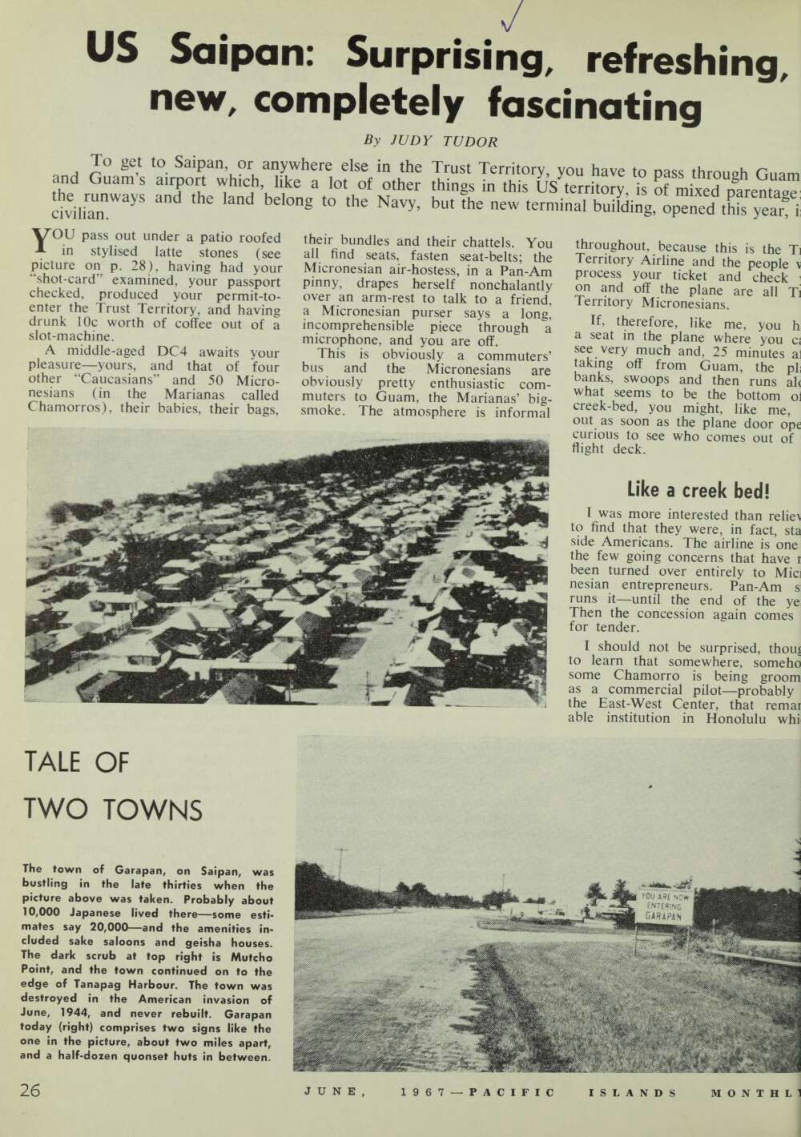
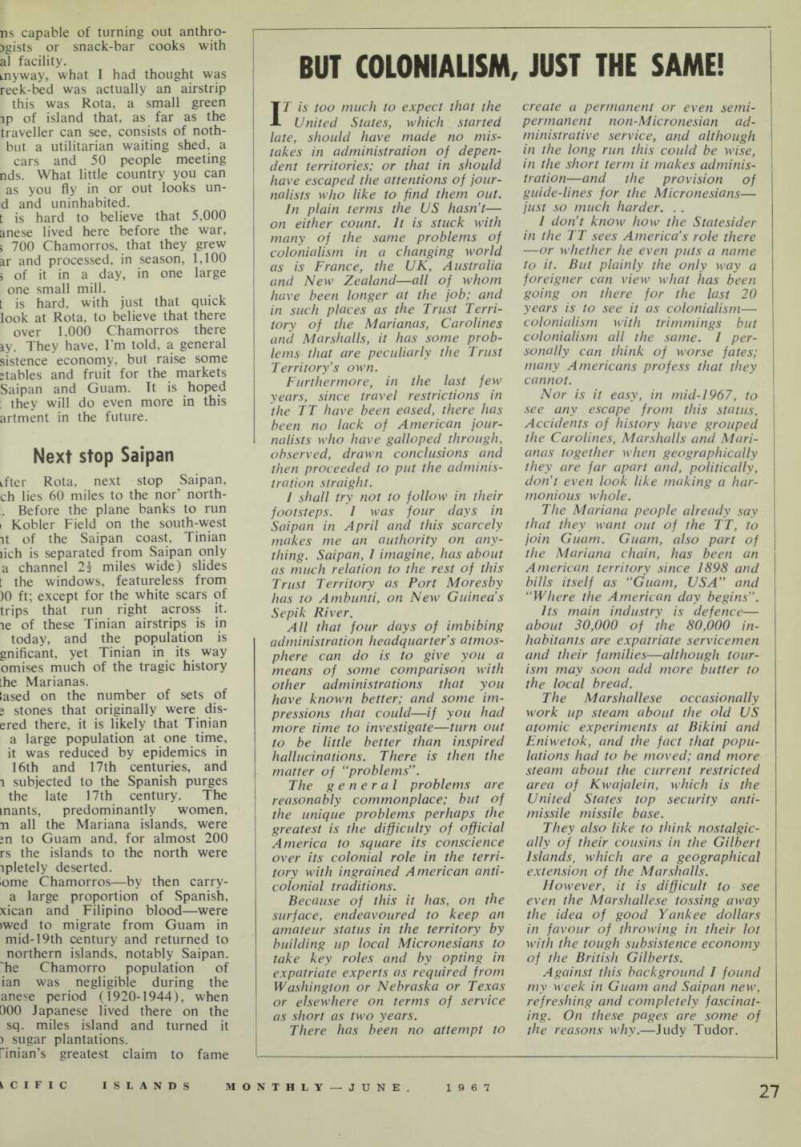
The town of Garapan, on Saipan, was bustling in the late thirties when the picture above was taken. Probably about 10,000 Japanese lived there—some esti mates say 20,000 —and the amenities in cluded sake saloons and geisha houses.
The dark scrub at top right is Mutcho Point, and the town continued on to the edge of Tanapag Harbour. The town was destroyed in the American invasion of June, 1944, and never rebuilt. Garapan today (right) comprises two signs like the one in the picture, about two miles apart, and a half-dozen quonset huts in between.
ns capable of turning out anthro igists or snack-bar cooks with al facility. myway, what I had thought was reek-bed was actually an airstrip this was Rota, a small green ip of island that, as far as the traveller can see, consists of noth but a utilitarian waiting shed, a cars and 50 people meeting nds. What little country you can as you fly in or out looks un d and uninhabited, t is hard to believe that 5,000 anese lived here before the war, 5 700 Chamorros, that they grew ar and processed, in season, 1,100 5 of it in a day, in one large one small mill, t is hard, with just that quick look at Rota, to believe that there over 1,000 Chamorros there ay. They have, Tm told, a general sistence economy, but raise some stables and fruit for the markets Saipan and Guam. It is hoped ; they will do even more in this artment in the future.
Next stop Saipan
Tter Rota, next stop Saipan, ch lies 60 miles to the nor’ north . Before the plane banks to run i Kobler Field on the south-west at of the Saipan coast, Tinian lich is separated from Saipan only a channel 2\ miles wide) slides t the windows, featureless from )0 ft; except for the white scars of trips that run right across it. ae of these Tinian airstrips is in today, and the population is gnificant, yet Tinian in its way omises much of the tragic history the Marianas. lased on the number of sets of ; stones that originally were dis ered there, it is likely that Tinian a large population at one time, it was reduced by epidemics in 16th and 17th centuries, and i subjected to the Spanish purges the late 17th century. The mants, predominantly women, ■n all the Mariana islands, were ;n to Guam and, for almost 200 rs the islands to the north were ipletely deserted. ome Chamorros—by then carry a large proportion of Spanish, xican and Filipino blood—were >wed to migrate from Guam in mid-19th century and returned to northern islands, notably Saipan, 'he Chamorro population of ian was negligible during the anese period (1920-1944), when 000 Japanese lived there on the sq. miles island and turned it ) sugar plantations, finian’s greatest claim to fame
now is that it was there, after the Americans had captured it and Saipan after bloody fighting in 1944, and had prepared the H mile long runways, that on August 6, 1945, an atomic bomb was loaded into the 829 Enola Gay and, some hours later, dropped on Hiroshima. Nagasaki’s bomb was loaded into another 829 there on August 9, 1945.
The flight distance to Japan was perhaps 1,500 miles—a 3,000 miles round trip, an epic for that time.
Unlike Pacific islands
Today, of course, bigger, blacker Bs2’s flying at 500 mph, thunder out of Guam daily, shaking the island with their noise, carrying bombs to dump on North Vietnam, and returning 12 hours later without having touched ground.
When I had previously thought of Saipan and the Marianas I had thought in terms of the Micronesia— or the Micronesians—l already knew, and certainly in terms of the Pacific.
In fact, these islands are now unlike Pacific Islands as we know them; and the people, however, the ancient Chamorros might be ethnologically designated, have little claim to being Pacific Islanders either.
Spanish, German, Mexican, Filipino, Japanese and more recently American have gone into their make up and the result is a person who generally looks like a Filipino and speaks Chamorro—a language that the missionaries reduced to writing for purposes of religious instruction and which now has big incursions of Spanish, Tagalog and other languages.
Spanish Catholicism still provides their cultural background, anything more ancient having been largely forgotten. Men drink for a pastime, or watch cock-fights, which are legal; the unmarried girls are more strictly
guarded than we are used to in most Pacifiic Islands societies; and now, over the top of this, is developing an American veneer.
Women and men drive what are probably the most dilapidated motor vehicles in the world; they patronise locally run supermarkets, drink Coke and Seven-up, eat ice cream and Spam and Kellogg’s corn flakes.
The Micronesian girls who run the snack-bar on Capitol Hill (Saipan) can produce all the well-known American delicacies from one hot plate hamburgers, cheeseburgers, grilled steak, eggs any style, French fried potatoes—with the slickness of Bronx-born natives. (One of them went to the East-West Center in Honolulu to learn how to do it).
Language miracle
Some oldies among the popula tion can speak Spanish or German; 75 per cent, of the population below 25 are alleged to speak English.
However, if Governor H. Rex Lee was appalled at the standard of English when he was appointed to American Samoa he probably would climb right up a wall after one week in Saipan.
The miracle is not that their
English is sometimes incompreh sible, but that they are even atterr ing to learn the language of another victor. By all the rules, people of the Marianas should philological and psychological wrec After they were discovered Magellan in 1521 they were forci Christianised by the Spaniards, < in over 200 years were reduced a handful of people who had 1 virtually all of their original cultr In 1899, Spain lost Guam to United States, and sold the rest the Marianas and its people Germany. Germany had scare time to do more than build a navi tion light on Garapan Heigl Saipan, when World War I arrh in 1914 and, with it, the Japan* who, for the next 25 years, turr the most fertile islands into plan tions. From 1941, the islands w< on a war footing and in June, 19< the American invasion began.
After a month’s fighting t United States had lost 3,144 de and 13,000 wounded, but they h pushed the Japanese into the northe tip of Saipan. From “suicide cli on the northern escarpment of IV Marpi, the remnants, plus sor Saipanese adherents, jumped to th<
Trust Territory head quarters on Capitol Hill, Saipan.
These latte stones were brought in I an ancient site and re-erected at Ag Guam. The stones were found all the Marianas, always in double r parallel to a stream or other water. [?] are believed to have been piles ben buildings or platforms. Today's Chamo have legends about them but the oi of the stones was probably lost e before the Spaniards arrived in Marianas in the 16th century. Now belong with the other stone mysteries the Pacific. They are one of the few c to the fact that the people who c lived in the Marianas did have a cul of their own, uninfluenced by Spania Germans, Japanese, Americans or w A stylised version of the latte stones been used to decorate the new terminal at Guam.
a ten Japs jumped
hs on to rocks 830 ft below, oday, there are people with mese blood in the Trust Territory, no Japanese. Almost all private rprise, such as it is, is in the is of Micronesians. (The excep -5 are Van Camp, the fish canners, have Okinawans operating a :n tuna boats for them in the u group; an American and ciates who have recently been ti a lease of 7,000 acres for a h on Tinian; and the same outfit :h has started to build a hotel he lagoon at Saipan). 11 retail business in Saipan is in I hands; so is car hire, garages the new bus company. The hotel ; also is run by Micronesians— -0 it is believed.
Mysterious hotel
r hen I arrived there I was re ;d, after pounding on the desk ittract attention, by a lady who an ironing-board in a back room, finally gave me a key and a s. to sign, but did not say a i. When I left I paid my bill mother Micronesian who denied connection with the place. He he worked in a government irtment but the wages were so ■ he had to take this second job uy Spam for his starving family. looked so well nourished I ;d my sobs). rom another source I learned it once had an American man , but it was currently believed a Peace Corps Volunteer was he helm. The Peace Corpsman ed it—Micronesians, he felt sure, ; now responsible. or a hotel that no one ran it man -1 itself rather well—l have been ‘ar worse in other parts of the fic. The bedroom block is new. rooms are airy with bathrooms have real baths that run real hot ;r. The furniture is plain but piate, the beds comfortable. Fans supplied and the place is reason quiet. i a town where you can bank hamburgers and omelets being le, the steak being doubtful and deep-fried chicken seemingly ted to the fact that cock-fighting the national hobby and one iter always dies—the food at the 1 is fair average quality, urthemore, for anyone who has ved in the place via Tahiti, lolulu and Guam, as I did, the
cost of a day’s lodging at Saipan Hotel is so reasonable that com plaints of any kind seem mean spirited.
Anyone can have a hotel with a hard-faced Hannah in the front office and people out back doing profit and loss sums. I thought Saipan’s hotel, with its air of being removed from such sordid matters, rather nice.
Like New Guinea
If Saipan Chamorros are strictly non-Pacific, so is their island. To me it looked like a small piece of the New Guinea central highlands, with 5,000 ft cut off the bottom and sunk to sea level.
The predominant vegetation is the leguminous scrub called luceana glauca, well-known in most volcanic tropical Pacific islands where it is usually regarded as a pest. It was introduced to the Marianas by the Germans, but after the American invasion of 1944 the whole country was so devastated, that seeds of this plant were sown from the air in order to prevent erosion.
Luceana has gone mad since, grow ing in almost impenetrable clumps 12 feet high, covering the old Japanese airstrip at the base of Mt.
Marpi and encroaching on the war time roads.
Above the scrub and along the rather lovely lagoon that skirts most of the west coast are casuarina trees.
There are coconuts, too, but few and far between; gone are the groves that before the war were described as lining the coast and extending up into the hills.
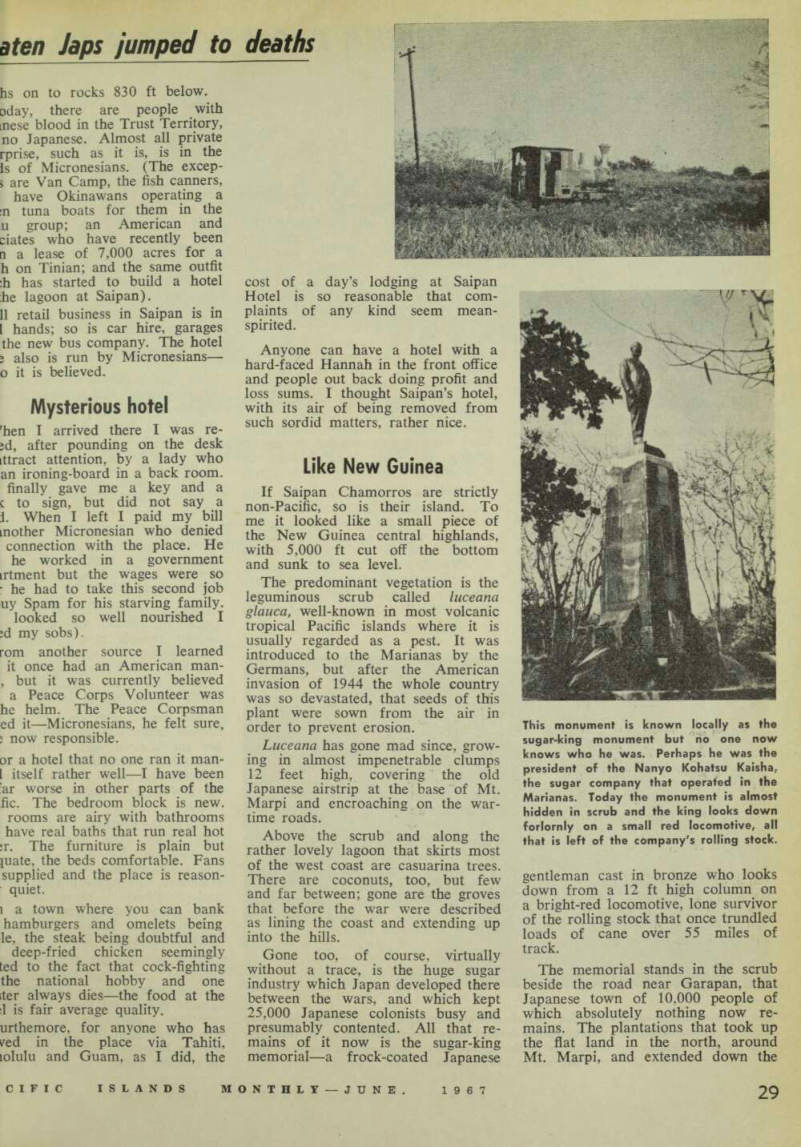
Gone too, of course, virtually without a trace, is the huge sugar industry which Japan developed there between the wars, and which kept 25,000 Japanese colonists busy and presumably contented. All that re mains of it now is the sugar-king memorial—a frock-coated Japanese
gentleman cast in bronze who looks down from a 12 ft high column on a bright-red locomotive, lone survivor of the rolling stock that once trundled loads of cane over 55 miles of track.
The memorial stands in the scrub beside the road near Garapan, that Japanese town of 10,000 people of which absolutely nothing now re mains. The plantations that took up the flat land in the north, around Mt. Marpi, and extended down the
This monument is known locally as the sugar-king monument but no one now knows who he was. Perhaps he was the president of the Nanyo Kohatsu Kaisha, the sugar company that operated in the Marianas. Today the monument is almost hidden in scrub and the king looks down forlornly on a small red locomotive, all that is left of the company's rolling stock.
west coast and south, to the east coast around Magicienne Bay, have reverted to luceana glauca scrub and coarse grass.
The railway once fed cane into two mills south of Garapan, and from the mills came molasses which, in 13 distilleries, were turned into spirit which was flavoured to resemble whisky, sake or other spirits for the delectation of mainland Japanese.
Busy pre-war days
What was produced on Saipan was produced by Japanese for Japanese and exported to Japan and it was all done without consulting or in volving the Saipanese.
It would be a mistake, however, to conclude that the Japanese robbed the Saipanese of their land in order to set up their industries, or generally mistreated them.
The Spaniards and the Germans, before the Japanese, at a time when the Marianas north of Guam were sparsely populated, had given grants of land to private individuals; it was largely these tracts of alienated land that, after the Marianas became part of the Japan’s C-class League of Nations Mandate, the Japanese used to develop their industries. Where they acquired other land, they seem to have done so in legal fashion or because the Saipanese failed to en close or cultivate their land as was required by law.