A remarkable leader on the threshold
pp. 26-27 · Read in the full issue
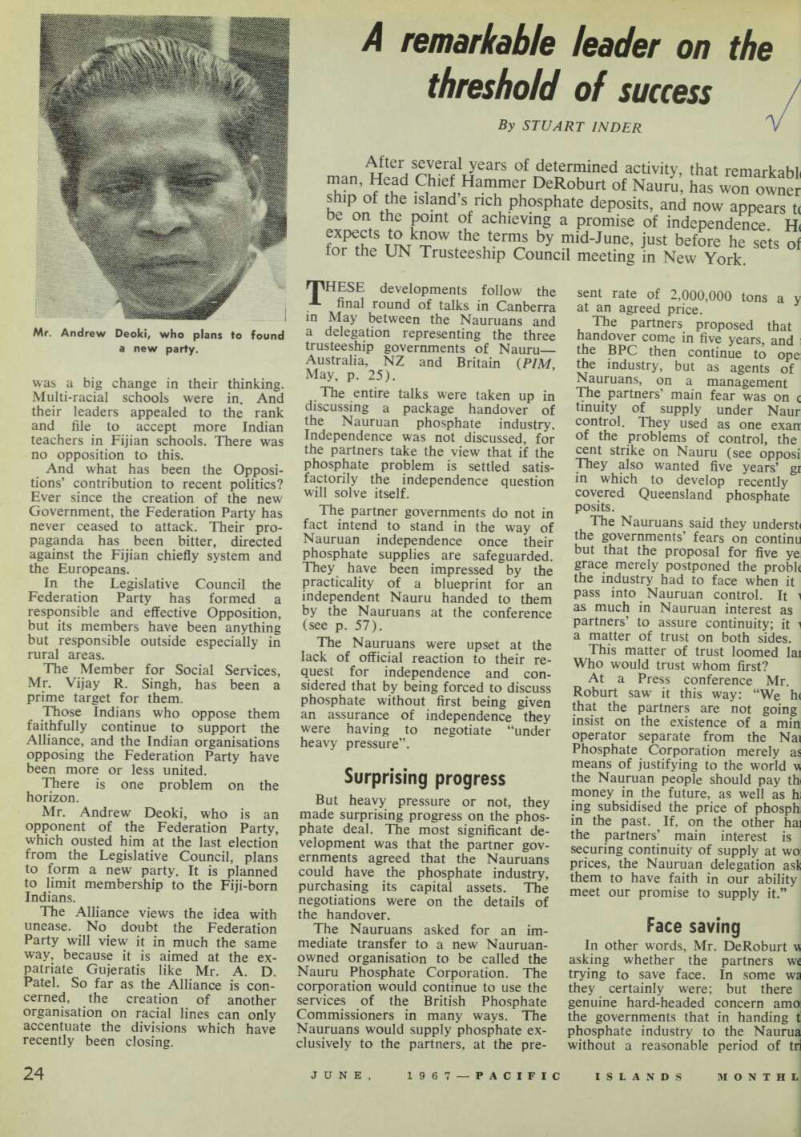
threshold of success
By Stuart Inder
After s everalye ars of determined activity, that remarkabl. man, Head Chief Hammer Deßoburt of Nauru, has won owner ship of the island s rich phosphate deposits, and now appears tc be on the point of achieving a promise of independence H< fnr^hp 5 wt W t the u ern i S by ™ id - June > just before he sets of for the UN Trusteeship Council meeting in New York.
rPHESE developments follow the . final round of talks in Canberra in May between the Nauruans and a delegation representing the three trusteeship governments of Nauru— Australia, NZ and Britain ( PIM , May, p. 25).
The entire talks were taken up in discussing a package handover of the Nauruan phosphate industry.
Independence was not discussed, for the partners take the view that if the phosphate problem is settled satis factorily the independence question will solve itself.
The partner governments do not in fact intend to stand in the way of Nauruan independence once their phosphate supplies are safeguarded.
They have been impressed by the practicality of a blueprint for an independent Nauru handed to them by the Nauruans at the conference (see p. 57).
The Nauruans were upset at the lack of official reaction to their re quest for independence and con sidered that by being forced to discuss phosphate without first being given an assurance of independence they were having to negotiate “under heavy pressure”.
Surprising progress
But heavy pressure or not, they made surprising progress on the phos phate deal. The most significant de velopment was that the partner gov ernments agreed that the Nauruans could have the phosphate industry, purchasing its capital assets. The negotiations were on the details of the handover.
The Nauruans asked for an im mediate transfer to a new Nauruan owned organisation to be called the Nauru Phosphate Corporation. The corporation would continue to use the services of the British Phosphate Commissioners in many ways. The Nauruans would supply phosphate ex clusively to the partners, at the pre
sent rate of 2,000,000 tons a y at an agreed price.
The partners proposed that handover come in five years, and ; the BPC then continue to ope: the industry, but as agents of Nauruans, on a management The partners’ main fear was on c tmuity of supply under Naur control. They used as one exan of the problems of control, the cent strike on Nauru (see opposi They also wanted five years’ gi in which to develop recently covered Queensland phosphate posits.
The Nauruans said they undersh the governments’ fears on continu but that the proposal for five ye grace merely postponed the probh the industry had to face when it pass into Nauruan control. It as much in Nauruan interest as partners’ to assure continuity; it i a matter of trust on both sides.
This matter of trust loomed lai Who would trust whom first?
At a Press conference Mr.
Roburt saw it this way: “We h< that the partners are not going insist on the existence of a min operator separate from the Nai Phosphate Corporation merely as means of justifying to the world w the Nauruan people should pay th money in the future, as well as h; ing subsidised the price of phosph in the past. If, on the other hai the partners’ main interest is securing continuity of supply at wo prices, the Nauruan delegation ask them to have faith in our ability meet our promise to supply it.”
Face saving
In other words, Mr. Deßoburt v, asking whether the partners we trying to save face. In some wa they certainly were; but there genuine hard-headed concern amo: the governments that in handing t phosphate industry to the Naurua without a reasonable period of tri
lartners may be giving away the ance for the shadow, le partners’ real difficulty in this ordinary series of talks is that have tied up phosphate Dimes with political nationalism, wanting what, after all, are lal business safeguards they them s are forced to negotiate “under y pressure” from the Nauruans by the threat of UN intervention, litical considerations have put governments on the run; finding ions is made harder by the fact the three partners are not always imous. Britain, for instance, has merest in Nauru’s problems than >ther two. though admittedly the Nauru tion has been of their own making, partners in recent months have much farther to reach a solu than the Nauruans have given credit for. Deßoburt, with his rity and unshakable principles, the fight in terms of black and *. The governments have some ; which belongs to the Nauruans, promise in order to achieve his dives is, he is inclined to feel, a rture from principles. He does see it as a genuine part of tiation, which also allows the es to save face.
"Pie in the sky"
hen in 1962 Deßoburt an ced in Canberra that he wanted jendence for Nauru plus owner of the phosphate the scheme was ed as “pie in the sky”. Yet now nows he is to achieve both, and only debate is on the timing, an afford to compromise on the g, yet the partners cannot con him of this. the end of the meeting he made important concession, and this ght victory closer. But he wor and fretted hard before making Tie Nauruans had proposed that would agree to a takeover in two ;, instead of immediately. This not acceptable to the partners the talks rose on a sour note, it next morning, Saturday, after i informal parleying during the , the Nauruans increased the d to three years, having received inderstanding somewhere during light that the governments might 5 down to four years, id on that brighter side the May jrence rose—with the promise the governments will reply to the phosphate and independence ;ions before the UN meeting on 19. eanwhile, Deßoburt appears to ilanning his independence cele ons for January 31!