Without safeguards, Market
pp. 23-24 · Read in the full issue
could be disaster for Fiji
The well-being of Fiji’s sugar industry should Britain enter the Common Market depends entirely on what safeguards Britain can win for the colony. The big problem will be whether Britain can obtain assurances for outlets and prices similar to those Fiji at present enjoys under the Commonwealth Sugar Agreement.
THE Common Market countries are seeking to maintain at least self sufficiency in sugar production, but it could be that production will be greater than self-sufficiency.
Under present Common Market sugar arrangements there is no place for guarantees of access, price and duration for sugar imported from non-member countries.
Sugar "dominant"
If Fiji were granted Associated Overseas Territory status her sugar exports would not be in a comparable position to that guaranteed under the CSA. Sugar is excluded from the schedule of commodities covered by the Common Market convention for associated territories. A recently negotiated arrangement for Nigeria gave only duty free entry and quotas, not a guaranteed price.
The sugar industry is the dominant economic activity in Fiji and the CSA is the major instrument for protect ing it.
Sugar products provide between 65 and 75 per cent, of Fiji’s total export income, and the industry is Fiji’s largest employer of people.
Under Fiji’s development plan drawn up in 1966, it is hoped that by the year 2000, export earnings from timber products and tourism will exceed earnings from sugar. But any such long-term development will have to depend on the sugar industry as the stable base on which to build.
To maintain Fiji’s living standards, let alone increase them, the Fiji national income has to be expanded at something like the rate of 3± per cent, per year. Present living stan dards are modest and the current low world prices for sugar have been having an adverse effect on these standards.
Export details
Most of the sugar produced in Fiji is exported. Internal consumption, plus sales to nearby island groups, is less than 20,000 tons per year.
The balance is exported, and for the forthcoming season the balance is expected to be between 320,000 and 380,000 tons (figures supplied by the CSR in Sydney in May). Fiji’s sugar exports in 1966 went in these direc tions: UK, 140,518 long tons; Canada, 57,553; USA, 33,904; and Singapore-Malaysia, 11,130. Total, 243,105 long tons.
The Commonwealth Sugar Agree ment was signed in 1951. Under it, the UK undertakes to buy sugar, and exporters undertake to sell it at a negotiated price each year.
CSA lasts for eight years ahead, and can be extended for a further year at the end of each year. It has been extended every year since its inception, and now extends until the end of 1974.
The UK buys about If million tons of sugar a year under CSA at a negotiated price. This tonnage, plus sugar produced from British sugar beet, accounts for about 90 per cent.
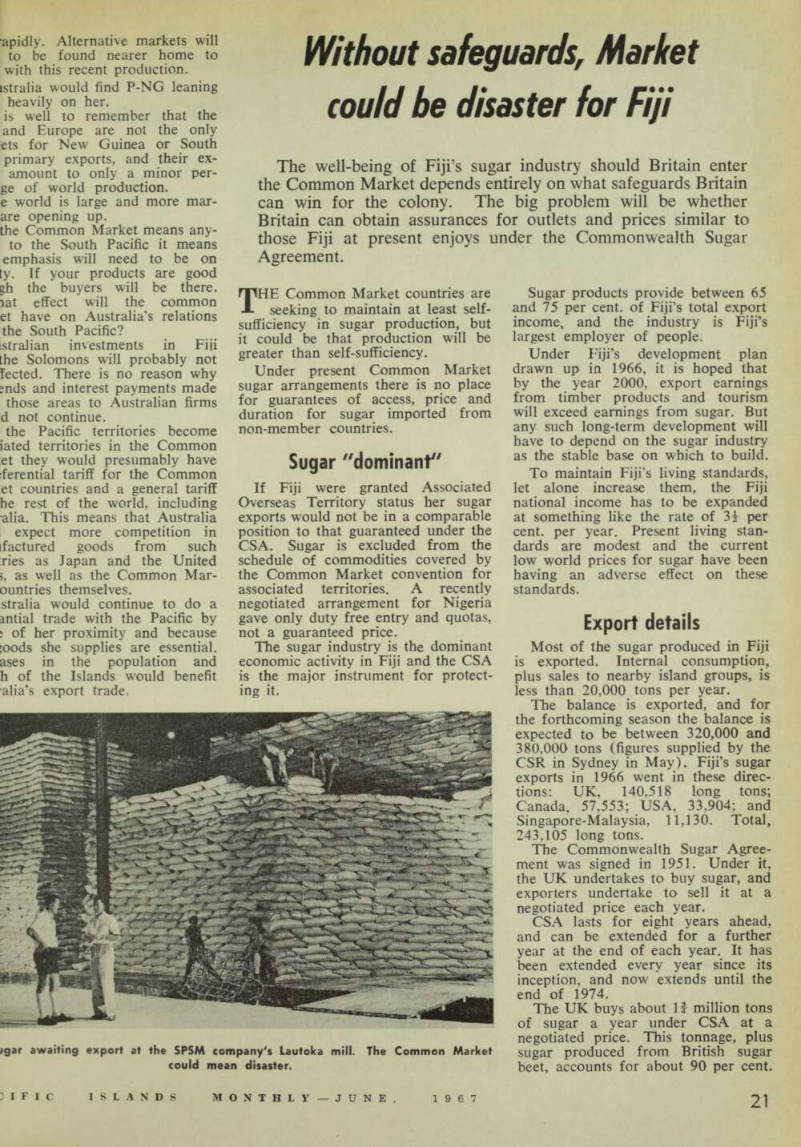
ugar awaiting export at the SPSM company's Lautoka mill. The Common Market could mean disaster.
of Britain’s domestic sugar require ments. Fiji’s share of the If million tons is 140,000 tons.
For 1966-68, the negotiated price is £Stg43/10/- per ton (fob and stowed). But in addition Fiji, with other less developed territories, re ceives an additional special payment each year, estimated on the world price, and which also takes account of the benefits British colonies used to get under the Colonial Certificated Preference system. At present Fiji gets a total additional payment of £Stg4 a ton of the negotiated price for sugar.
The effects
What happens if Fiji cannot obtain the equivalent of the present CSA arrangements?
If it has to sell 140,000 tons at the world market price of £Stgl7/10/- per ton cif UK, the annual loss to the industry in export income would be £Stgs.3 million per year.
This would represent an annual loss of from 20 to 30 per cent, of Fiji’s total annual export income, and this reduction would be more than enough to destroy the country’s economy.
Thus it would be a calamity for Fiji and its sugar industry if Britain entered the Common Market without safeguarding the provisions of the
Csa.
The British Prime Minister is aware of these difficulties. He said in London that it was the Govern ment’s duty to seek safeguards in the negotiations.
In Sydney in May the acting general manager of the Colonial Sugar Refining Company, Mr. J. M.
Dixon, said Mr. Wilson’s statement was important, because it and similar statements made recently gave “satis faction and badly needed reassurance to the sugar industries of Australia and Fiji”.
Mr. Dixon added: “If this assur ance had not been given, those in dustries would be facing serious— indeed disastrous—situations . . .
“The sugar industries of Australia and Fiji, and those of the other countries of the Commonwealth, were expanded in the 1950’s specifically to meet Britain’s sugar requirements.
This was done in the faith that the CSA would be kept in existence by Britain. It was a compact, and is therefore satisfying to note Mr. Wil son’s clear remarks about the CSA and the seeking of safeguards in re lation to it.”
• Figures from a census taken in Fiji last September, and issued in Suva in May, show that Fiji’s total population of 476,727 is made up of 240,960 Indians, 202,176 Fijians, 9,687 part-Europeans, 6,590 Euro peans, 5,797 Rotumans, 5,149 Chinese and part-Chinese, 6,095 “other”
Pacific islanders, and 273 others.