Will Be Striking Feature
pp. 20-21 · Read in the full issue
Ancient Polynesian Ritual
Of Tongan Coronation
From Betty Sanft in Nukualofa T..nnn h T e v Cor °? a i tio ? ce ,y e u monies for Ton ga's King Taufa’ahau Tupou IV on July 4 will be a compound of ancient Tongan and Christian ritual.
actual coronation ceremony in the Royal Chapel will closely follow the pattern used at the coro nations of British monarchs, but the accompanying ceremonies will be purely Polynesian in character.
King Taufa’ahau will be the third Tongan monarch to be crowned in European style. The first was King George Tupou II in 1893. The other was Queen Salote Tupou 111, the present king’s mother, in 1918.
Since ancient times, however, the kings of Tonga have been installed m a ritual called taumafakava. The Tongan people look forward to this more than the church ceremony, since it is a part of their tradition and must follow exactly the ancient pattern,
Samoan influence
Before Tonga was united under King George Tupou I in 1845, the taumafakava ceremony took place only on the western side of the island of Tongatapu, at Pangai Hihifo.
There was no crown in those days and the king sat with his back to a special koka tree.
When the tree died, it was sent to Australia where part of it was used to carve the present throne in the Royal Chapel, so that when Tupou IV is crowned, he, like Tupou II and 111, will have his back against part of the same koka tree.
The taumafakava, first used in the 17th century, reflects a Samoan in fluence.
Ngata, the first Tu’i Kanokupolu (temporal king of Tonga), had a Samoan mother, and the major part of his installation, at the same koka tree, was conducted by Samoan chiefs and attendants.
When Ngata’s first son was born, the people were called ha’angata, meaning the issue of Ngata.
Fijian bodyguard
Ever since the second Kanokupolu. the ha’angata people have been re sponsible for the installation of kings, and the present coronation will be no exception. They will share the re sponsibility of certain tasks and cer tain performances with other people, but they are jealous of their signal honour.
Tradition demands that the new king must have a Fijian warrior and dancer as bodyguard.
This tradition stems from an in cident during the reign of the third Tu’i Kanokupolu, in the 17th century, when a Fijian chief, Tuisoso, visited Tonga.
The Tongan king requested Tuisoso to name his newly-born son, and the chief was so overjoyed that he spon taneously responded with a wild and joyful dance.
This amused and pleased the king
so much that the offspring of Tub were sometimes asked to perforn subsequent installations.
On this occasion, a kinsman Tuisoso, from Lakeba Island Fiji’s Lau group, will take part.
The taumafakava ceremony bej with the giving and receiving of g Baskets of food, of great variety cooked to perfection, are placed front of the assembled nobles j matapules (who rank below nobles). A special installation fc called ’umu fakapangai, which never seen at other functions, is pared in earthen ovens. It consists 20 small whole yams and one pig, whole presented in a Samoan basl made for the occasion. The 'u fakapangai is the only food which
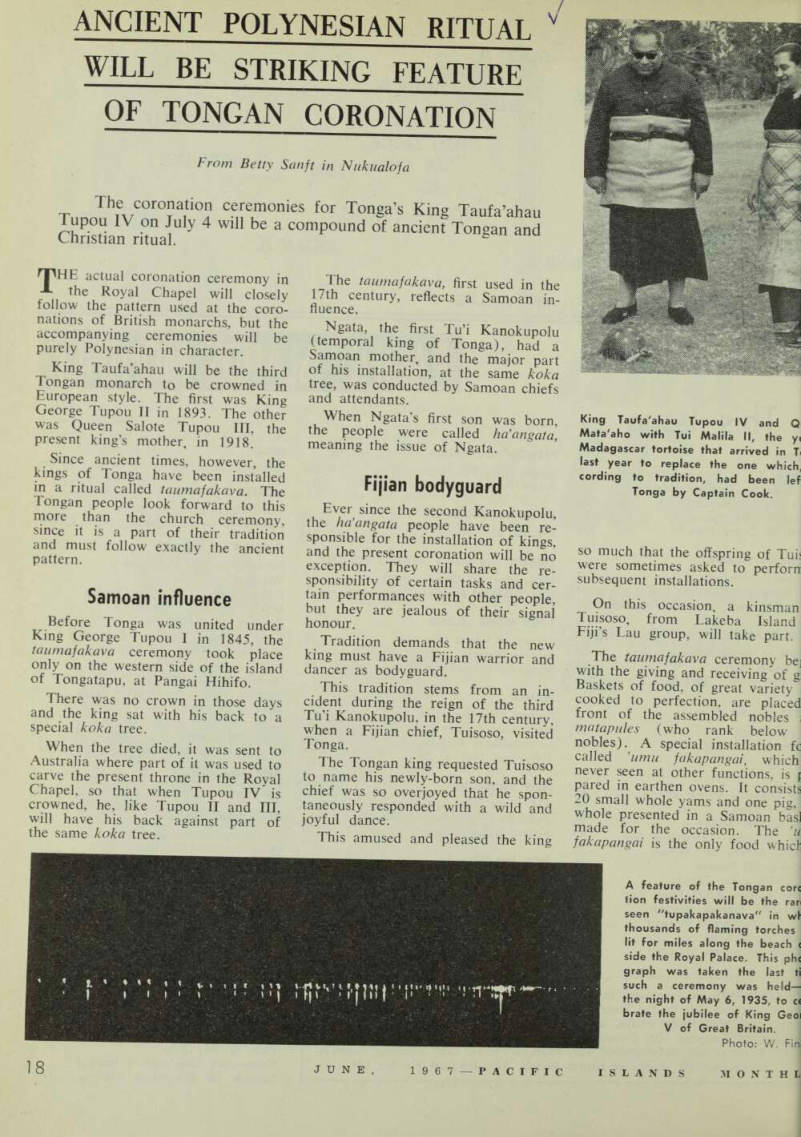
King Taufa'ahau Tupou IV and Q Mata'aho with Tui Malila II, the ye Madagascar tortoise that arrived in T[?] last year to replace the one which, cording to tradition, had been lef Tonga by Captain Cook.
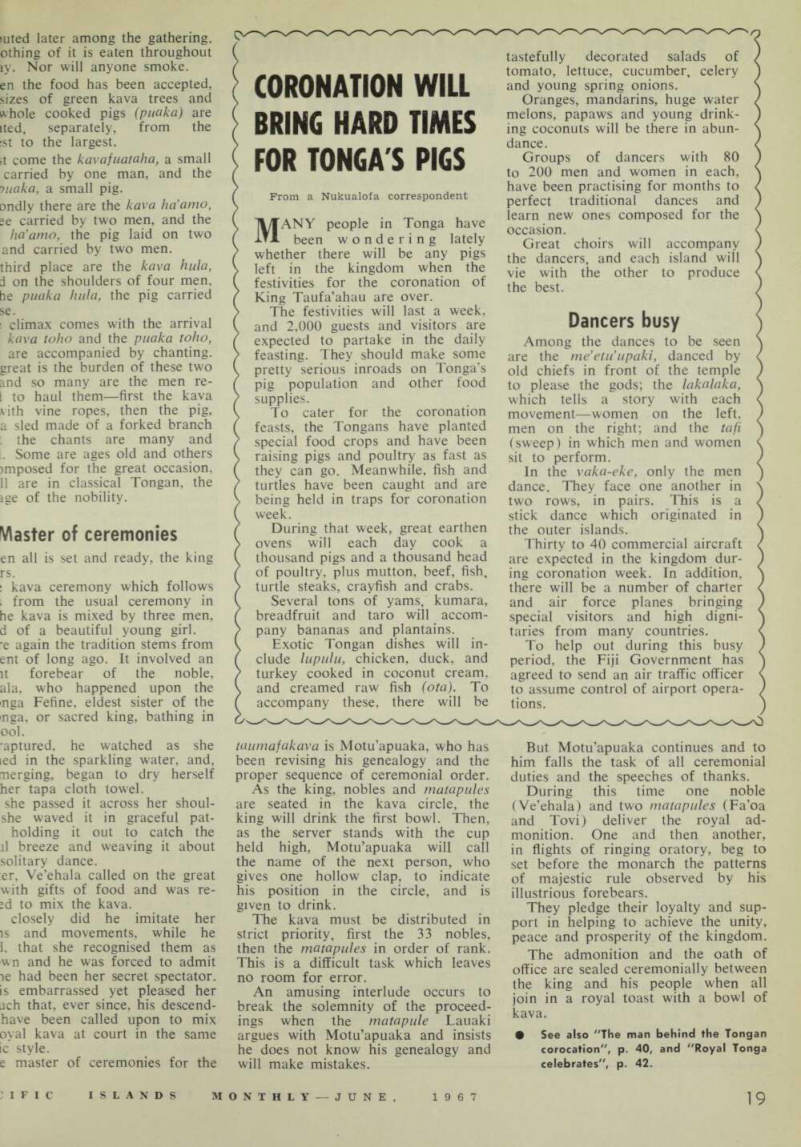
A feature of the Tongan cono tion festivities will be the rar[?] seen "tupakapakanava" in wH thousands of flaming torches lit for miles along the beach [?] side the Royal Palace. This pho graph was taken the last ti such a ceremony was held— the night of May 6, 1935, to ce brate the jubilee of King Geo[?] V of Great Britain.
Photo: W. Fin
>uted later among the gathering, othing of it is eaten throughout ly. Nor will anyone smoke, en the food has been accepted, sizes of green kava trees and tvhole cooked pigs (pmka) are ited, separately, from the :st to the largest, it come the kavafuataha, a small carried by one man, and the maka, a small pig. □ndly there are the kava ha’amo, se carried by two men, and the ha’amo, the pig laid on two and carried by two men. third place are the kava hula, j on the shoulders of four men, he puaka hula, the pig carried se. : climax comes with the arrival kava Who and the puaka who, are accompanied by chanting, great is the burden of these two and so many are the men re- I to haul them—first the kava vith vine ropes, then the pig, a sled made of a forked branch the chants are many and I. Some are ages old and others imposed for the great occasion, II are in classical Tongan, the ige of the nobility.
Master of ceremonies
en all is set and ready, the king rs. i kava ceremony which follows . from the usual ceremony in he kava is mixed by three men, d of a beautiful young girl, *e again the tradition stems from ent of long ago. It involved an it forebear of the noble, ala, who happened upon the mga Fefine, eldest sister of the mga, or sacred king, bathing in 001. •aptured, he watched as she ted in the sparkling water, and, merging, began to dry herself her tapa cloth towel, she passed it across her shoul she waved it in graceful pat holding it out to catch the il breeze and weaving it about solitary dance. er, Ve’ehala called on the great with gifts of food and was re :d to mix the kava. closely did he imitate her is and movements, while he 1, that she recognised them as wn and he was forced to admit le had been her secret spectator, is embarrassed yet pleased her jch that, ever since, his descend have been called upon to mix oval kava at court in the same ic style. e master of ceremonies for the
taumafakava is Motu’apuaka, who has been revising his genealogy and the proper sequence of ceremonial order.
As the king, nobles and matapules are seated in the kava circle, the king will drink the first bowl. Then, as the server stands with the cup held high, Motu’apuaka will call the name of the next person, who gives one hollow clap, to indicate his position in the circle, and is given to drink.
The kava must be distributed in strict priority, first the 33 nobles, then the matapules in order of rank.
This is a difficult task which leaves no room for error An amusing interlude occurs to break the solemnity of the proceedings when the matapule Lauaki argues with Motu’apuaka and insists he does not know his genealogy and will make mistakes.
But Motu’apuaka continues and to him falls the task of all ceremonial duties and the speeches of thanks.
During this time one noble (Ve’ehala) and two matapules (Fa’oa an d Tovi) deliver the royal ad monition. One and then another, i n flights of ringing oratory, beg to S et before the monarch the patterns 0 f majestic rule observed by his illustrious forebears, They pledge their loyalty and sup port i n helping to achieve the unity, peace an d P rosperity of the kingdom, The admonition and the oath of office are sealed cere monially between the king and his people when all . ( ; roya l toas f with a bowl of 1 J • See also "The man behind the Tongan corocation", p. 40, and "Royal Tonga celebrates", p. 42.