of sheep breeding
pp. 153-155 · Read in the full issue

The Practical Planter
How Fiji tackles the problem of sheep breeding
From Jane Gregor, in Suva Nadi, to most people these days, means aircraft and tourists. But to the Fiji Agriculture Department it means sheep, and has done so for the past two years. Under the Colonial De velopment and Welfare Scheme, financed by the British Government, a total of some £Stg.3o,ooo has been granted, to be expended over a first period of five years.
HE experiment of rearing sheep in Fiji was initiated in December, >4, and got off to an unfortunate rt, for the 90 half-bred ewes, eight rriedale rams and five half-bred is which had been purchased in nterbury, NZ, arrived in the middle a hurricane, and getting them to experimental farm was not easy, rhe farm is situated about 14 es south east of Nadi airport at I ft above sea-level. In the tropical i and malevolent winds of a South :ific hurricane, neither animals nor n relished the herding to their v home. fhat home is some 425 acres of country in the Nausori High ds, known to tourists for their turesque contours.
Little rain
"he western side of Viti Levu is drier side of the island but over last two years rainfall has been isually scanty and in addition to expected dry seasons between ril and December, have received y scanty rain in the normal wet son; the average rainfall is around inches per year; in 1966 this ire was halved and at no time ing the two years that the farm been established has the wet son’s average of between five and inches been reached, lo that, once the imported live ;k recovered from its initial shock, lid not even face good pasture. ; cover on the Highlands varies veen Mission grass, a species ch can grow up to some six feet i, reeds which reach a height of ;n or eight feet, and Nadi blue ss on the more extensive, open as.
Previous controlled grazing had helped to eliminate the taller species and had allowed the shorter sheep type, Nadi blue grass, to spread.
But one major problem was the infestation of guava; in this case it was a particularly persistent species which could grow to 20 feet in height and could form bush verging on forest. There was a continual balance to be held between over grazing, thus allowing the guava to infiltrate, and the danger. of erosion from heavy, tropical rains.
The man with this load of problems was Mr. G. Colledge, a New Zea
lander with extensive experience of sheep farming.
Initially, the sheep had not grown out too well and it was decided to put only the 35 choicest animals to the ram in 1965. As a result, there had been about an 80 per cent, lamb ing.
In April, 1966, all ewes had been put to the ram but, due to the con tinuance of the exceptionally dry weather, there had only been a 50 per cent, lambing.
The first lot of sheep had been shorn in December, 1965, yielding an average of about eight pounds a head, which had sold in Australia
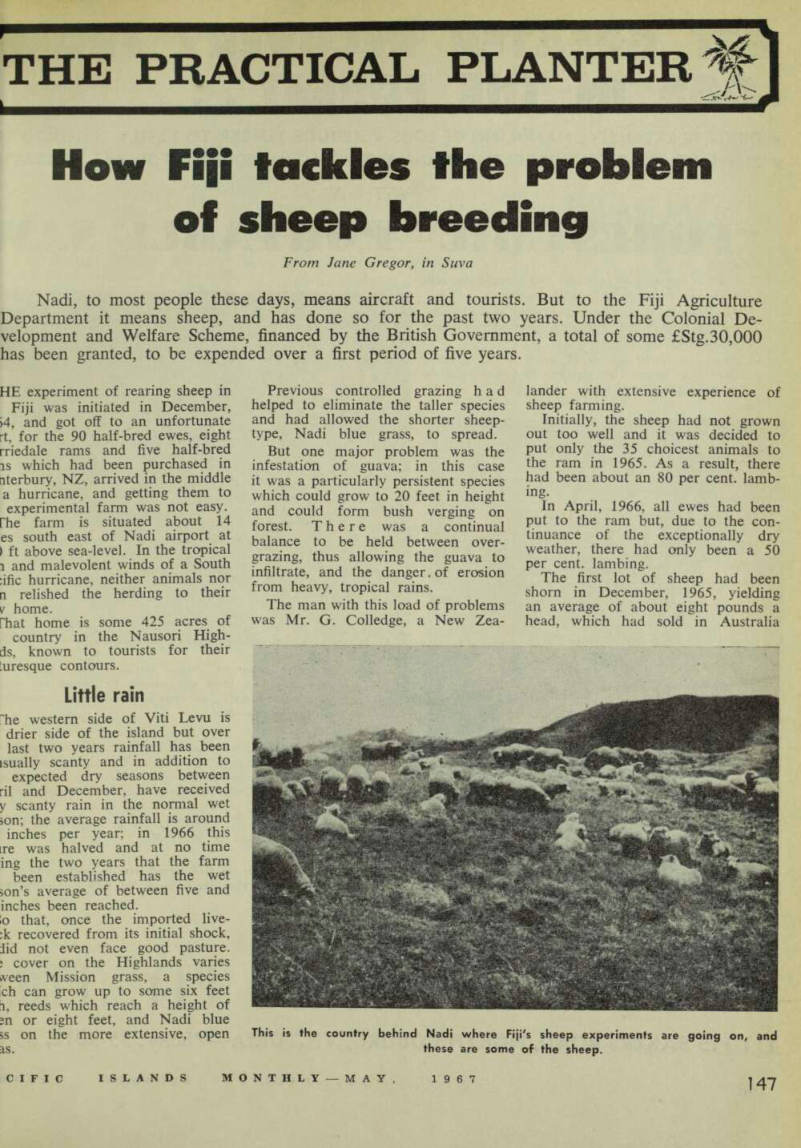
This is the country behind Nadi where Fiji's sheep experiments are going on, and these are some of the sheep.
an average net return per ewe bout 20/- (NZ). le wether lambs from this first had been killed at about five ;hs and, when dressed, had aver some 26 lbs, and two of these sved fame by being served at a ;r party given by Fiji’s Governor, Derek Jakeway, to Queen beth the Queen Mother when visited the islands last year. ie remainder of the lambs were on the local market at 2/6 per ressed weight and their meat I have been sold many times so high was local interest in appreciation of the venture.
Estimate of return
seems that, this year, the lambs be taken to a heavier weight when ready will again be sold ie local market, to the cheers of housewives. me of these lambs will be sold e Indian population, to test that et and, from the previous year’s ation, it would seem that a re of between £Stg.s and £Stg.B head might be expected. It is ional for Indians to buy a whole , keep it, feed it and kill it selves and ram lambs have been bt for as much as £9 or £lO intended for a religious festival.
Particular difficulties
;arly, problems are tough when mes to sheep rearing in Nadi.
Colledge, whose ideas of the ads best employed did not, un nately, chime with those of the mltural Department, has now pushed his post, which is being over by Mr. A. M. Phillip, a of Fiji.
Phillip is curently in New Zea gaining experience of sheep gement; he has spent time in iland and in North Canterbury ell as at Lincoln College with ssor J. W. McLean and no doubt Phillip will have his own ideas the best way to overcome Fiji’s :ular difficulties. )m the wide selection of sheep tally introduced at Nadi within breed, it seemed that the ?er wooled beasts would probably ie most suitable type from the of view of actual wool produc and of fertility in breeding, e search for the best breed goes nd on a recent visit to New nd, Mr. Baker, of the Agri •al Department, bought two
more Corriedale rams from Bushey Park estate and a half-bred ram from C. T. Burrows, of Culverden.
Experiments are now going ahead to discover the best time for lamb ing, among other things such as the overcoming of internal parasites ... a particular hazard of the wet season —the best types of fertiliser and pasture required, the introduction of legumes such as siratro, all adding up to a thorough evaluation of the situation.
Sheep have been successfully reared in the New Hebrides for a
The Practical Planter is a new section in PIM. It is written by people with practical experience, and is published each month. Queries on technical matters are invited.
relatively long time and, in the past, Fiji had sheep—up to about 12,000 of them in the early 1900’s, in fact. Niue has also experimented with a small number of sheep.
Although there have been dif ficulties and diverging opinions as to the best way to tackle them, actual losses of sheep over the past two years have been very light—no more than some 20 ewes.
With the extensive trials planned for the next two or three years, hopes are high and it is planned to give small numbers of ewes to Fijian and Indian farmers so that they may start their own flocks, once rearing has been successfully established.
These initial flocks would number no more than 20 or 30 ewes but even these small numbers would help the small land owner to diversify his agriculture and to augment the in comes of those arable farmers whose leases include a portion of hill country. Such small holdings at pre sent normally grow rice, tobacco, sugarcane, maize, sorghum and passionfruit.
Sheep husbandry would be a new departure for many of these small holders.
Saw chatter prevention IN order to prevent saw chatter when cutting thin timber, a pair of lockable pliers can prove most useful. By firmly clamping the pliers over the saw cut, chatter is eliminated and the left hand remains free to cope with the breakthrough at the end of the timber. This also permits cuts to be made neatly with no splintering on either side.