Book Reviews
pp. 98-99 · Read in the full issue
On the track of the mysterious coconut
The South Seas are filled with coconut palms. Most of the population, one way or another, earns a living from them. But have you ever stopped to ponder where the coconut palm comes from? Frankly, we haven’t, and thus we were all the more fas cinated to learn that botanists have as much unanimity on how the coconut got here as anthropologists have on where the Poly nesians came from.
IN The Natural History of Palms the author, Professor E. J. H.
Corner, of the University of Cam bridge, suggests the coconut’s origin was the Indo-Pacific east of Borneo.
But he admits nobody knows for sure.
He argues that monkeys, bears, squirrels and rats would have pre vented it surviving in Asia, west of Borneo.
The theories
“Its survival until the coming of primitive man must have been out side the range of these intelligent mammals, eastwards in the ancient Pacific,” Professor Corner says. He adds: “In 1906, H. B. Guppy suggested that the palm was native to the Pacific coast of tropical America and that it had been carried westwards by ocean-currents or sea-rovers to Polynesia, and, thus, to Asia away from the Cocoid home in South America.
“The nut is capable of floating for three or four months without the growing seedling being destroyed— and during that time it might have drifted 3,000 miles. Native craft nearly aways carry coconuts on their journeys for use or to plant at their destination, “In 1910, O. F. Cook developed this idea of Cubby’s but gave it an improbable turn by supposing the palm to have had an inland origin, quite contrary to its nature.
“There is some evidence that the palm was on the Pacific coast of Panama in pre-Columbean days. It is certain that it was not in the Caribbean area, the Guineas, or the Amazon region when Columbus
arrived, but the Spanish and the Portuguese quickly brought it there from India.
“There is the question how the palm got to Cocos Island which lies 250 miles west of Panama.
“That it thrives on the Cocos- Keeling Islands of the Indian Ocean is sure because they lay in the path of the Malaysian sea-rovers that went to Madagascar.
“The Kon-Tiki expedition proves that all round the world there has been ‘Westward Ho!’ to the setting sun. For the Amazon region, Wallace wrote of the coconut; ‘lt is in a foreign land. It flourishes . . . but no part of it is applied to any useful purpose, the fruit only being con sumed as an occasional luxury. ‘ln the towns and larger villages where the Portuguese have settled it has been planted, but among the Indians of the interior it is still quite unknown.’
“Beccari replied to these ideas in 1917 by marshalling an amount of evidence in favour of the Old World origin of the palm. He suggested the Cocos-Keeling Islands, Ceylon, or some extinct island of the Indian Ocean.”
Professor Corner says the recent discovery of small fossil nuts, in the form of small coconuts, in the North Island of New Zealand, indicates that coconuts existed in this part of Poly nesia long before it was reached by man.
Coconuts no longer grow in Ne Zealand, which is far too south fi their cultivation, but the fossil di coveries are important because tl possibility of migration to the Pacil from Gondwanaland or Antarctii cannot be ruled out.
And so the argument continues botanical circles, as does the Pol nesian question in anthropologic ones.
Its habits
About its habits, Professor Corn, tells us that the coconut palm canm tolerate drought or cold. Dry weath* impedes its growth. The productic of leaves, roots and nuts declin< as rain becomes infrequent. If tl water-table is not near the surfac the roots must get continual rail heavy water-logged soils are unsui able.
“It can be grown up to son: two thousand feet in altitude an< though fairly tall palms may be see at four thousand feet, they do n< flower,” he says.
“It has been said that it will m fruit far inland, but this may be question of dry seasons rather tha distance from maritime conditions.
“The coconut water in the fres green nut is remarkably cool, slightl aromatic, and saturated with carbo dioxide, derived from the interns tissues of the nut . . . and this sell effervescence, though slight, adds t its delectableness.”
According to the professor th
Id’s annual harvest of copra is nated at more than three million ric tons, three-quarters of which east comes from the Far East.
Production figures
or comparison, palm-kernels and n-oil are estimated at two million i, mostly from Africa; and olive mostly from Europe, at a little than a million tons each year, his copra is produced from over million acres of plantations, or at 600 million palm trees—and e figures he thinks are probably underestimate. ftth a world population of three isand million, there is thus a mut palm for every five persons, •oughly, one per family. As the a bears 50 to 100 nuts annually, e should be 10 to 20 nuts for yone every year, f palm trees generally, the test number of species in the Id are in the Asia-Australasia ;io n s (including the Pacific
Islands). Here there are 1,150 species. A big majority of these would be coconut trees—but certainly not all.
This great number of species in Asia and on islands in the Pacific and Indian Oceans could mean the area is the origin of the whole palm tree family, not merely the coconuts, Professor Corner seems to believe.
Dozens of drawings of nuts and leaves, several photographs and an appendix of palm tree species and where they are found, makes this work a fine reference book for the botanist, if a bit heavy-going for the layman.
The book is, after all, a history of all palms, and Pacific planters may be a little disappointed there is not more about coconuts in their area, especially as Professor Corner made a recent study of coconuts in the Solomon Islands.—K. McG.
(The Natural History Of Palms.
Weidenfeld and Nicolson, London. $16.30.) Our copy from Hicks Smith & Sons, Kent St., Sydney.
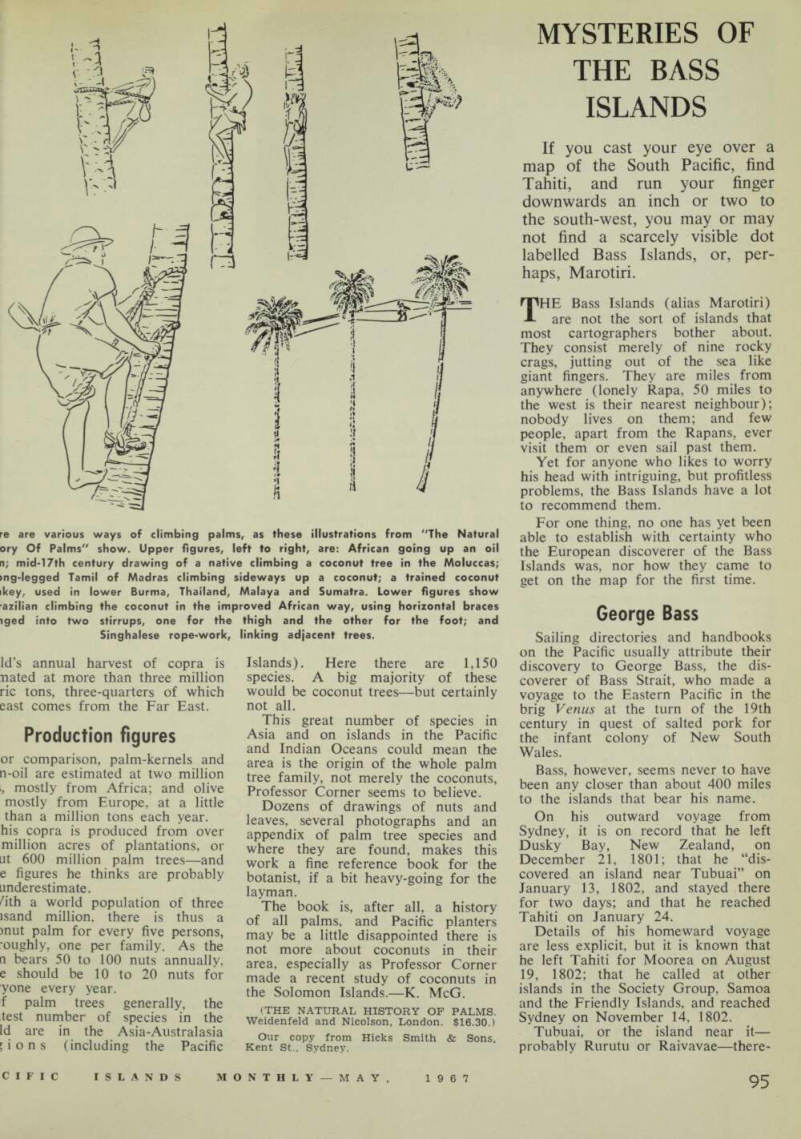
[?]e are various ways of climbing palms, as these illustrations from "The Natural ary Of Palms" show. Upper figures, left to right, are: African going up an oil [?]n; mid-17th century drawing of a native climbing a coconut tree in the Moluccas; [?]ng-legged Tamil of Madras climbing sideways up a coconut; a trained coconut [?]key, used in lower Burma, Thailand, Malaya and Sumatra. Lower figures show [?]azilian climbing the coconut in the improved African way, using horizontal braces [?]ged into two stirrups, one for the thigh and the other for the foot; and Singhalese rope-work, linking adjacent trees.