Magazine Section
pp. 89-95 · Read in the full issue
Pacific Islands Monthly
Big Bay, Espiritu Santo:
Land Of Tall Tales
And Weird Imaginings
By Robert Langdon
Ever since April, 1606, when the Spanish navigator, Pedro Fernandez de Quiros discovered and named St. Philip and St. James Bay at Espiritu Santo, New Hebrides, the bay has been a place of weird imaginings and very tall stories.
HIS is one of the conclusions I have come to after reading ough such literature on the bay I have been able to find, following discovery there in January of a ange wall, which I have suggested y be a relic of the Quiros edition (PIM, Mar., p. 13). \nother of my findings is that, ept for the Quiros expedition, re is no documentary evidence of r Europeans ever having lived in south-eastern corner of the bay, ere the strange wall is situated, ■ of having attempted to establish mselves there. (Some people have gested that the wall is the remains a trade store). fhe European history of the bay ually known these days as Big 0 is, in fact, quite brief, for lough the bay was one of the t places in the Pacific to be dis ered, it is only in the last 70
years that Europeans have been liv ing in any part of it.
The tall stories and weird imagin ings, however, have been going on for much longer than that. Indeed, it was Quiros, himself, who started them, for on the very day that he sailed into the bay, he imagined that the outcroppings of white coral rock that he could see on his port side were deposits of the finest marble, and he immediately had visions of building a huge cathedral with it.
Later, when he got back to Spain, Quiros insisted, among many other fantasies, that the land he had seen abounded in gold, silver and pearls, and he implored the king to allow him to lead another expedition to Espiritu Santo to exploit them. The king refused, fortunately, as no gold, silver or pearls have been found there to this day.
For the next century and a half,
thanks to Quiros’ fantasies, Big Bay remained in the realm of the semi fabulous.
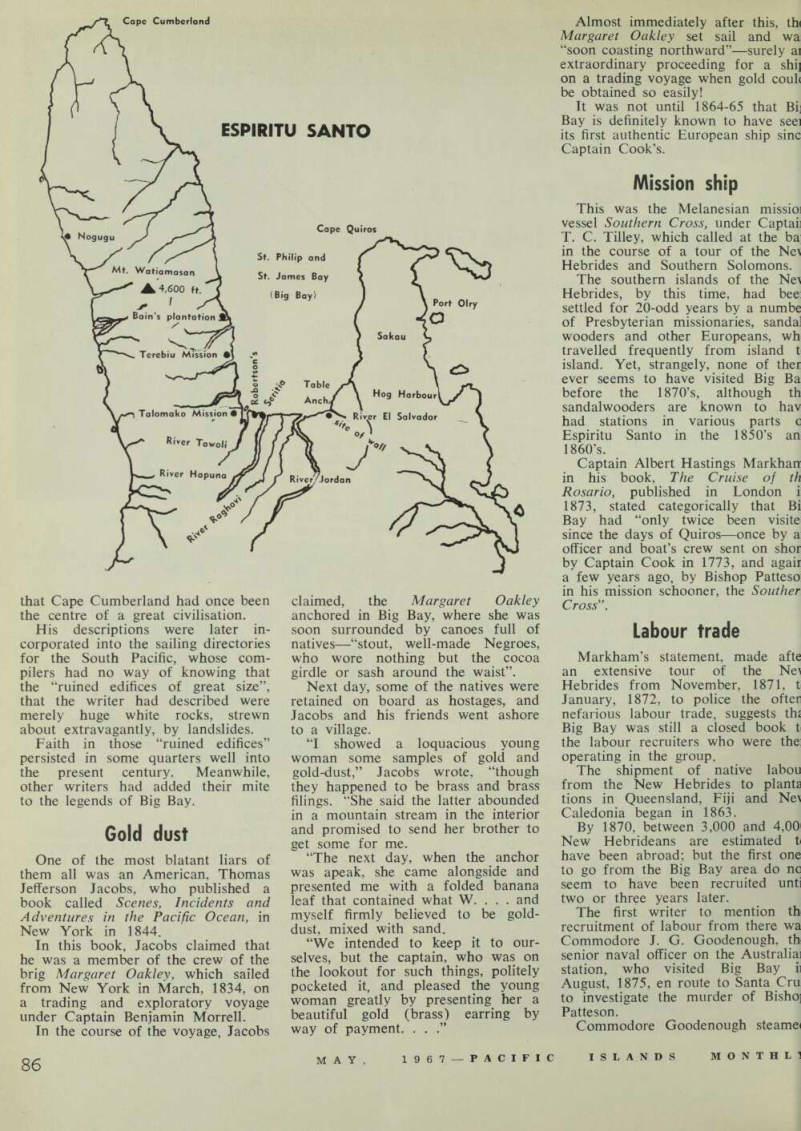
Then, in 1774, it was visited again by the down-to-earth Captain Cook, whose descriptions of the bay con tained none of the fairy-tale qualities of his Spanish predecessor.
"Ruined edifices"
But fantasy again crept in when an anonymous seaman, who visited the New Hebrides several times in whalers between 1828 and 1834, wrote about the Cape Cumberland peninsula of Big Bay in the Sandwich Island Gazette for February 10, 1839.
“Not far from Cape Cumberland,” this man said, “are to be seen appear ances of several antiquities in the shape of ruined edifices of great size, pillars of regular shape composed of large stones, and detached portions of wall.
“Fragments of cemented masonry are scattered over a plain about three miles in extent. The mortar with which the stones appear to have been connected resembles chenam. . .
The writer went on to speak of ruined cities in various parts of the world, and so gave the impression
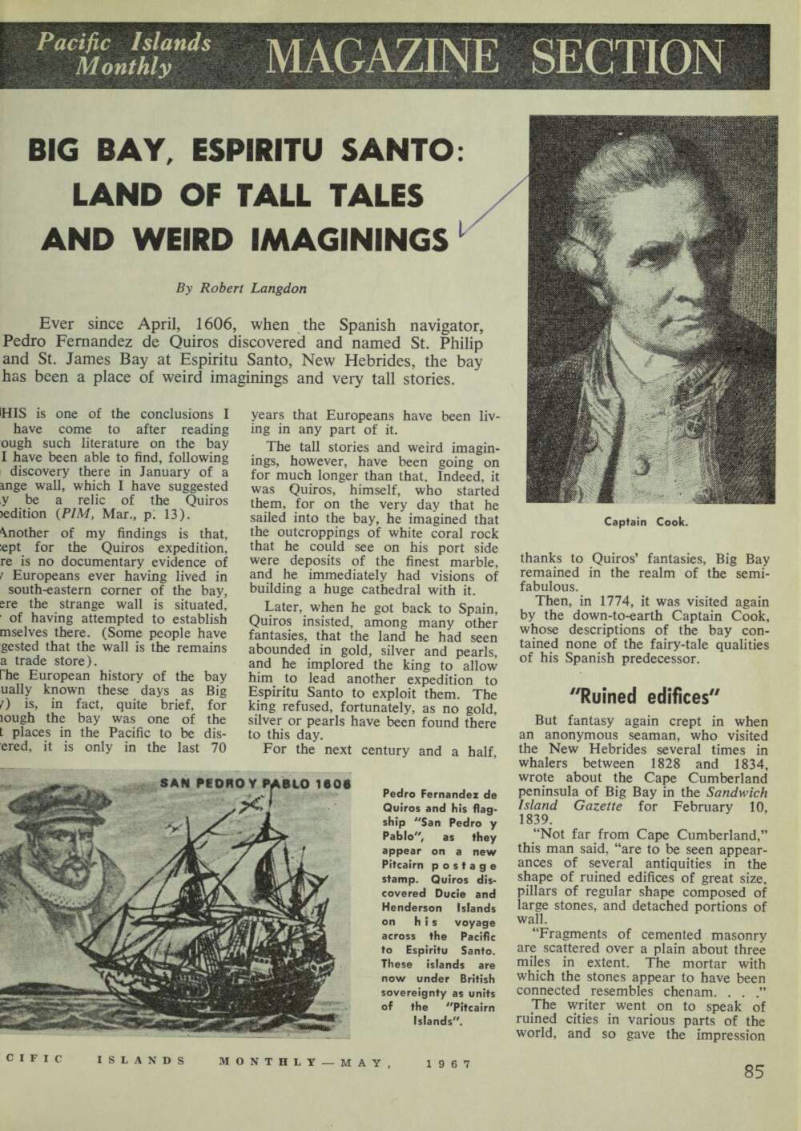
Sah Pedroy Pablo 1606
Pedro Fernandez de Quiros and his flag ship "San Pedroy Pablo", as they appear on a new Pitcairn postage stamp. Quiros dis covered Ducie and Henderson Islands on his voyage across the Pacific to Espiritu Santo.
These islands are now under British sovereignty as units of the "Pitcairn Islands".
Captain Cook.
that Cape Cumberland had once been the centre of a great civilisation.
His descriptions were later in corporated into the sailing directories for the South Pacific, whose com pilers had no way of knowing that the “ruined edifices of great size”, that the writer had described were merely huge white rocks, strewn about extravagantly, by landslides.
Faith in those “ruined edifices” persisted in some quarters well into the present century. Meanwhile, other writers had added their mite to the legends of Big Bay.
Gold dust
One of the most blatant liars of them all was an American, Thomas Jefferson Jacobs, who published a book called Scenes, Incidents and Adventures in the Pacific Ocean, in New York in 1844.
In this book, Jacobs claimed that he was a member of the crew of the brig Margaret Oakley, which sailed from New York in March, 1834, on a trading and exploratory voyage under Captain Benjamin Morrell.
In the course of the voyage, Jacobs
claimed, the Margaret Oakley anchored in Big Bay, where she was soon surrounded by canoes full of natives —“stout, well-made Negroes, who wore nothing but the cocoa girdle or sash around the waist”.
Next day, some of the natives were retained on board as hostages, and Jacobs and his friends went ashore to a village.
“I showed a loquacious young woman some samples of gold and gold-dust,” Jacobs wrote, “though they happened to be brass and brass filings. “She said the latter abounded in a mountain stream in the interior and promised to send her brother to get some for me, “The next day, when the anchor was apeak, she came alongside and presented me with a folded banana leaf that contained what W. . . . and myself firmly believed to be gold dust, mixed with sand.
“We intended to keep it to our selves, but the captain, who was on the lookout for such things, politely pocketed it, and pleased the young woman greatly by presenting her a beautiful gold (brass) earring by way of payment. . . .”
Almost immediately after this, th< Margaret Oakley set sail and wa “soon coasting northward”—surely ai extraordinary proceeding for a shi] on a trading voyage when gold couh be obtained so easily!
It was not until 1864-65 that Bi; Bay is definitely known to have seei its first authentic European ship sine Captain Cook’s.
Mission ship
This was the Melanesian missioi vessel Southern Cross, under Captaii T. C. Tilley, which called at the ba in the course of a tour of the Ne\ Hebrides and Southern Solomons.
The southern islands of the Ne> Hebrides, by this time, had bee settled for 20-odd years by a numbe of Presbyterian missionaries, sandal wooders and other Europeans, wh travelled frequently from island t island. Yet, strangely, none of ther ever seems to have visited Big Ba before the 1870’s, although th sandalwooders are known to hav had stations in various parts c Espiritu Santo in the 1850’s an 1860’s.
Captain Albert Hastings Markhan in his book, The Cruise of th Rosario, published in London i 1873, stated categorically that Bi Bay had “only twice been visite since the days of Quiros —once by a officer and boat’s crew sent on shor by Captain Cook in 1773, and agair a few years ago, by Bishop Patteso in his mission schooner, the Souther Cross”.
Labour trade
Markham’s statement, made afte an extensive tour of the Ne> Hebrides from November, 1871, t January, 1872, to police the ofter nefarious labour trade, suggests ths Big Bay was still a closed book t the labour recruiters who were the operating in the group.
The shipment of native labou from the New Hebrides to plants tions in Queensland, Fiji and Caledonia began in 1863.
By 1870, between 3,000 and 4,00' New Hebrideans are estimated t have been abroad; but the first one to go from the Big Bay area do nc seem to have been recruited unti two or three years later.
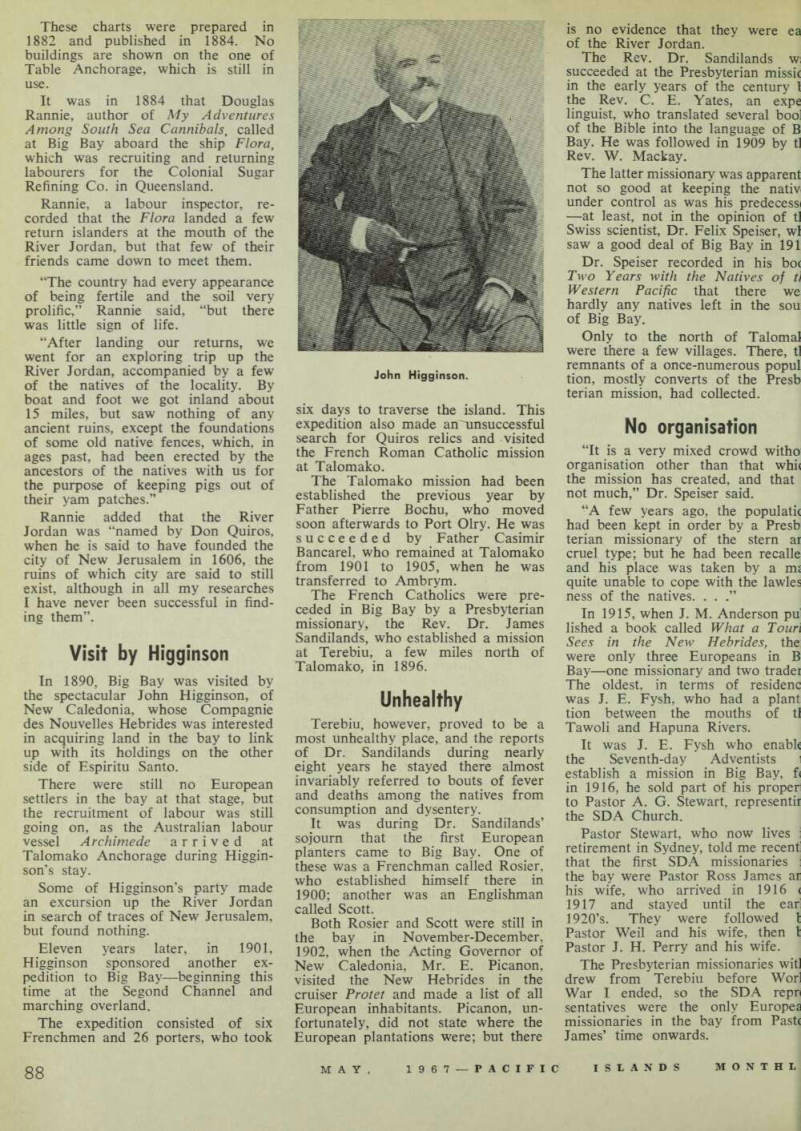
The first writer to mention th recruitment of labour from there wa Commodore J. G. Goodenough, th senior naval officer on the Australia] station, who visited Big Bay ii August, 1875, en route to Santa Cm to investigate the murder of Bisho] Patteson.
Commodore Goodenough steamei
ito the bay in HMS Pearl on August and stayed three days.
Less than two weeks later he was ortally wounded by a poisoned row.
He was therefore unable to pudiate the fantastic claims about mself and Big Bay, made by a •enchman, Henri Le Chartier, in book called La Nouvelle Caledonie les Nouvelles Hebrides, published Paris in 1885.
Le Chartier, a fonctionnaire in jw Caledonia, claimed that he had sited Big Bay in the recruiting ssel Tanna at the same time as jmmodore Goodenough, that he ;nt on board the Pearl, and that Dodenough had told him, in effect, at Britain would not object if ance annexed the New Hebrides.
"Colonnades of bricks"
Le Chartier also claimed that he d discovered the ruins of Quires’ :w Jerusalem in Big Bay.
“Nothing remains but colonnades bricks, where that fervent iristian must have erected the arch that he built before every ng else,” Le Charter said—bliss ly unaware that Quiros had never lit a church at all. (Le Chartier’s book was published a time when Australian feeling was :h on the possibility of French aexation of the New Hebrides, is therefore interesting to note that ontemporary French writer, Alfred gen, described it as “a tissue of i”).
A reporter of a completely different stamp from Le Chartier was Dr Bolton Glanyill Corney, an Englishman who visited Big Bay m August, 1876, aboard the 260-ton barque Prospector.
Recrmtmn shin
9 P This ship had been chartered by the Fiji Government to return 476 New Hebrideans to their homes after working on the cotton, maize or coconut plantations of Fiji.
Dr. Corney described his visit 28 years later in the Hakluyt Society edition of The Voyages of Pedro Fernandez de Quiros.
He said the Protector anchored about 300 yards west of the River Jo y dan - .
We recruited four men to go with us to Fiji for three years,” Dr.
Corney wrote.
I cannot say if they were the true ” h ‘f' s ° f r *{“ as we saw V *\ or . huts ’ they may have teHnr mou , l ? tameers from the m “ Fy * I,; exactly two years after Dr. rey s visit, some Presbyterian missionaries called at Big Bay for the DalsDriil m heiF toUrmg vesse1 ’
Uaysprmg.
Tbe anchored m the bav th ’whlVe (^ Ul m° n S n COmer * f - the oay, where a man came off m a
canoe who had been in Fiji and knew a little English.
“We took him ashore with us and saw his place, and also visited another village where we were very well received,” the missionaries said in their annual report. “Only one I ? lan knew a little English, and through him we explained who we • • • Thls . whole bay contains a large population who seem quite tractable an . d . friendly and anxious to have missionaries. This is the true key to Santo, and should be occupied as . ? oon as possible by two missionaries.” fhartc nronarorJ
LnarTS prepared
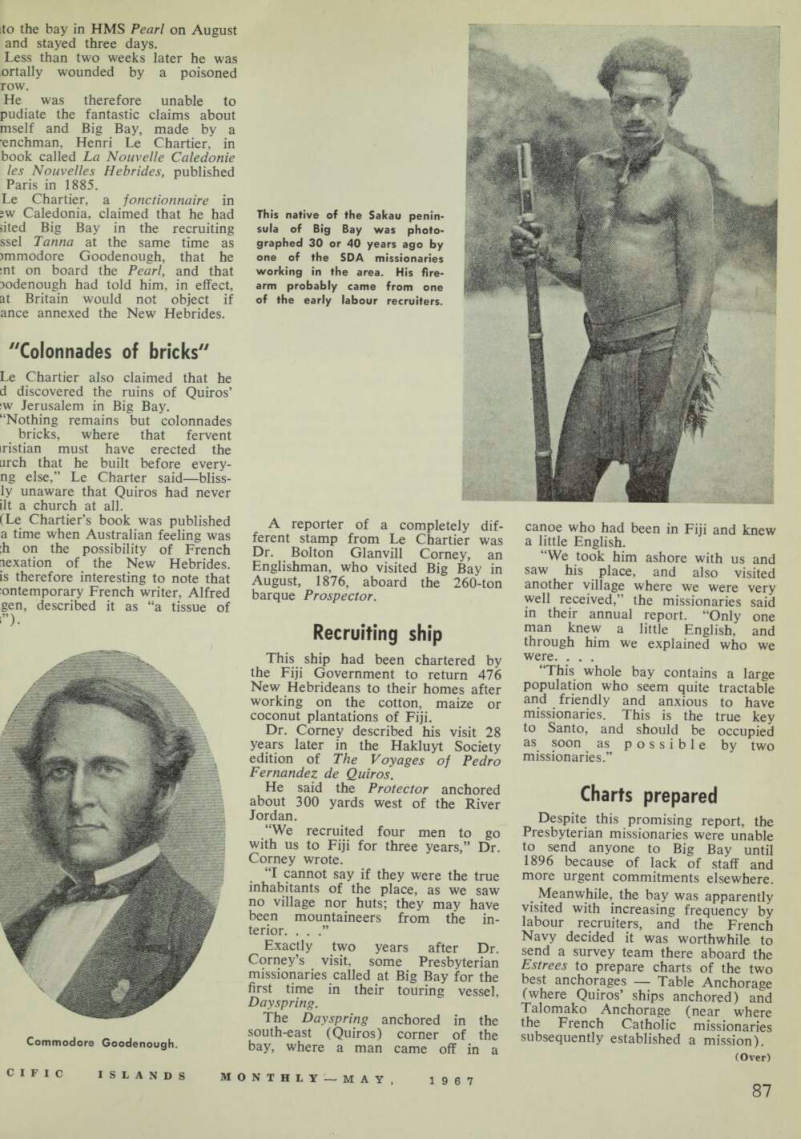
Despite this promising report, the Presbyterian missionaries were unable to send anyone to Big Bay until 1896 because of lack of staff and more urgent commitments elsewhere Meanwhile, the bay was apparently visited with increasing frequency by labour recruiters, and the French Navy decided it was worthwhile to send a survey team there aboard the Estrees to prepare charts of the two best anchorages Table Anchorage (where Quiros’ ships anchored) aid Talomako Anchorage (near where the French Catholic missionaries subse£ l uently established a mission), , ' (Over)
Commodore Goodenough.
This native of the Sakau penin sula of Big Bay was photo graphed 30 or 40 years ago by one of the SDA missionaries working in the area. His fire arm probably came from one of the early labour recruiters.
These charts were prepared in 1882 and published in 1884. No buildings are shown on the one of Table Anchorage, which is still in use.
It was in 1884 that Douglas Rannie, author of My Adventures Among South Sea Cannibals, called at Big Bay aboard the ship Flora, which was recruiting and returning labourers for the Colonial Sugar Refining Co. in Queensland.
Rannie, a labour inspector, re corded that the Flora landed a few return islanders at the mouth of the River Jordan, but that few of their friends came down to meet them.
“The country had every appearance of being fertile and the soil very prolific,” Rannie said, “but there was little sign of life.
“After landing our returns, we went for an exploring trip up the River Jordan, accompanied by a few of the natives of the locality. By boat and foot we got inland about 15 miles, but saw nothing of any ancient ruins, except the foundations of some old native fences, which, in ages past, had been erected by the ancestors of the natives with us for the purpose of keeping pigs out of their yam patches.”
Rannie added that the River Jordan was “named by Don Quiros, when he is said to have founded the city of New Jerusalem in 1606, the ruins of which city are said to still exist, although in all my researches I have never been successful in find ing them”.
Visit by Higginson
In 1890, Big Bay was visited by the spectacular John Higginson, of New Caledonia, whose Compagnie des Nouvelles Hebrides was interested in acquiring land in the bay to link up with its holdings on the other side of Espiritu Santo.
There were still no European settlers in the bay at that stage, but the recruitment of labour was still going on, as the Australian labour vessel Archimede arrived at Talomako Anchorage during Higgin son’s stay.
Some of Higginson’s party made an excursion up the River Jordan in search of traces of New Jerusalem, but found nothing.
Eleven years later, in 1901, Higginson sponsored another ex pedition to Big Bay—beginning this time at the Segond Channel and marching overland.
The expedition consisted of six Frenchmen and 26 porters, who took
six days to traverse the island. This expedition also made an'nnsuccessful search for Quiros relics and visited the French Roman Catholic mission at Talomako.
The Talomako mission had been established the previous year by Father Pierre Bochu, who moved soon afterwards to Port Olry. He was succeeded by Father Casimir Bancarel, who remained at Talomako from 1901 to 1905, when he was transferred to Ambrym.
The French Catholics were pre ceded in Big Bay by a Presbyterian missionary, the Rev. Dr. James Sandilands, who established a mission at Terebiu, a few miles north of Talomako, in 1896.
Unhealthy
Terebiu, however, proved to be a most unhealthy place, and the reports of Dr. Sandilands during nearly eight years he stayed there almost invariably referred to bouts of fever and deaths among the natives from consumption and dysentery.
It was during Dr. Sandilands’ sojourn that the first European planters came to Big Bay. One of these was a Frenchman called Rosier, who established himself there in 1900; another was an Englishman called Scott.
Both Rosier and Scott were still in the bay in November-December, 1902, when the Acting Governor of New Caledonia, Mr. E. Picanon, visited the New Hebrides in the cruiser Protet and made a list of all European inhabitants. Picanon, un fortunately, did not state where the European plantations were; but there
is no evidence that they were ea of the River Jordan.
The Rev. Dr. Sandilands w; succeeded at the Presbyterian missic in the early years of the century 1 the Rev. C. E, Yates, an expe linguist, who translated several boo] of the Bible into the language of B Bay. He was followed in 1909 by tl Rev. W. Mackay.
The latter missionary was apparent not so good at keeping the nativ under control as was his predecess* —at least, not in the opinion of tl Swiss scientist, Dr. Felix Speiser, wl saw a good deal of Big Bay in 191 Dr. Speiser recorded in his bo( Two Years with the Natives of t) Western Pacific that there we hardly any natives left in the sou of Big Bay.
Only to the north of Talomal were there a few villages. There, tl remnants of a once-numerous popul tion, mostly converts of the Presb terian mission, had collected.
No organisation
“It is a very mixed crowd witho organisation other than that whic the mission has created, and that not much,” Dr. Speiser said.
“A few years ago, the populatic had been kept in order by a Presb terian missionary of the stern ar cruel type; but he had been recalle and his place was taken by a ms quite unable to cope with the lawles ness of the natives. . .
In 1915, when J. M. Anderson pul lished a book called What a Touri Sees in the New Hebrides, the: were only three Europeans in B Bay—one missionary and two trader The oldest, in terms of residenc was J. E. Fysh, who had a plant tion between the mouths of tl Tawoli and Hapuna Rivers.
It was J. E. Fysh who enable the Seventh-day Adventists 1 establish a mission in Big Bay, f< in 1916, he sold part of his proper! to Pastor A. G. Stewart, represents the SDA Church.
Pastor Stewart, who now lives i retirement in Sydney, told me recent] that the first SDA missionaries i the bay were Pastor Ross James an his wife, who arrived in 1916 ( 1917 and stayed until the ear] 1920’5. They were followed t Pastor Weil and his wife, then t Pastor J. H. Perry and his wife.
The Presbyterian missionaries wit] drew from Terebiu before Worl War I ended, so the SDA repr< sentatives were the only Europea missionaries in the bay from Paste James’ time onwards.
John Higginson.
Meanwhile, J. E. Fysh’s plantation is taken over by a former bosun of ; Makambo, “Hookrope” Robert n, and a New Zealander, P. L. in, started a plantation half way the west coast.
Robertson’s plantation was stroyed by a tidal wave in March, 34, as was the SDA mission. >bertson left Big Bay soon after irds to manage a plantation at Port ry, but the SDA missionaries re ilt their station and stayed on until 38.
Since 1938, there have been no iropean missionaries of any kind in 5 Bay as far as I can establish, ropean planters have been almost aally scarce.
At present, the only European inter there is Mr. Joseph Santino, 10 works a property which Mr. E.
Lamberty has had since 1955. is property, like all the other mtations and missions of which I i find a record, is on the western e of the bay.
Not much business
Phis, therefore, brings the history Big Bay down to the present day. does not prove any particular ory about the wall in the south tern corner. But it does, I suggest, row down the period in which could have built a store in it locality.
Phat period would have been be jen 1902 (when Acting Governor :anon listed the European in stants) and 1910 (when Dr. user said there were hardly any ives left in the south of the bay). [n view of Dr. Speiser’s remarks, •ugh, I cannot imagine that any re in that vicinity would have had ich business to do.
Pastor Stewart.
• In an item on the Fiji island of /euni in PIAA for January (p. 133), mtion was made of a rare flowering mt called "tagimaucia", which, we said, ourishes only on the shores of a lake Taveuni's mountains". This statement > drawn a friendly letter from Mr. S.
Modzelewski, of Encino, California, who ints out that botanists have also re ded finding "tagimaucia" on Mt. Seatura Vanua Levu. Another reader, Mrs. nifred McHugh, of Auckland, has itten to tell us the legend of "tagi ucia", which, she says was originally led "kau ni drano" (tree by the lake).