Oh , what fuss and bother
pp. 73-75 · Read in the full issue


over decentralisation!
From a Port Moresby correspondent Papua-New Guinea’s Institute of Higher Technical Educa tion, educational companion to the University of Papua-New Guinea, has also opened for business this year—and found itself with more growing pains than the university.
rHE institute is currently in temporary accommodation at dubada, Port Moresby, because plans o give it a permanent home in the erritory’s capital have been upset by >ressure from the House of Assembly o decentralise.
Thus the institute is to be moved o the New Guinea side of the terri ory, on a site five miles outside of .ae, next to an area where the Aus ralian Army is spending a few trillion dollars on barracks for the rd Battalion of the Pacific Islands legiment.
Nobody can say exactly when it dll be moved.
The Administration, in a deliber tely blunt statement of the facts, Did the House of Assembly’s March leeting that the move to Lae would ost at least an additional $417,000 -plus another whopping sum for acilities which in Port Moresby it rould have been able to share with ae university.
The 'Assistant Administrator Services) Mr. L. Johnson, pointed ut that it had been planned to share oads, sewerage, electricity and other jrvices between the institute and uni ersity, and in the early years it rould have been possible for the two ;udent bodies to share the library, porting fields and dining rooms.
Now the basic engineering facilities
needed at Port Moresby would not be “significantly reduced”, even though the institute wouldn’t share the site. Therefore the cost of establishing both the institute and the university “would be increased by a substantial amount”.
Facilities to be built at Lae in place of those the institute would have shared with the university would require an additional $360,000 in the
next three years, although this may not have been necessary for some time later.
Mr. Johnson said all the extra money needed to relocate at Lae would have to be met from territory revenues. Money would have to be diverted from other projects, or else both the institute and the university would have to be developed at a slower rate.
Mr. Johnson then twisted the knife: “When the bill to alter the location of the institute to Lae was before the House it was proposed (by the Administration) that consideration of the amendment be postponed until the effects of the possible change could be examined, so that the House could make its decision in the light of the implications of the proposals.
The House did not accept this suggestion. . . .
“The purpose of this statement is to draw the attention of the House to the financial consequences which the House did not consider at the time it passed the amending ordinance.”
Dismissed with a sniff
The Assembly appeared not to be impressed, and virtually dismissed Mr. Johnson with a sniff.
The decision to move the institute to Lae was made as a result of a private member’s bill, introduced by Mr. Don Barrett, of Rabaul, into an Assembly whose members fre quently deplore the development of Port Moresby ahead of other territory centres. Thus it was obvious the bill would be supported.
And despite the extra cost, Lae is a better site. There is likelihood of considerable industrial expansion in Lae or Madang if the Ramu River hydro electric scheme goes ahead, and there is also a greater volume of road construction going forward on the New Guinea side, requiring
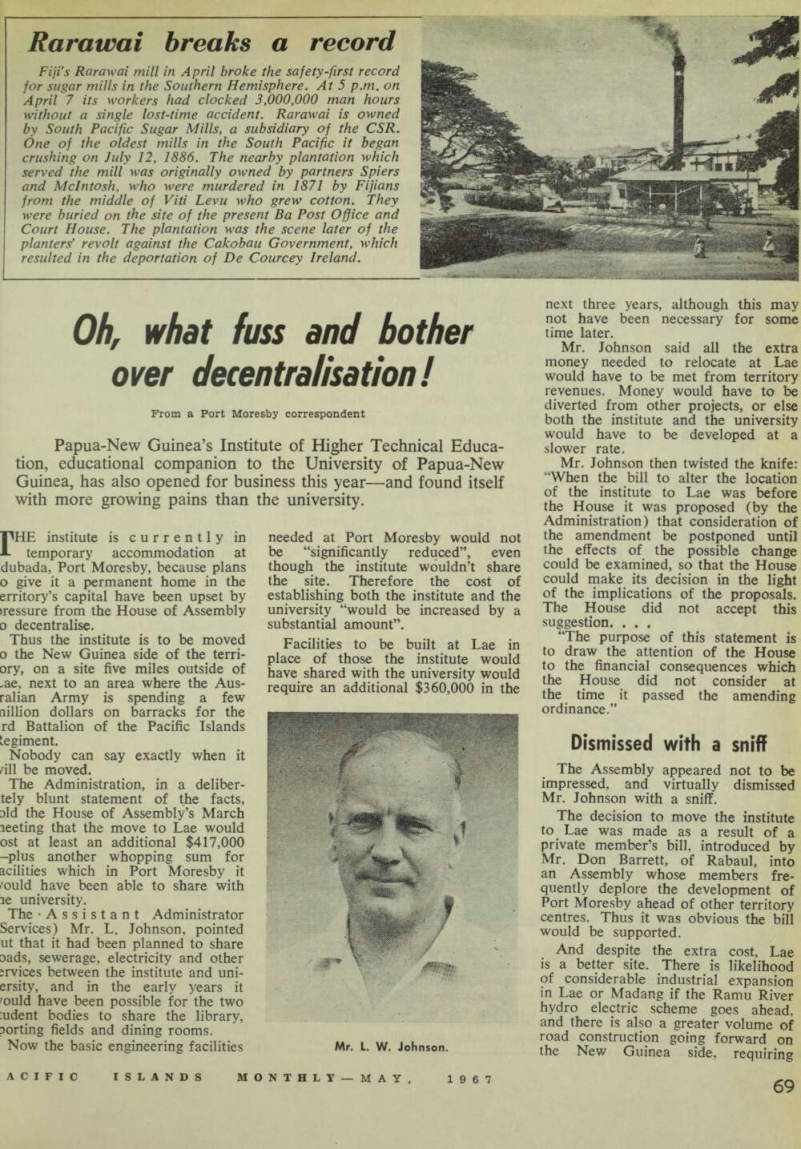
Mr. L. W. Johnson.
Moresby not popular
survey and design work. Students will be closer to fields of practical train ing.
But more importantly, institute students, most of whom will come from the New Guinea side, will prefer Lae. Port Moresby has never been popular with New Guineans because of its long dry seasons and the lack of native foods and vege tables.
In the current wet season Port Moresby is positively beautiful, with the hills and valleys green, but this is an unusually wet wet and for most of any year Port Moresby looks like the brown North Queensland out back.
Like the university, the institute was established by an ordinance in 1965. It is governed by a council, two of whom are members of the House of Assembly.
Chairman is Dr. Louis Matheson, vice-chancellor of Monash Uni versity, Victoria, who is also a member of the Papua-New Guinea University’s interim council. Director of the institute is Dr. W. E.
Duncanson, who was director of a similar institute in Ghana and later moved to India where he was chiefly responsible for establishing a tech nical institute.
Has 32 students
The P-NG Institute opened its classrooms at Idubada this year with 32 students. Six of them had begun last year on a surveying course con ducted by the Department of Lands, and they will now complete it as students of the institute.
The other 26 have started basic studies which will lead some of them to a Diploma in Civil Engineering and others to a Diploma in Survey ing.
The decision to start with these two courses makes sense. The terri tory is in urgent need of local surveyors in considerable numbers— whether employed by the Administra tion or on their own account.
The institute also plans to under take research into hydraulics, soil structure and stability, and the impor tance of these subjects is underlined when one looks at the huge annual sum spent on road construction and maintenance in the territory.
Professor John Lavery, who heads the civil engineering division at Queensland University, is a founda tion member of the institute’s council.
Next year there will be a course
in business and accountancy—a field which needs attention in the territory.
The House of Assembly public accounts committee has reported on the serious lack of trained accounting staff, which has handicapped admini stration departments. (This year for the first time there is a course for clerks at the Administrative College in Port Moresby).
Mechanical and electrical courses should start at Lae by 1969 if the building programme goes to plan.
The P-NG Electricity Commission is already training its own staff and will want to put its best trainees into a diploma course.
Most of the new institute’s students will study under Administra tion scholarships, but this year’s first intake includes two students sponsored by Conzinc-Riotinto, the company involved in copper exploita tion on Bougainville. More privately sponsored students will no doubt follow.
The Council of the Institute of Higher Technical Education is also concious that standards have to be high. No institute or university is of value unless it accepts, and pro duces, students with proper qualifica tions.
The present territory secondary school system allows of only four years leading to a school certificate.
English, surprisingly enough, is not compulsory for a school certificate, but the institute demands good passes in English, mathematics and science, with at least one other subject, for those seeking entry.
Mr. Don Barrett.