It's Boom Time In The
pp. 65-68 · Read in the full issue
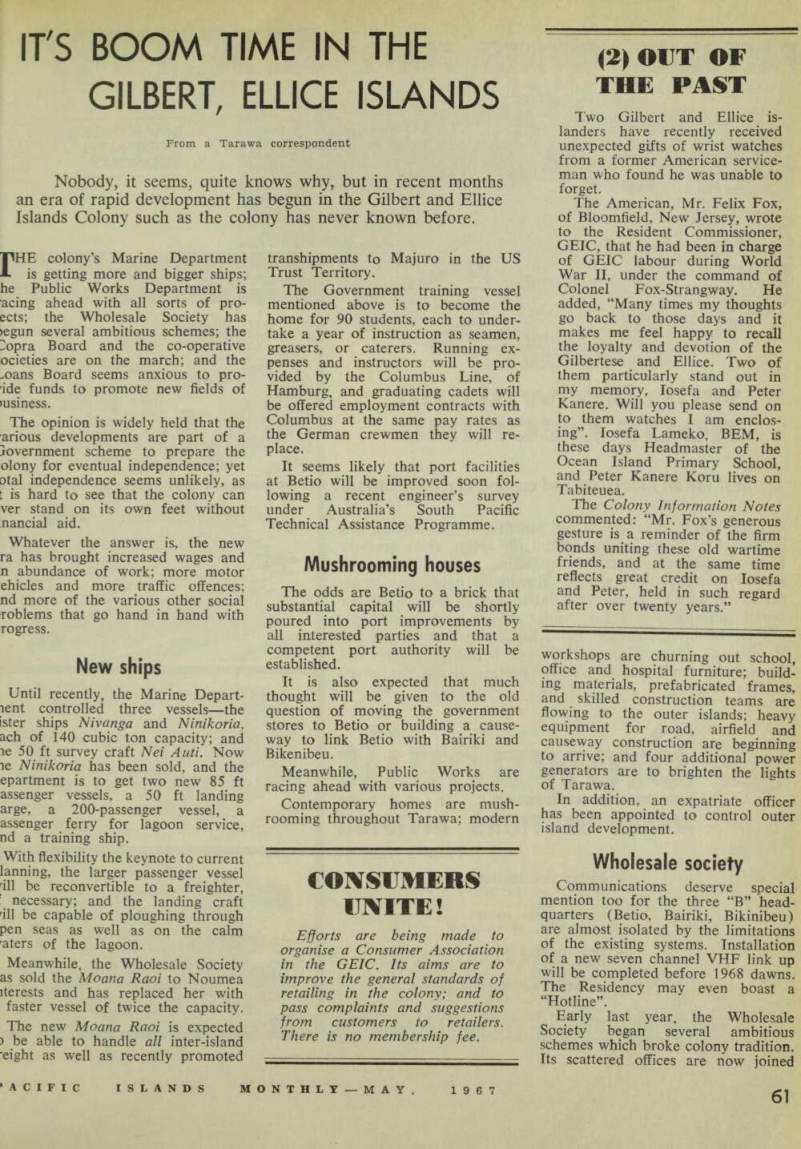


Gilbert, Ellice Islands
From a Tarawa correspondent Nobody, it seems, quite knows why, but in recent months an era of rapid development has begun in the Gilbert and Ellice Islands Colony such as the colony has never known before.
rHE colony’s Marine Department is getting more and bigger ships; he Public Works Department is acing ahead with all sorts of pro ects; the Wholesale Society has >egun several ambitious schemes; the Uopra Board and the co-operative ocieties are on the march; and the -oans Board seems anxious to pro ide funds to promote new fields of >usiness.
The opinion is widely held that the arious developments are part of a Jovernment scheme to prepare the olony for eventual independence; yet otal independence seems unlikely, as t is hard to see that the colony can ver stand on its own feet without nancial aid.
Whatever the answer is, the new ra has brought increased wages and n abundance of work; more motor chicles and more traffic offences; nd more of the various other social roblems that go hand in hand with regress.
New ships
Until recently, the Marine Depart ment controlled three vessels—the ister ships Nivanga and Ninikoria, ach of 140 cubic ton capacity; and le 50 ft survey craft Nei Auti. Now le Ninikoria has been sold, and the epartment is to get two new 85 ft assenger vessels, a 50 ft landing arge, a 200-passenger vessel, a assenger ferry for lagoon service, nd a training ship.
With flexibility the keynote to current lanning, the larger passenger vessel 'ill be reconvertible to a freighter, necessary; and the landing craft 'ill be capable of ploughing through pen seas as well as on the calm 'aters of the lagoon.
Meanwhile, the Wholesale Society as sold the Moana Raoi to Noumea iterests and has replaced her with faster vessel of twice the capacity.
The new Moana Raoi is expected ) be able to handle all inter-island •eight as well as recently promoted
transhipments to Majuro in the US Trust Territory.
The Government training vessel mentioned above is to become the home for 90 students, each to under take a year of instruction as seamen, greasers, or caterers. Running ex penses and instructors will be pro vided by the Columbus Line, of Hamburg, and graduating cadets will be offered employment contracts with Columbus at the same pay rates as the German crewmen they will re place.
It seems likely that port facilities at Betio will be improved soon fol lowing a recent engineer’s survey under Australia’s South Pacific Technical Assistance Programme.
Mushrooming houses
The odds are Betio to a brick that substantial capital will be shortly poured into port improvements by all interested parties and that a competent port authority will be established.
It is also expected that much thought will be given to the old question of moving the government stores to Betio or building a cause way to link Betio with Bairiki and Bikenibeu.
Meanwhile, Public Works are racing ahead with various projects.
Contemporary homes are mush rooming throughout Tarawa; modern
workshops are churning out school, office and hospital furniture; build ing materials, prefabricated frames, and skilled construction teams are flowing to the outer islands; heavy equipment for road, airfield and causeway construction are beginning to arrive; and four additional power generators are to brighten the lights of Tarawa.
In addition, an expatriate officer has been appointed to control outer island development.
Wholesale society
Communications deserve special mention too for the three “B” head quarters (Betio, Bairiki, Bikinibeu) are almost isolated by the limitations of the existing systems. Installation of a new seven channel VHP link up will be completed before 1968 dawns.
The Residency may even boast a “Hotline”.
Early last year, the Wholesale Society began several ambitious schemes which broke colony tradition.
Its scattered offices are now joined
Copra Board on march
>y a 25-extension telephone service; md the new wing of their general >ffice —the envy of all white collar vorkers —was smartly completed.
A partly-erected, two-storey office, lore and amenities block at the boat yard, has already assumed “sky craper” proportions; foundations lave been laid for a workship Com dex to house mechanics, joiners, dumbers and shipwrights; a new imber store has been completed; lipping facilities will shortly be ivailable for craft up to 100 tons; nd the roofing of all these build ngs will drain to a huge under jound water storage.
Not satisfied with all this home ront activity, the society has under aken contracts to erect copra stores or various island co-ops. One store ias been completed, and two more re under construction.
The Copra Board is on the march, 30, for an experiment has been onducted in producing copra at anely Gardner Island in the Phoenix iroup.
Similar schemes elsewhere in the ninhabited Phoenix Islands may allow.
Meanwhile, the various co-operative ocieties are almost reeling under ae introduction of modern manage lent ideas. They are gradually dopting the idea of allocating re ;rve funds for future capital de elopment.
Pushing hard on their doorstep to icrease copra production and to itroduce new food crops, chicken ;ocks and better bred swine is the igricultural Board. Additional funds ave just been granted for agricultural 'ork.
Fisheries, tourism
The Loans Board, financed by the 'opra Board, appears to be anxious ) provide funds to promote new elds of business. Expert advice has een sought on various schemes, in luding fisheries and tourism.
Recent shipping developments, the ecision to proceed with construction f airfields for an internal service, nd dreams of a through air link dth Guam and Honolulu, could give irth to a tourist trade (see p. 65).
British Petroleum have already lade a survey for the installation f proper refuelling equipment at onriki.
Apart from all these physical de elopments, there have been pro osals for a new constitution from
the Administration, local government elections and the appointment of Island Executive Officers to the newly created Local Government Service Board. The board is destined to be the backbone of an independent ad ministration.
All appointees are graduates of the first course in basic law and accoun tancy run by the Local Government Training School.
One condition of service is that appointees will not be permitted to serve the local government of their home islands, for the Gilbertese and Elice Islanders are followers of the old adage, “blood is thicker than water”.
Another new development is the proclamation of the colony’s first registrar of trade unions, which could inject increased enthusiasm into the colony’s political parties.
Until now the colony has boasted only one union, that formed by Wholesale Society employees some time ago.
All of these briefly outlined changes have wrought an effect on the community.
Increased wages and an abundance of work have naturally followed; pur chasing power and taste are altering dramatically.
Cars doubled
Private car registrations on Tarawa almost doubled in 1966 while regis trations of new motor cycles soared to 129.
In 1967, registrations will greatly exceed the 1966 total as the Whole sale Society is now importing machines for sale in all of the islands.
The extra motor vehicles have brought more convictions for traffic offences, and drunken driving has caused three fatalities.
There are now more prisoners in HM gaols than there used to be; and drunken brawls and organised crime have appeared and trespassing and delinquency have become part of the GEIC scene.
On the credit side missions. Red Cross, youth movements and adult education programmes are rapidly expanding.
Just like a Christmas pudding, sleepy hollow has been well stirred. • The development of cattle rais ing and the establishment of canning factories at Santo and Vila, New Hebrides, have become significant factors in the Condominium’s economy. Nearly 100,000 cans of meat worth over seven million NH francs were exported in the year ended July, 1966.