needs aid at the grass roots
pp. 41-42 · Read in the full issue
Peace Corps? Fine! But Micronesia needs aid at the grass roots
By JUDY TUDOR, just returned from Saipan
At present there are about 450 Peace Corps volunteers working in the U.S. Trust Territory of Micronesia and before the end of 1967 there will likely be 250 more. There then will be one volunteer to every 150 Micronesians and one and a half volunteers to every regular expatriate public servant.
THE volunteers are mostly young, mostly inexperienced, mostly eager—and therein lies the strength as well as the weakness of the system.
Although American Peace Corps volunteers have been going to other under-developed countries for years, they did not move into the US’s own Trust Territory of Micronesia until late last year.
Micronesia asked for volunteers in May, 1966. A team of PC experts immediately went into operation in the US on a recruitment drive through 65 major colleges and universities.
They distributed thousands of attrac tive booklets that were entitled, pre dictably enough, The Peace Corps goes to Paradise.
The first paragraph in the booklet said: “Tropical islands. Enchanted even ings. Swaying palms and sunkissed maidens. Under-staffed schools. Bad
roads. Insufficient medical facili ties. Inadequate water and sanitary systems. An island territory that has to import its seafood. In short, there are problems in paradise.”
Some of the usual tests were dis pensed with, applications were called for through newspapers and television advertisements and the usually ex haustive application form was cut down to suit. As a result the Trust Territory may have got a few more misfits than normal.
In no time at all, 3,000 applications were in from people who wanted to go to Micronesia and set paradise right. By August, 1966, 500 had been selected and were in training pro grammes in the United States or Hawaii. By the end of October the first 300 volunteers were in business in the Trust Territory.
The average age of the volunteers is 24; 70 per cent, are recent college graduates although some have inter-
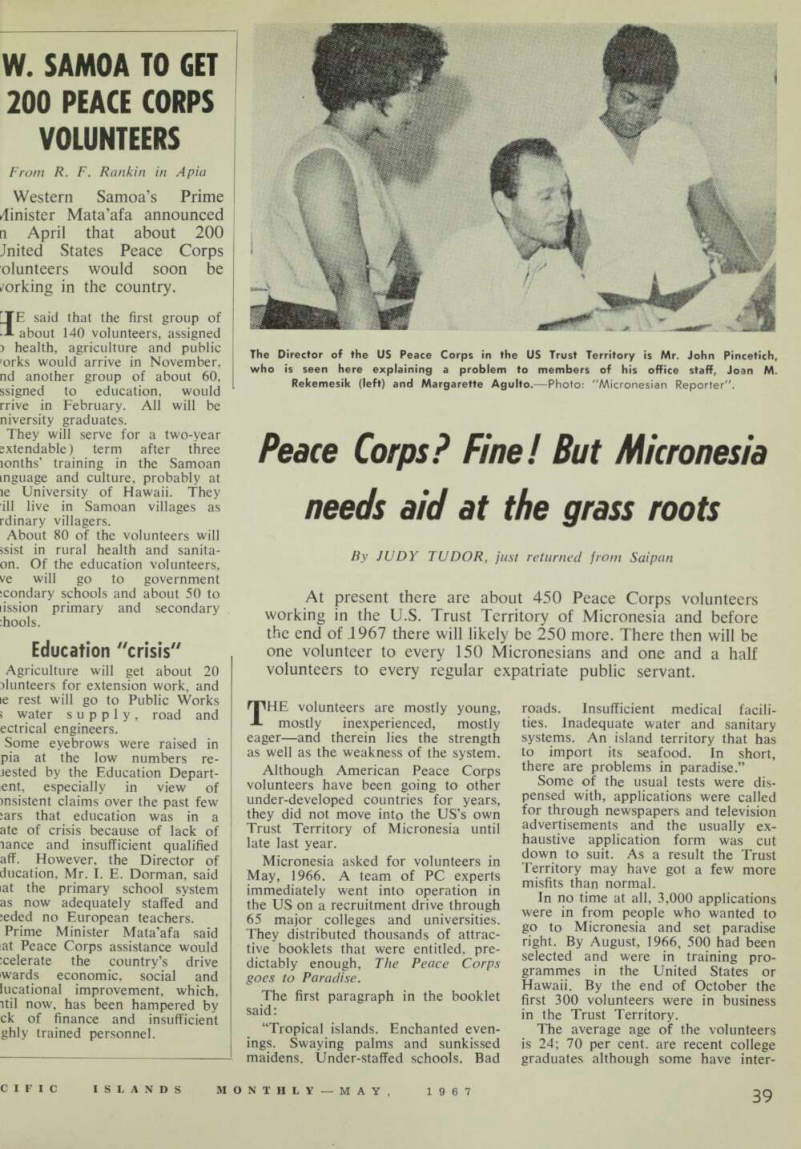
The Director of the US Peace Corps in the US Trust Territory is Mr. John Pincetich, who is seen here explaining a problem to members of his office staff, Joan M.
Rekemesik (left) and Margarette Agulto. Photo: "Micronesian Reporter".
Saipan: Until recently, a school for spies
rupted college courses for financial or other reasons. (Service in the Peace Corps can earn deferment from mili tary service but does not carry exemp tion; while I was in Saipan two volunteers were, in fact, drafted.) About 70 per cent, of the corps are what are termed “generalists”. They have a BA degree and the theory is that they are, at this stage, easily trained for a variety of jobs—health work, social work, teaching English as a second language (which was the main aim of the programme in the initial stages).
Some are trying—and I say “try ing” advisedly—to show Micronesians how to run hotels and small busi nesses.
Each volunteer is paid $BO a month plus $lO a month rental allowance.
A further $75 per month “readjust ment allowance” is paid to them in a lump sum when they get home.
Washington foots the bill. Corpsmen serve for two years, including the initial training period.
Altruistic ideals
Directing the volunteers, who are scattered over the territory’s 2,100 islands (total dry land area 687 square miles, afloat on three million square miles of water), is a head quarters staff in Saipan of about 13 who are on normal salaries.
The whole scheme is based on altruistic ideals, but it allows great scope for initiative and original think ing among these young volunteers, so it can have a practical value to them as well.
There are, for example, quite a pro portion of young lawyers fresh out of law-school who would probably be sitting on their behinds in offices for some years before cases came their way.
In an undeveloped country like the Trust Territory, with no non government legal opinion available, they have a ready-made clientele.
They get good experience and, as someone pointed out to me, they may even get to write the constitution in some emerging country and get a good background knowledge of inter national law.
The same goes for budding en gineers. architects, surveyors and others who have already assisted the Trust Territory and its people in practical ways.
Nonetheless, the bias up to date has been on social services and as the whole basis of the scheme is for the volunteers to get right down to grass
roots level with the indigenous people, this gives plenty of scope for starry eyed and impractical idealism in all its aspects.
It is this which occasionally pro duces friction between the volunteers and the more mature public servants on Saipan’s Capitol Hill, and out in the District Headquarters.
The volunteers are not subject to public service discipline, although it is laid down in their agreement that the High Commissioner must approve the number sent to the territory and the type of service to be performed by them. Otherwise, it seems up to the corps to decide what to do and how to do it. There appears to be a great deal of scope for both the corps and also individual members of it to initiate programmes or abandon them.
Some energy is thus dissipated in unproductive directions and there are complaints that because service is “voluntary” some corpsmen feel that they can fix their own hours of work, and also the kind of work, regardless of departmental or anyone else’s con venience.
The 1967 intake of volunteers is to be trained in Truk and not the United States; there has been time to screen them better and, I believe, there has been some effort made to recruit those with agricultural, horti cultural and other scientific skills.
No veterinarians
There is, at present, not one veterinarian in the whole of the Trust Territory, although private enterprise has now set up a ranch that occupies a quarter of Tinian and has stocked it with imported cattle.
There is a lamentable lack of tradesmen of the ordinary motor mechanic, carpenter, plumber type and—with respect—it appears to me that this is the class of help the Trust Territory needs rather than an endless stream of young academics.
Peace Corps volunteers in the Trust Territory, at present, do in fact re flect the American education system that seems to turn out BA’s ad nauseam —graduates with often no place to go.
The civilian administration of the Trust Territory has had a tough time since the end of the Pacific war. It inherited three completely different groups of islands and people, scattered over vast areas of ocean.
The most governable islands, the Marianas, had been literally beaten into the ground by active warfare;
its people bewildered after havii been adminstered by Spain, German Japan and then the United States, less than a century. The Mariam Carolines and Marshalls are n economically rich and the annu budget of the civil administration h never been of a size capable of cove ing more than essential expenditure Furthermore, from the early 195( to the early 1960’5, the main islan of the Marianas were again tak< from the civil administration. Behii the facade of the US Navy, th< were used by the US Central Intel gence Agency as a huge school f training master-spies from National] China for the infiltration of R( China.
During this time the Trust Ten tory headquarters operated fro Guam.
It is only in very recent years th the government has been gettir around to grappling with the re problems of the territory and no> of course, it is doing it in a Pacif that is alive with new politic thought.
The territory needs practical hel quickly and to this extent the Pea( Corps volunteers are an expedien But I doubt that they can ever I more than that.
The people of the territory are HI unwanted orphans who have bee handed around among indifferei relatives too long. What they wai now is some sort of fixed fathe; figure; someone whom they can curs* damn and blame, if they wish, bi essentially someone who will sta put and not go off after two years.
In short, they need well-traine field officers, permanent, mature e? patriate public servants and practicj technical experts.
They probably also need outsid private enterprise to come in and prc vide a living example of how efficier businesses operate—but that is ar other story, I don’t see the Peace Corps volur teers, idealistic although their motive are, fulfilling any of these vital an< down-to-earth needs.