Tropicalities
pp. 39-40 · Read in the full issue
If officials of the French company, Compagnie Francaise de I’Oceanie still take an interest in Pacific phosphate matters, they must frequently heave a sigh of relief that the deposits they worked at Makatea, French Polynesia, for 53 years have now given out.
HE fact is that exploiting—and you can put your own interpreta i on that word—a Pacific phos te island is not what it used to ione are the fine old carefree s when it was just a matter of ging the phosphate out and ship g it away; when the happy-go cy local inhabitants were content i a 6d a ton royalty you paid them, s compensation for any trees you troyed.
'he time has now come when the Us —having woken up to the im ise value of their islands’ deposits re demanding, at every oppor ity, that they be paid a fair price their phosphate.
'he world—Australia and New land, in particular—has heard a d deal these last few years of the :ess of the persistent people of jru. he Banabans, from neighbouring, •sphate-rich Ocean Island, have been able to make their presence to anywhere near the same effect the Nauruans, or to make any ire near the same financial pre ss.
Getting noisier
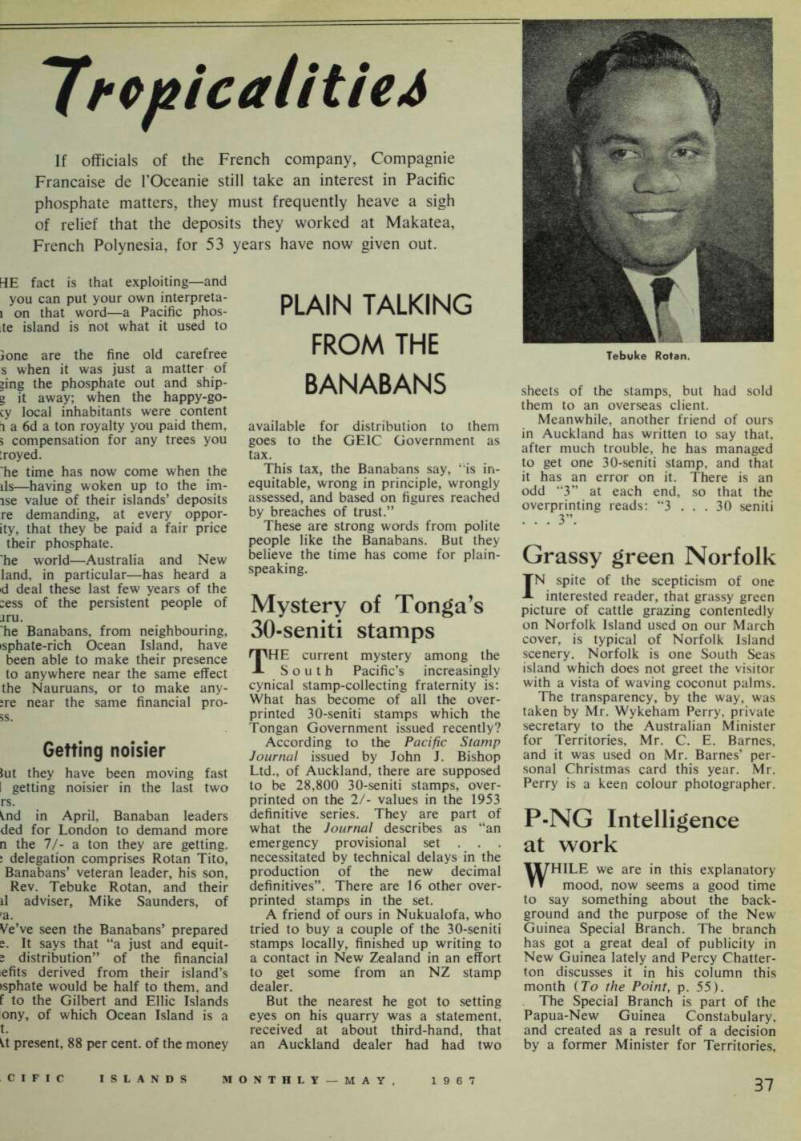
lut they have been moving fast 1 getting noisier in the last two rs. in April, Banaban leaders ded for London to demand more n the 7/- a ton they are getting. ; delegation comprises Rotan Tito, Banabans’ veteran leader, his son, Rev. Tebuke Rotan, and their U adviser, Mike Saunders, of r a.
Ve’ve seen the Banabans’ prepared 2. It says that “a just and equit -2 distribution” of the financial efits derived from their island’s tsphate would be half to them, and f to the Gilbert and Ellic Islands ony, of which Ocean Island is a t. it present, 88 per cent, of the money
Plain Talking
From The
Banabans
available for distribution to them goes to the GEIC Government as tax.
This tax, the Banabans say, “is in equitable, wrong in principle, wrongly assessed, and based on figures reached by breaches of trust.”
These are strong words from polite people like the Banabans. But they believe the time has come for plain speaking.
Mystery of Tonga’s
30-seniti stamps
THE current mystery among the South Pacific’s increasingly cynical stamp-collecting fraternity is: What has become of all the over printed 30-seniti stamps which the Tongan Government issued recently?
According to the Pacific Stamp Journal issued by John J. Bishop Ltd., of Auckland, there are supposed to be 28,800 30-seniti stamps, over printed on the 2/- values in the 1953 definitive series. They are part of what the Journal describes as “an emergency provisional set necessitated by technical delays in the production of the new decimal definitives”. There are 16 other over printed stamps in the set.
A friend of ours in Nukualofa, who tried to buy a couple of the 30-seniti stamps locally, finished up writing to a contact in New Zealand in an effort to get some from an NZ stamp dealer.
But the nearest he got to setting eyes on his quarry was a statement, received at about third-hand, that an Auckland dealer had had two
sheets of the stamps, but had sold them to an overseas client.
Meanwhile, another friend of ours in Auckland has written to say that, after much trouble, he has managed to get one 30-seniti stamp, and that it has an error on it. There is an odd “3” at each end, so that the overprinting reads: “3 . . . 30 seniti . . . 3”.
Grassy green Norfolk
IN spite of the scepticism of one interested reader, that grassy green picture of cattle grazing contentedly on Norfolk Island used on our March cover, is typical of Norfolk Island scenery. Norfolk is one South Seas island which does not greet the visitor with a vista of waving coconut palms.
The transparency, by the way, was taken by Mr. Wykeham Perry, private secretary to the Australian Minister for Territories, Mr. C. E. Barnes, and it was used on Mr. Barnes’ per sonal Christmas card this year. Mr.
Perry is a keen colour photographer.
P-NG Intelligence
at work
WHILE we are in this explanatory mood, now seems a good time to say something about the back ground and the purpose of the New Guinea Special Branch. The branch has got a great deal of publicity in New Guinea lately and Percy Chatter ton discusses it in his column this month {To the Point, p. 55), The Special Branch is part of the Papua-New Guinea Constabulary, and created as a result of a decision by a former Minister for Territories,
Tebuke Rotan.
Mr. Paul Hasluck. It’s creation was notified in the P-NG Government Gazette of October 15, 1964.
The present strength of the branch is 11 overseas officers, two New Guinean officers, four New Guinea sergeants and 18 constables.
We now take words out of the mouth of the P-NG Secretary for Law, Mr. W. W. Watkins, speaking in the House of Assembly; “The functions of Special Branch are the same as in Australia and most other countries of the world, including developing countries. Its responsibility is to detect subversive activities and thus contribute towards the maintenance of internal security.
Subversive activity is activity aimed at disrupting the work of Govern ment by unconstitutional means.
“Officers of Special Branch are in fact Government Intelligence officers.
They collect information and make it available to the appropriate authority in Government who decides what action, if any, should be taken. They do not take any action themselves.
“Procedures for obtaining and pro cessing intelligence are modelled on those used by Special Branches throughout the British Common wealth. They are standard procedures and our Soecial Branch is not a clan destine organisation. It acts overtly and collects the greater part of its intelligence from District Intelligence Committees, which are comprised of the District Commissioner and his District staff.
“The Constabulary at present is concerned with the development of an efficient and effective Special Branch organisation which when pro
perly established, will be capable of forewarning the Government of the day of any serious threat to its security which may arise.
“It is hoped that such an organisa tion will be operating in its intelli gence gathering role well before -sub version is practised in the territory.
It is too late to start setting up such an organisation after the Government is subverted.”
That’s the background. For some of the practical problems and dangers, read Percy Chatterton.
A little bit of
Australia
THEY call it Guam, USA, and it is just about as American as an unincorporated territory of the United States can get. But one small part of it, high on the cliffs above Agana, is to all intents and purposes Aus tralian.
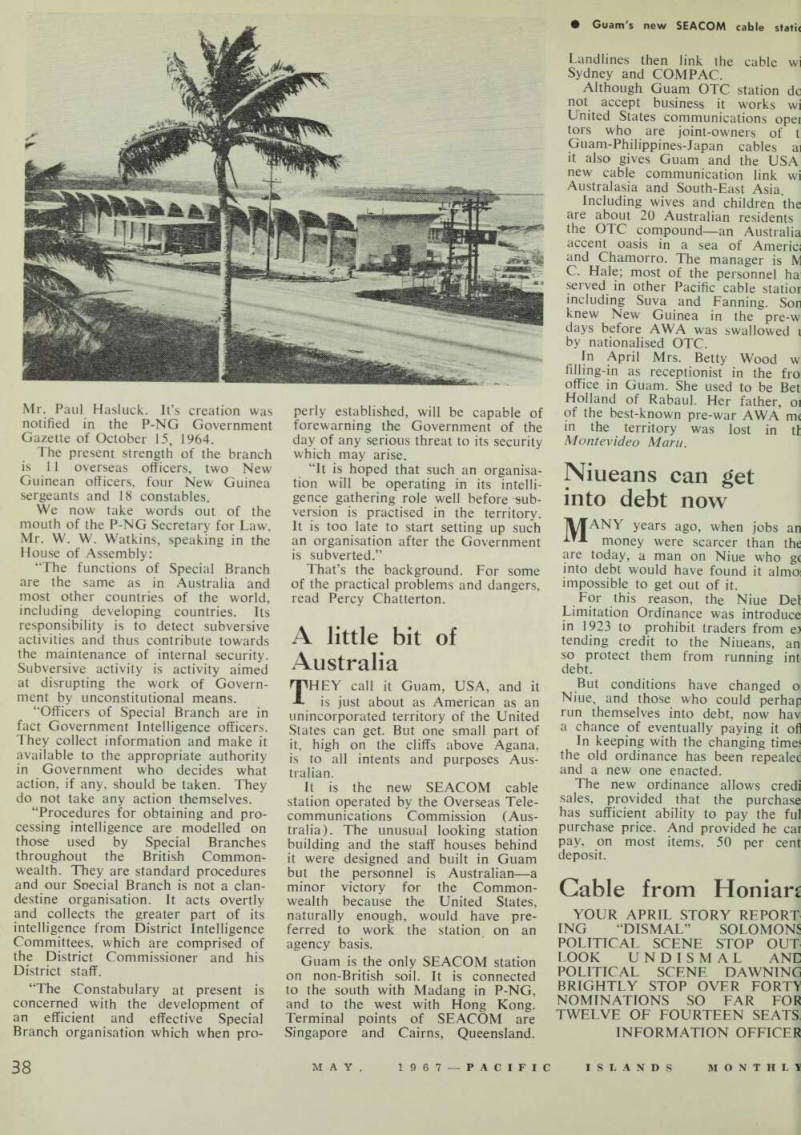
It is the new SEACOM cable station operated by the Overseas Tele communications Commission (Aus tralia). The unusual looking station building and the staff houses behind it were designed and built in Guam but the personnel is Australian—a minor victory for the Common wealth because the United States, naturally enough, would have pre ferred to work the station on an agency basis.
Guam is the only SEACOM station on non-British soil. It is connected to the south with Madang in P-NG, and to the west with Hong Kong.
Terminal points of SEACOM are Singapore and Cairns, Queensland.
Landlines then Jink the cable wi Sydney and COMPAC.
Although Guam OTC station dc not accept business it works wi United States communications opei tors who are joint-owners of t Guam-Philippines-Japan cables ai it also gives Guam and the USA new cable communication link wi Australasia and South-East Asia.
Including wives and children the are about 20 Australian residents the OTC compound—an Australia accent oasis in a sea of Americ; and Chamorro. The manager is W C. Hale; most of the personnel ha served in other Pacific cable statior including Suva and Fanning. Son knew New Guinea in the pre-w days before AWA was swallowed \ by nationalised OTC.
In April Mrs. Betty Wood w filling-in as receptionist in the fro office in Guam. She used to be Bet Holland of Rabaul. Her father, 01 of the best-known pre-war AWA rm in the territory was lost in tl Montevideo Maru.
Niueans can get
into debt now
jl/TANY years ago, when jobs an money were scarcer than the are today, a man on Niue who g( into debt would have found it almo: impossible to get out of it.
For this reason, the Niue Del Limitation Ordinance was introduce in 1923 to prohibit traders from e? tending credit to the Niueans, an so protect them from running int debt.
But conditions have changed o Niue, and those who could perhap run themselves into debt, now hav a chance of eventually paying it ofl In keeping with the changing times the old ordinance has been repealed and a new one enacted.
The new ordinance allows credi sales, provided that the purchase has sufficient ability to pay the ful purchase price. And provided he cai pay, on most items, 50 per cent deposit.
Gable from Honian
Your April Story Report
Tng “Dismal” Solomons
Political Scene Stop Out
LOOK U N D I S M A L ANE
Political Scene Dawning
Brightly Stop Over Forty
Nominations So Far For
Twelve Of Fourteen Seats.
Information Officer
Guam's new SEACOM cable static