"No Shadow Of Doubt"
pp. 31-33 · Read in the full issue
ew Hebrides Govt. "should act"
Over Origin Of
That Big Bay Wall
By Robert Langdon
Despite no less than seven theories to the itrary, there is now no shadow of doubt in mind that the strange wall found at Big Bay, ?iritu Santo, is—as I suggested in PIM in irch —a relic of the Spanish expedition of Pedro rnandez de Quiros of 361 years ago.
JE wall was discovered in January by Mr. Ted Hebble te, of Sydney, and reported to i in February. However, several pie in the New Hebrides have e claimed that they have known ut the wall for years.
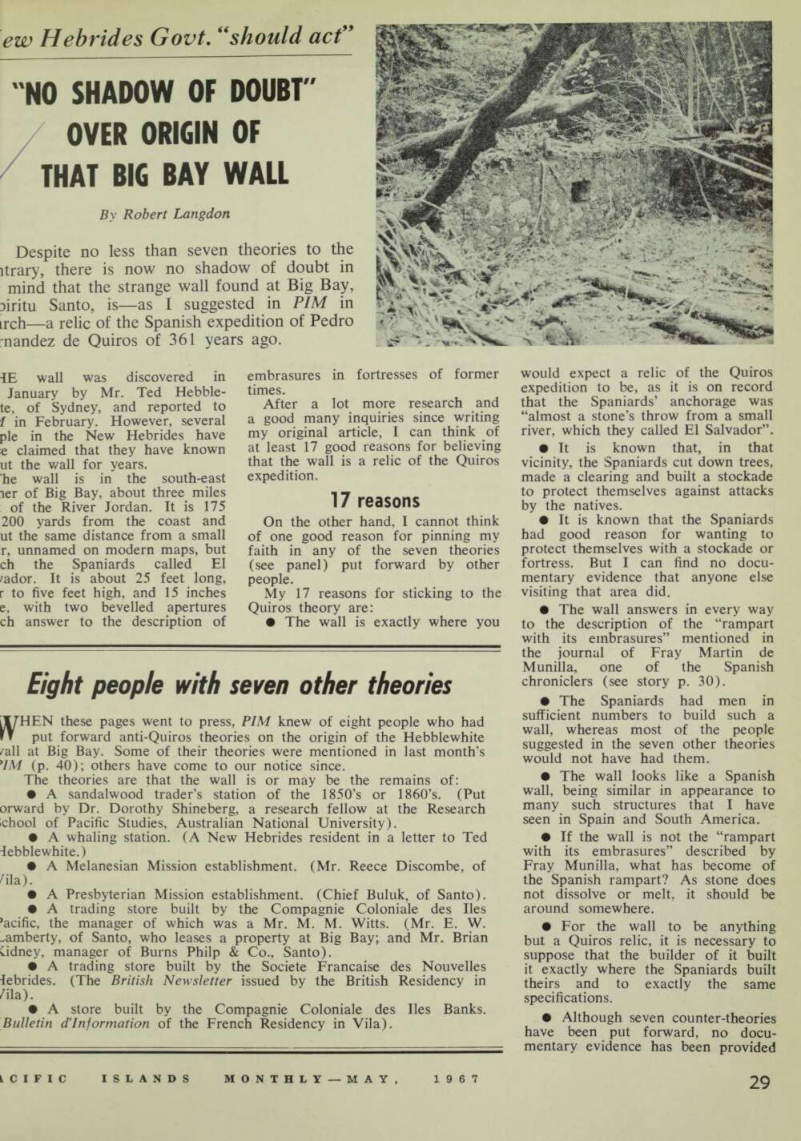
'he wall is in the south-east ier of Big Bay, about three miles of the River Jordan. It is 175 200 yards from the coast and ut the same distance from a small r, unnamed on modern maps, but ch the Spaniards called El /ador. It is about 25 feet long, r to five feet high, and 15 inches e, with two bevelled apertures ch answer to the description of
embrasures in fortresses of former times.
After a lot more research and a good many inquiries since writing my original article, I can think of at least 17 good reasons for believing that the wall is a relic of the Quiros expedition.
17 reasons
On the other hand, I cannot think of one good reason for pinning my faith in any of the seven theories (see panel) put forward by other people.
My 17 reasons for sticking to the Quiros theory are: • The wall is exactly where you
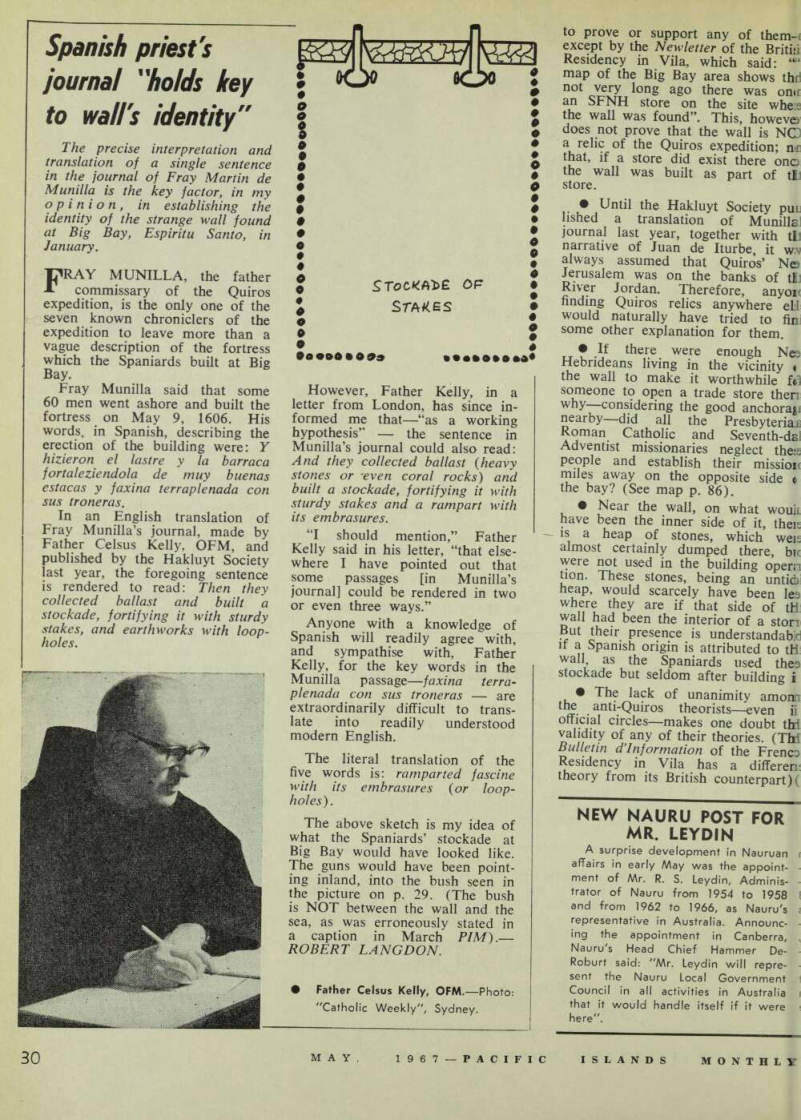
would expect a relic of the Quiros expedition to be, as it is on record that the Spaniards’ anchorage was “almost a stone’s throw from a small river, which they called El Salvador”. • It is known that, in that vicinity, the Spaniards cut down trees, made a clearing and built a stockade to protect themselves against attacks by the natives. • It is known that the Spaniards had good reason for wanting to protect themselves with a stockade or fortress. But I can find no docu mentary evidence that anyone else visiting that area did. • The wall answers in every way to the description of the “rampart with its embrasures” mentioned in the journal of Fray Martin de Munilla, one of the Spanish chroniclers (see story p. 30). • The Spaniards had men in sufficient numbers to build such a wall, whereas most of the people suggested in the seven other theories would not have had them. • The wall looks like a Spanish wall, being similar in appearance to many such structures that I have seen in Spain and South America. • If the wall is not the “rampart with its embrasures” described by Fray Munilla, what has become of the Spanish rampart? As stone does not dissolve or melt, it should be around somewhere. • For the wall to be anything but a Quiros relic, it is necessary to suppose that the builder of it built it exactly where the Spaniards built theirs and to exactly the same specifications. • Although seven counter-theories have been put forward, no docu mentary evidence has been provided
to prove or support any of them-i except by the Newletter of the Britisi Residency in Vila, which said: “** map of the Big Bay area shows thd not very long ago there was omr an SFNH store on the site whe;s the wall was found”. This, howev© does not prove that the wall is NO a relic of the Quiros expedition; ndi that, if a store did exist there ono the wall was built as part of tU store. • Until the Hakluyt Society puu lished a translation of MunillsJ journal last year, together with tU narrative of Juan de Iturbe, it w,v always assumed that Quiros’ Ne Jerusalem was on the banks of till River Jordan. Therefore, anyone finding Quiros relics anywhere eli would naturally have tried to fini some other explanation for them. •.W there were enough Nes Hebrideans living in the vicinity « the wall to make it worthwhile fo] someone to open a trade store then why considering the good anchoragi nearby did all the Presbyterian Roman Catholic and Seventh-dsJ Adventist missionaries neglect the:a people and establish their missioit miles away on the opposite side c the bay? (See map p. 86). • Near the wall, on what wouk have been the inner side of it, theia is a heap of stones, which weis almost certainly dumped there, bic were not used in the building opern tion. These stones, being an untitbi heap, would scarcely have been les where they are if that side of tH; wall had been the interior of a ston But their presence is understandabid if a Spanish origin is attributed to tH: wall, as the Spaniards used thee stockade but seldom after building i • The lack of unanimity amonn the anti-Quiros theorists—even ii official circles—makes one doubt tM validity of any of their theories. (TM Bulletin d’lnformation of the Frence Residency in Vila has a differem theory from its British counterpart) (
i All the documentary evidence t I have been able to find on the tory of Big Bay (see p. 85)
:ually eliminates the possibility
t anyone but the Quiros expedition ild have built the wall. » There is no physical evidence t any European planter has had plantation in the vicinity of the [1 in the past 70 years. There no coconut trees in that area, rough the effective life of a onut tree is about 70 years. » If the wall was built as a tress in the past 70 years, or at r other time since it is rcely possible that its existence 5 never recorded by any visitor to Bay, or that knowledge of its »in should now be confused or gotten. i If the wall was not built as t of a fortress, what are the brasures in it for? n the light of all the foregoing, iclieve that no reasonable person continue to argue that the wall y not be of Spanish origin— ess he has positive, concrete proof the contrary. am certain that no such proof i be found.
Jowever, as some people will bably not be satisfied merely by :umentary evidence or the lack it, I hope that the American haeologist, Dr. Richard Shutler, 0 is working in the New Hebrides, 1 go ahead with his plans to iduct a “dig” at the wall site, and t he will be lucky enough to find nething of indisputably Spanish gin.
There may be one really convinc ing item awaiting a finder—and that is a bottle, or some other container, enclosing a copy of the document by which Quiros took possession of the land he called Austrialia del Espiritu Santo and founded the city of New Jerusalem.
Dr. Shutler could therefore be on the verge of making an exciting historical discovery.
But whether he makes such a dis covery or not, it seems to me that the New Hebrides Government should immediately take steps to safe guard the treasure that has already been found.
This, by a long stretch, is the oldest relic yet found of European penetration in the South Pacific. It antedates by 10 years the oldest relic ever found in Australia —the Dirk Hartog plate, which was nailed on a tree in 1616, and which is now in an Amsterdam museum.
Ted Hebblewhite’s discovery is therefore something quite extra ordinary.
In future years it could well be a popular tourist attraction and moneyspinner for the New Hebrides.
If legislation does not already exist in the New Hebrides to protect sites of major historical interest, I believe it behoves the Administration to enact some quickly—before some rich and enterprising American buys “the rampart with its embrasures” and ships it off to a museum or sideshow in the United States! • See also "Land of Tall Tales/' p 85.