Culture Drain
pp. 28-30 · Read in the full issue
Brings New Look
To Ng Artifacts
Trade
By staff writer KEN McGREGOR
The drain overseas of primitive New Guinea artifacts, which has been going on at an ac celerated rate over the last 10 years, has finally had its effect. Large areas of the territory, parti cularly the artistically-rich Sepik, have now been almost washed out of items worth preserving, and the whole pattern of artifacts collecting in New Guinea has been changed. These are the conclu sions I reached after investigating the situation with dealers and traders, anthropologists, museum officials and P-NG Government officers.
New Guinea and Australia must face it —most of the worthwhile items of primitive New Guinea culture are today in museums abroad, in Europe and America .
And in getting there they have often made fat profits for middlemen.
SOME experts I talked to in Sydney believe that, as a centre of culture and art, the territory has simply had it.
“Anything left is very hard to find, because it would have to be in an isolated region,” said one dealer. “1 have had to go farther afield, and now I am interested only in the Solomons, where it is still possible to get genuine old material.”
Professor R. W. Geddes, Professor of Anthropology at the University of Sydney, told me that old Sepik masks and several other types of native carvings were impossible to find in New Guinea.
The biggest Sydney dealer, Mr.
Stephen Kellner, who has been re exporting artifacts from Sydney for 10 years, estimated that artifacts worth $50,000 had been leaving Sydney every year—and at least $150,000 worth left the territory every year, most of it direct from the territory.
A big Sydney forwarding agent, Youngs Pty. Ltd., in 1965 exported 608 artifacts for Sydney dealers.
Their value varied from $2 to several hundred dollars for a fertility statue.
More than 40 per cent, went to the United States and about 35 per cent, to Japan.
The firm told me of one big pur chase a year ago, when the American department store, C. S. Roebuck, collected 700 artifacts for the Ameri can market.
Official P-NG figures put the value of “native curios” exported in 1964- 65 at $83,900, but the Department of Territories, Canberra, says this figure will be greatly exceeded when the 1965-66 figures are released. And it does not include artifacts taken by travellers in their luggage.
Sepik drums fetch $4OO to $5OO overseas, Mai masks no longer than 24 inches are worth $lOO to $2OO, and big canoes, which have extensive carvings on their sides, have sold for well over $l,OOO, but would be worth a lot more now if you could get them.
Big prices for originals
Private European and American collectors are prepared to pay big sums for original material. Sepik masks, world-famous because of their colour and carving, are constantly in demand.
Until two years ago there was nothing to stop anyone buying genuine old New Guinea art in New Guinea and selling it overseas.
Many Administration officers in the
outback areas have made good mom doing this. Most of the artifae were, and still are, exported throm Madang and Wewak—probably aboc 80 per cent, of them.
In 1965 the National Cultuu Property (Preservation) Ordinam came into force, after it had b©( considered since 1959.
Under this ordinance the trustU of the Papua-New Guinea Museuu Port Moresby, are responsible i issuing permits to export and hsi wider powers of acquisition tW: existed under previous laws.
The trustees can delegate thd authority to District Commissioner and there is a weakness here, becaur the system needs to be policed museum staff members, or others to know their artifacts. District Coo missioners are already heavily bid dened with work without worrya^
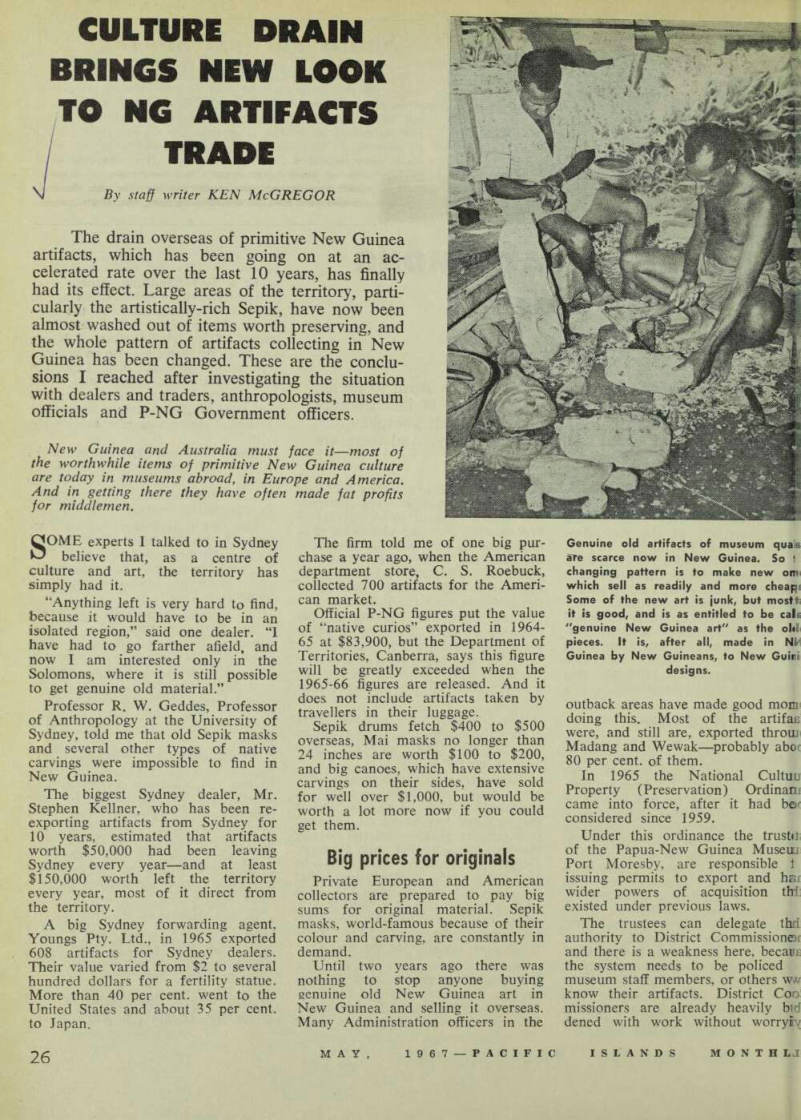
Genuine old artifacts of museum qua[?] are scarce now in New Guinea. So[?] changing pattern is to make new on[?] which sell as readily and more cheap.[?] Some of the new art is junk, but most[?] it is good, and is as entitled to be cals[?] "genuine New Guinea art" as the ol[?] pieces. It is, after all, made in N[?] Guinea by New Guineans, to New Guin[?] designs.
siting collectors will be checked in future
ut the finer points of permits, so 5 still possible to export rare items lout real difficulty.
E the museum decides that any facts are of unique cultural value / can ban their export. The Ad istration has not in fact withheld nits from accredited museum col ors for export of pieces collected e the ordinance was introduced.
Jenuine museum collectors and ntists have donated many pieces the territory museum and have a willing to collect artifacts for museum when they have been ;d to do so.
Tiat does not mean that all over ; collectors in New Guinea have a honest. renuine artifacts have been ex ted under permits issued for non nine ones, and natives have been ped by dishonest dealers. But the ves today know values. l ruse which has frequently been ;tised in the past is for visitors daim they are collecting for over i museums when in fact they are ely middlemen who will offer Pacts for sale to the museums, filer overseas museums have often a glad enough to give these dlemen letters of accreditation, e they stood to gain some pieces n the expedition, even if only a .11 portion of what is collected. middleman has sold most of it the highest bidder.
No Australian interest
Inly recently there was an example his which has so annoyed territory dais that future collectors can be ired that their credentials will be dully scrutinised. lost material goes overseas be se Australian agents claim there no genuine private collectors in tralia, where, they say, little is wn about New Guinea primitive mstralian museums, the dealers aren’t interested. A big Sydney ler said he offered a rare canoe to a Melbourne university. The /ersity said it would pick up the ae from New Guinea through the ler’s agent. But the university i’t contact the agent and as a lit the canoe was given to some else. mother Sydney dealer, Mr. Robert ;s, said he offered a 14 ft Upper ik canoe to the Australian seum, Sydney, for ssoo—after an erican proposed giving him $l,OOO
for it. The museum turned him down and the canoe is now in Alabama. , The museums say that they haven t got the money, and that they are overstocked anyway. The Australian Museum has far more New Guinea material in its vaults than it can find room to display.
Mr. Roy Mackay, preparator-mcharge of the Papua-New Guinea Museum said that the museum could not afford to buy all the material available to it at present but added: “I should like to point out that as a result of the museum’s development over the past two years, since it has had effective staff, the acquisition of artifacts last year totalled 1,500, which is three times the total of acquisitions for any previous year, Already, the material to be brought in from New Guinea outstations— at great cost—points to this being another very productive year.
“The museum has no field staff and cannot afford them. To be able to compete with overseas museums we must be in a position either to pay the same prices or to restrict dealers to the sale of newly manufactured items.”
A spokesman for the New Guinea Administration in Port Moresby, said native artifacts were prone to decay in their normal state, “and in
a changing society such as New Guinea today it is better for genuine articles to be preserved in museums rather than be left to rot”. Adminis tration patrols often collect artifacts as part of their routine.
He added: “The Administration has never been in a position where it could afford to purchase every piece of museum quality collected. In any case there is no reason why it should do this, as most cultures produce only a few different articles. For example, the Elima people produce literally hundreds of different designs on Gope boards, but they are all Gope boards. No one museum could have the finance available to purchase everything offering.
Costs go up
“Although a piece may be pur chased for a small sum in a remote village, by the time the cost of the patrol is added, the cost of getting each piece to the post may be 10 or 20 times the price paid for it. Break ages and losses could bring this figure even higher.”
The official said that of every 100 pieces exported there would be fewer than one of museum quality. The Administration was satisfied if genuine pieces went to other museums.
He added, “The vast majority of pieces are today made purely for commercial purposes. The Adminis tration is interested in building up trade in this field as it offers a source
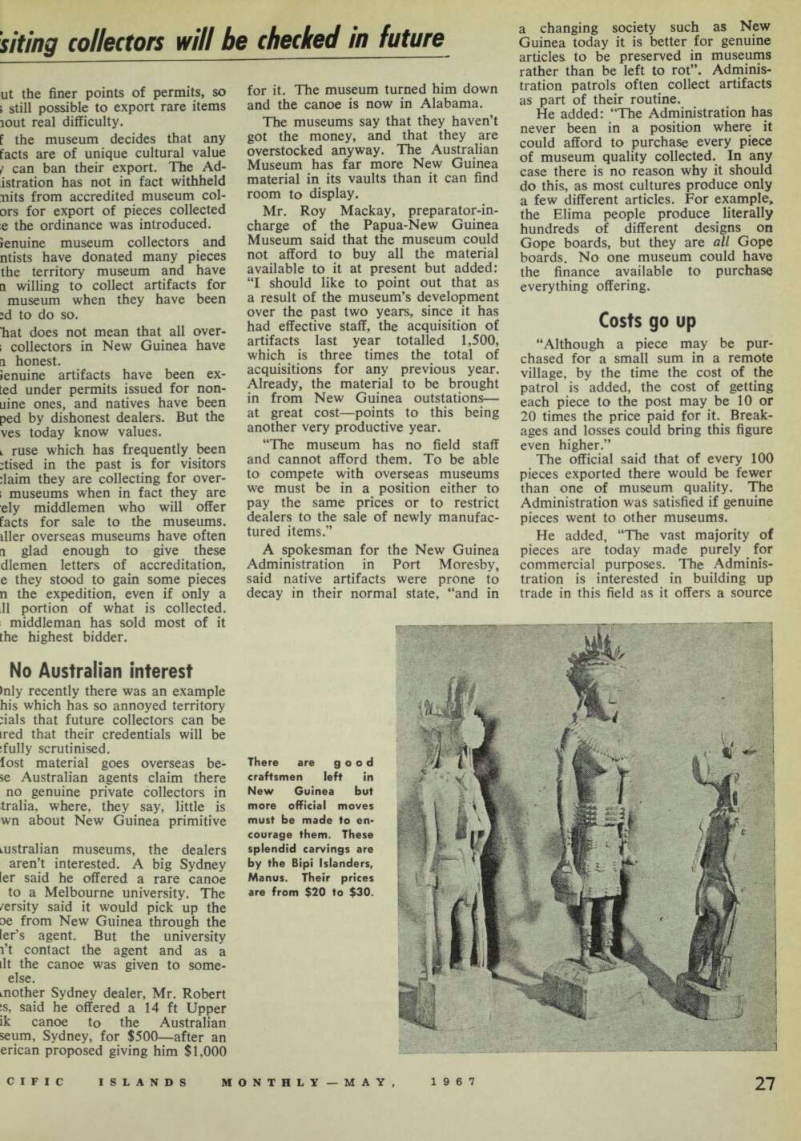
There are good craftsmen left in New Guinea but more official moves must be made to en courage them. These splendid carvings are by the Bipi Islanders, Manus. Their prices are from $20 to $30.
Genuine artists should be helped'
of income for many New Guinea people who have little opportunity otherwise for a cash income.”
The official thus put his finger on the changing trend.
The days of large-scale collections of NG artifacts are over. Of the old pieces of individual art still left even the big dealers find the prices beyond their means. Commercial curios are now the vogue.
Mr. Mackay put it this way: “At the same time as these collec tions were made and taken to over seas countries a fashion or cult of primitive art evolved. This fashion appears to be reaching its peak and with it the commercialisation of the traditional art forms is rapidly de veloping to meet the demand of primitive art galleries, private collec tors and tourists.
“Much of this can be very good for the native manufacturers, as it tends to maintain their skill in carving and their knowledge of form and colour.
“This side of things might be con sidered distinct from the requirements of art museums and ethnographic or ethnological museums, where the material culture of peoples is pre served for serious study and for everyone to see and admire.
"A major crime"
“One of the major crimes com mitted by dealers has been the trans fer of unique carvings, paintings and other artifacts into the hands of private individuals who, for their own lifetime, might enjoy having the specimens hanging up on their sitting room walls, collecting dust and gradu ally being destroyed by termites or borers.
“Eventually these specimens lose their value with the loss of docu mentation and so become entirely lost to science, to the people’s own cultural heritage and to public educa tion.”
Mr. John Pasquarelli, well-known Sepik trader and member of the P NG House of Assembly, who is the official collector for the Sepik District for the Territory Museum, believes the last really big shipment of genuine pieces left the Sepik six months ago, headed for the Basle Museum.
He said. “In the Sepik today the large-scale manufacture of new ‘tourist’ material is the vogue. The smaller dealers tend now to concen trate on the purchase of this newer material and some of them have tried
to pass off this new material as a genuine article. This has led to a somewhat diminishing reputation for Sepik art.
“The local government councils are also to blame, as young unin formed native clerks and European patrol officers have over-zealously purchased large quantities of this new art, and have paid prices out of all proportion. The inflationary trend has led to a fall-off in quality and has encouraged faking.”
Mr. Pasquarelli said that the Sepik missions had helped mass-production take place. The Catholic Mission at Wewak (which is certainly the largest single exporter) had “virtually a mass-production workshop” and cer tain controls should be introduced in the Sepik to help preserve the repu tation of Sepik art.
Education needed
Mr. Pasquarelli said the trustees of the museum had been approached on the matter and it had been suggested by the P-NG Chief Justice, Sir Alan Mann, that it would be beneficial if native local government clerks could be educated in the purchase of Sepik art, so they could differentiate between a good or bad article.
All agree that missions in the past have destroyed much genuine art in their zeal to civilise the people, but attitudes have now changed. Some Sepik natives have even been to the missions in an effort to obtain some sort of reparation for artifacts and ceremonial houses destroyed by mis sionaries before the war.
But neither Mr. Pasquarelli nor any other experts in New Guinea see the position as hopeless, and that’s the important thing. There are still a large number of genuine native artists at work in the Sepik, and these must be encouraged so they can hand on to the next generation.
There's hope left
Mr. Pasquarelli suggests that genuine artists could be assisted if the Territory Museum could provide some sort of scholarship to augment their supply of tools, or to help them travel.
He adds: “The Territory Museum still has a long way to go, but with the co-operation of local and overseas dealers, and the missions, all need not be lost.
“Overseas authorities have told me that the Territory Museum now has a great collection of Melanesian art.
The museum simply needs more finance and more space to preserve what it has and what is left in the territory.”