West-And, Oh, That
pp. 24-25 · Read in the full issue
Move For Union In Samoa
East Is U.S. And West Is
The Twain Shall Meet!
By a staff writer
A move by two American Samoan senators in late March to seek ways of welding Western and American Samoa into one political unit appears to have fallen on rather stony ground— at least for the time being. But it shows that, even after three generations of separation, there is still a strong feeling of kinship among the people of those islands.
THE two Samoas have been politic ally separate since 1899, when Germany annexed Western Samoa and the United States assumed sovereignty over the eastern islands.
The eastern islands have remained under the US flag ever since; but Western Samoa was under New Zealand control—first as a League of Nations mandate and later as a United Nations trusteeship territory— from World War I until it achieved independence in 1962.
"Immediate exploration"
The move for a union of the two Samoas was made by Senators Rapi Sotoa and Mulitauaopele by means of a joint resolution introduced in the Tenth Legislature of American Samoa.
The resolution says it would be im perative that the political union should be under the protection of the United States, but it does not make any suggestions on the nature of this protection.
If passed, the resolution would ask the United States Secretary of the Interior to negotiate with the State Department “the immediate explora tion of all possible means” of uniting the two Samoas.
The resolution is the first attempt for many years on the part of Samoans in either Western or American Samoa to have the union of the two Samoas discussed on an official level.
There was a mixed reception to it among politicians in American Samoa; and almost complete silence about it elsewhere.
The main points of the resolution are that: • There is a strong desire on the part of many people of American Samoa to form a union with the people of Western Samoa, with whom they have many ties of kinship and culture. • A union of Samoa is the ulti mate desire of the people as a race, inasmuch as American Samoans and Western Samoans are one people and
one colour, with the same langusi and culture—“an existing race of tt Great Polynesia”. • No matter when Samoa w united, American Samoans would n consent to any union without the pic tection of the United States.
In a discussion on the resolutit in the American Samoan Senate, t president, Lauvao-Lolo, said he w sure that some Western Samcoi
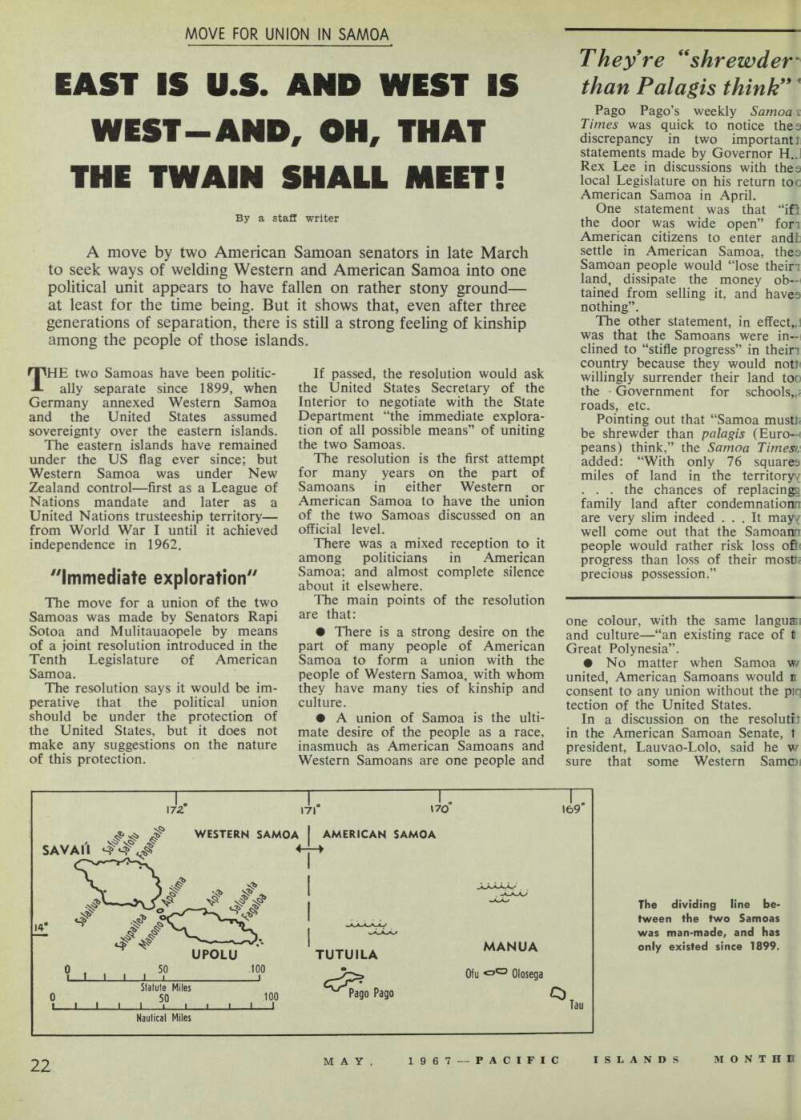
The dividing line be tween the two Samoas was man-made, and has only existed since 1899.
ials would not be receptive to idea. He added that there would nore support for it in Western oa on Savai’i than on the main d of Upolu. ther comments were that while idea behind the resolution was Ilent, it would have been better andle the matter fa’a Samoa (in Samoan way) than through the ; Department and the New and Government (which would to become involved because it lies Western Samoa’s external rs). ae American Samoan senator “The official approach would specially unfortunate considering t’afa’s recent remarks on Dean ;, and his attitude of ‘no money, riendship’. It would be better if lington and Wellington were told decision by the Samoan people, ad of being asked to conduct ligations.” te Samoa Times, of Pago Pago, i editorial on the resolution, said: hould be the occasion for wide, st discussions on the hopes and tions of the whole Samoan race.”
"Silly barrier"
e idea that the two Samoas Id be united was strongly urged IM in January, 1955, when the editor, Mr. R. W. Robson, said “if the silly political barrier were m down” and American Samoa’s )my were joined to that of the , the problem of how to provide ■ican Samoa with an overseas ne would be solved overnight, nerican Samoa, at that time, was e financial doldrums because of vithdrawal, a few years earlier, e US Navy from the Pago Pago base. Western Samoa, on the hand, was “rich and comfort ’ because cocoa-production had established as the chief industry ddition to coconut-growing long ago”. >w, however, the boot is on the foot. :stem Samoa, with a population 140,000 and a land area ore than 1,100 square miles, is g a lean time because of ageing mt plantations, crop pests and factors. :anwhile, the 20,000 American ans are having a reasonably easy of things thanks to massive Duts from the United States for us projects over the past six