But the pirates are not all dead!
pp. 22-138 · Read in the full issue


• Happy with your local shopkeepers? Get a fair deal from them always? Get good, friendly servlv that makes you want to go back again? Retorts this Suva housewife, "Not on your life!" If you agree wiv her, wherever you live, and have some pet hates of your own, let off steam through RIM. It may help to o things changed.
From JANE GREGOR, in Suva Ask the female residents of Fiji about shopping and you will see flashing eyes and hean indignant stories. The males of the community, coming less frequently into contact with the shops, t may make tolerant noises in the background and endeavour to ensure that their womenfolk only \ fume gently. . . .
BUT, for once, the women are right; there’s cause for com plaint.
Too many housewives around Fiji can tell tales of old stock, particularly of foodstuffs, being sold without due warning or a price reduction; of prices which are far in excess of what they need be; of unfair methods in too many shops.
Most people are aware of the high cost of freight and duties. And most people who can afford to buy im ported goods at all are willing enough to give the merchant his fair mark up. But fair is the operative word.
Take the case of a young Nausori wife who, recently back from a trip overseas, gasped at the Suva price of breakfast cereal . . . three times what she’d been paying while on leave. Meeting a local citizen who also happened to be a reporter, she exploded her righteous indignation at him. Next morning, The Fiji Times told the story, asked why such a popular food should need such an elevated mark-up and . . . happy ending ... the day after, that break fast cereal in one particular store, at least, was cheaper by quite a substantial amount.
Daylight robbery!
The humble but essential plastic laundry basket, too, can be picked up overseas for a few shillings in any popular-price chain store but after it has travelled a few hundred miles to Fiji it costs something like four times the amount it retails at “back home”. Now that seems to me just a little on the greedy side.
And for sheer daylight robbery, another case takes one’s breath away.
In a Suva shop you can have the choice of a bottle of milk or a bottle of cold milk from the fridge; but you’ll have to pay fourpence extra for the cold one!
There are dozens of similar stories
being told by the shoppers of Fiji, who are growing so resentful of being taken for suckers that a Con sumers’ Association has now been established to try to create a better state of affairs between shopper and shopkeeper.
Another anomaly which strikes me as odd, in this land of the widely proclaimed “duty-free” bargains, is that some transistors and cameras, as well as perfumes, prove to be far more expensive if bought in Fiji than if bought in their country of origin.
Bitter complaint
One bitter complaint of Suva residents in particular is the often too short shrift given to locals in the teeth of competition from the tourists.
Especially frustrating in this respect are the Indian tailors who will blithely keep a regular customer
dangling for weeks while they rm off orders for tourists.
I see their point . . . tourists doo have time to be critical about altoJ ations; they’re not in a mood to finicky, they pay up and they g Which is good if your businer method is merely to take as muir as you can get the easiest way poc sible.
I think, and so do many Suu residents, that it would be muu smarter to pay attention . . . real ; tention ... to building up a nuclei of good, satisfied, regular customes through them, as many merchasi kings of the past have found, comtn eventually, the best foundation ft profits.
The same grumble over tourih preference applies to shop hours. H maddening for working wives . i, or husbands, for that matter . , . .
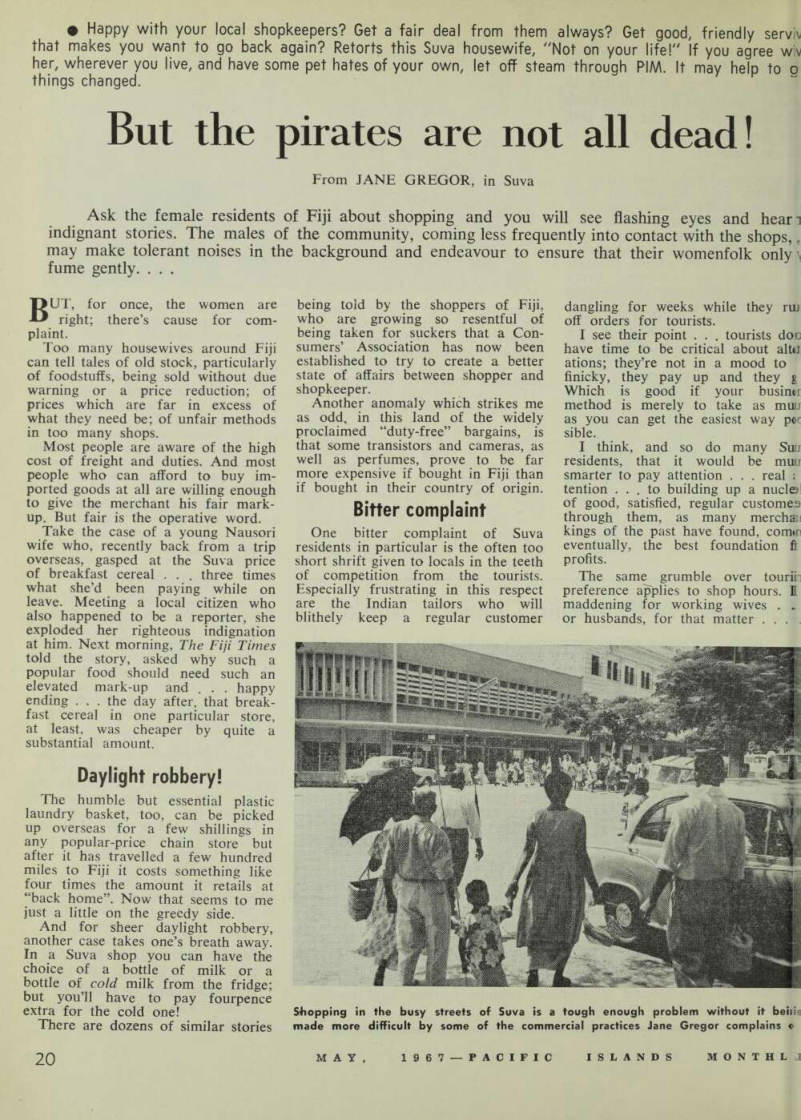
Shopping in the busy streets of Suva is a tough enough problem without it beilis made more difficult by some of the commercial practices Jane Gregor complains
lable to shop during lunch hours to have shop doors shut in our as we try to make the most lucky break in finishing work minutes early some afternoon, often our clock-beating spurts to that essential forgotten item end But it’s even more :ing when you see that shop ts find no difficulty whatsoever ening at the most unlikely hours if there’s a tourist ship in. ere are many lesser complaints.
Dr service is one you hear over over again; here, I blame the :eepers . . . not the sales staff, itions of service for most sales and women are not good and ng appears to be, in most cases, lal. i you, then, blame the counter who can’t be bothered to even what they do stock, let alone d find out if and when a specific :an be obtained? Like the young /ho, pointing to three scraps of ling, curling-edged ham on a tray, the other morning, ly informed me that was all the the supermarket had. tunately for me, a senior sales whom I have often dealt with, nost happily, came along and le matter right. as lucky, but too often shoppers 3t. And, merchants please note, >nly is the would-be shopper ited, but she’s just slightly more against that particular store time such an encounter occurs, at it’s not only the immediate /hich is lost. ie of these incidents can, of :, be put down to the growing natural among an emerging
country’s peoples.
But other trading practices are carried on by people who should know better.
Why, for instance, do shops sell inferior quality “seconds” without always telling the shopper what he’s really getting for his money?
A friend of mine discovered a piece of cloth, bought in good faith as first quality material, had, in fact, a large fault in it; when she returned it to the shop where it had been bought she was told she should have noticed it at the time.
When I heard this story I remembered that, as a newcomer to Fiji, I was warned by an “old-hand” that much of the merchandise sold was, in fact, seconds and to
beware. Unhappily, my informant was not wrong.
But when you move into the big money items and still find they are too often faulty, you really do begin to wonder if the days of piracy will ever end.
It is a sad fact that every major item I’ve bought in Fiji, that “shopper’s paradise”, has proved faulty. Sometimes seriously so, some times only to the extent, for example, that a slide-projector had a large smear across the lens which I could not get at.
Being a resident, I can get these things rectified by taking my purchases back, which is tiring and time-con suming. But one doesn’t expect to pay £5O for a tape recorder, let us say, only to have the mike pack up on you a month or two later; or for a record-player which unaccountably changes speed in mid-record.
Maybe there are good, simple answers to much of this . . . like packages being clumsily handled . . . but after a run of unsatisfactory buying of what to me are major items, I begin to harbour dark thoughts.
Can it be . . . even in this price bracket . . . the tailor/tourist story all over again . . . “Sell ’em any thing . . . they’ll never be back to complain”?
(Continued on p. 132)
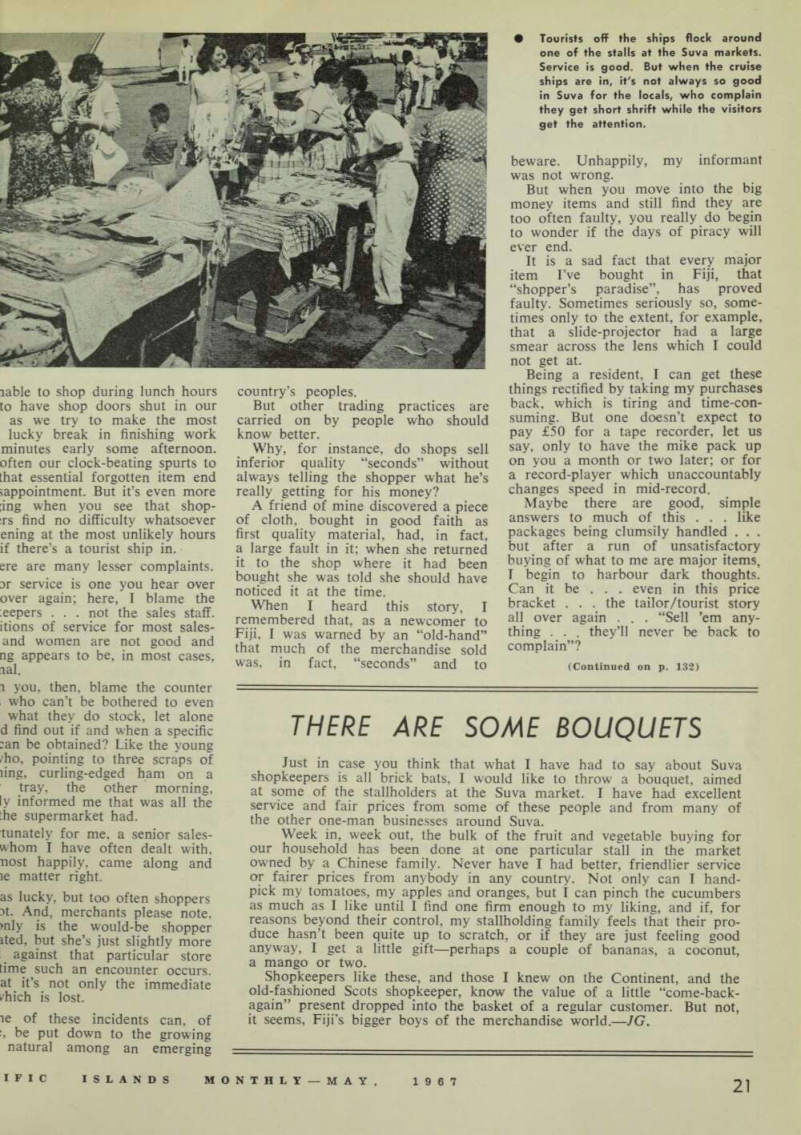
Tourists off the ships flock around one of the stalls at the Suva markets.
Service is good. But when the cruise ships are in, it's not always so good in Suva for the locals, who complain they get short shrift while the visitors get the attention.
Delicate mechanical toys such as we all love to acquire in this gadget happy age can, obviously, be easily damaged in transit to our “far-away” isle but isn’t it the vendor’s respon sibility to inspect such items before he sells them? Or . . , surely it can’t be that, in this field too, there are devious ways of buying-up inferior quality goods which can then be passed on to an unsuspecting public at top-quality prices?
Surely not. Such thoughts are onl>
the feverish aftermath of a dose < Fiji shopping?
And yet, the episode which ii flamed me most, in recent weeks, wi certainly not imaginary.
I bought a new camera with a flas attachment especially because wanted to record the imminent bloon ing of a nights-flowering cereus i the garden. All went well until I signed the cheque. Only then did tl salesman “remember” to tell me th: the shop was out of the batterii needed to operate a flash earner But they’d be in soon.
I was disappointed but ui suspicious, I watched the buds c my cactus grow fat and went in agai for the batteries. This time I wj told by another salesman that n< only were the batteries not obtainah but were unlikely to be so . .
“nobody has them at present” I w« told blandly . , . “not even Ne Zealand”.
“It may be weeks or months,” I went on. But at that point I cease to be a polite but disappointe customer. 1 informed the young ma that I had handed him the full pric for a camera including batterie flash and film ... in exchange he' only sold me what amounted, for m purpose, to half a camera and he' better do something about it!
He did. But why not in the fir place? Was this “sale” worth tl reaction?
Then there’s the matter of pric differential. Brand goods are so] with huge differences in various shoi not yards from each other, in mo; of Fiji’s towns. In Suva, for instano a certain roll of film is obtainab] at three different prices, and th variation is eight shillings!
“Caveat emptor” is a time-honoure Latin phrase meaning that it’s up t the buyer to take reasonable pr< cautions to see that he’s not handin over his hard-earned cash foolishly You will tell me that buying an selling still retain something of sporting element all over the work All right, fair enough!
But I can’t suppress a sneakin suspicion that some of the tradin habits operating currently in Fi; smack too much of the method brought here by the 18th centur pirates. They made their profits b trafficking in sandalwood, beche-de mer, mother-of-pearl, and, when i suited them, human beings.
Those pirates may be dead, bn something of their spirit lingers.