Cost Of Living Increase
pp. 20-21 · Read in the full issue
Cook Islands Hard Hit By
From W, H. Percival in Rarotonga Recent heavy increases in the cost of living in the Islands are expected to become an added incentive to many \ Cook Islanders to emigrate to the El Dorado of New Zealand, f where unskilled and semi-skilled workers can earn at least five t or six times as much as they do at home.
SHORTLY after the New Zealand Government vessel Moana Roa arrived at Rarotonga on March 22, the prices of basic food lines such as bread, butter, and canned meat rose alarmingly.
The cause of this was the New Zealand Government’s decision to remove subsidies from wheat, flour and butter.
The New Zealand price increases were naturally passed on to the Cook Islands.
Many other food lines, such as biscuits, breakfast foods, milk powder, evaporated milk, vermicelli and spaghetti, were also affected.
Cook Islanders with large families and low incomes were the hardest hit, especially outer islanders living in Rarotonga. These people have no land on which to plant, and most of their income goes on food and rent.
Tougher still
Ironically, the people who will have to pay the highest prices for basic food lines will be the inhabitants of the northern atolls who can export only limited amounts of copra and dwindling supplies of pearl shell. In addition to paying the highest freight rates in the Cook Group, boating charges from ship to shore and extra cartage costs are added to the already high costs of the canned food they buy.
Life in the outer islands has always been tough, especially in the northern group—and these sudden price increases can only accentuate the people’s problems.
The first price increases to be announced were: Flour in 160 lb sacks, £2B/7/6 per ton (an increase of £2/11/6); butter, lOd per lb.
The Premier, Mr. Albert E.
Henry, said in early March that to alleviate and stabilise prices, the Cook Islands Price Tribunal would
be brought into operation immeo ately.
All prices for goods and servio were to be maintained at existiiJ levels until increases had bea< authorised by the tribunal.
Mr. Henry also made these pointn • Although the Government w firmly of the opinion that wage an salary levels should be stabilised, J acknowledged that workers on ba:£ rates of pay might have stroD grounds for an increase. • Old age pensions, which & fixed by enactment, would be i viewed when the Legislative A sembly met later this year.
O The position of Public Serviv salary earners would be discusses with the New Zealand Governmeie which had met the cost of ruliil rate survey increases in past years..e • Everything possible would done to mitigate the effect of tt inevitable increases in the cost living.
The Premier went on to request tJ
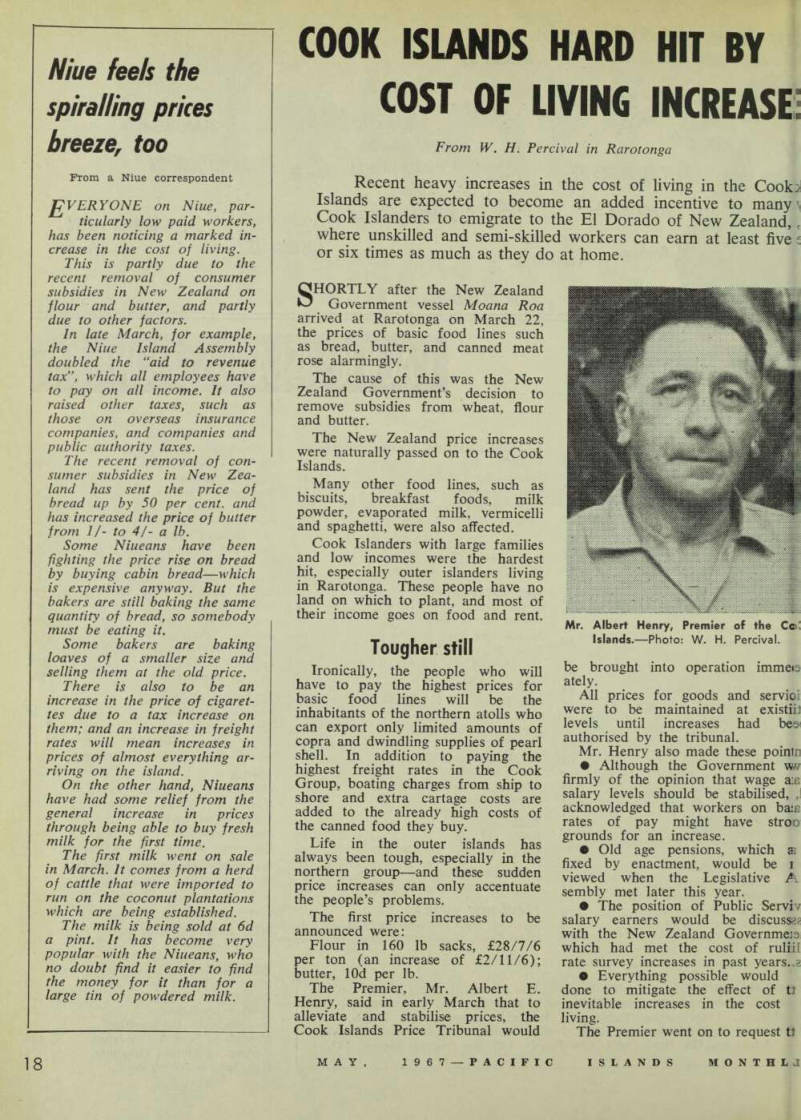
Mr. Albert Henry, Premier of the Co Islands. Photo: W. H. Percival.
peration of traders and bakers in mising price increases in basic commodities. Planters and copra ucers were asked to make every t to increase production.
"here is,” he said, “an unsatisfied and for many export products for fruit for processing. Every t should be made this year to est our crops. By this means :an recover more than the extra of the essential foodstuffs on h subsidies have been lifted.”
Prices pegged
ie Cook Islands Price Tribunal for the first time on March 16, issued a Price Order pegging prices of all goods and services le prices charged on that date, ie tribunal made it illegal for is not covered by Price Orders >e increased without its prior oval. lis action ensured that prices d not be increased until after the al ol new stocks on the March na Roa.
Because price control covered
"*sees ".he inviteJ “the
services, the tribunal invited the chamber of Commerce to present a st S ooc * s and services that they considered should be exempted, To save time and frustration in the outer islands, the tribunal dele gated its powers to the Resident Agents and Clerks-in-Charge, enabl ing them to deal with applications for price increases on the spot, The next Price Order issued showed that bread prices on Raro tonga had jumped by 50 per cent, A 24 to 27 oz loaf now costs 1/6 instead of 1/-, and smaller sized loaves have become correspondingly dearer.
After the Moana Roa shipment was received, shoppers discovered a few more hard facts.
Butter had leapt from 2/8 to 3/7 per lb; a 12 oz tin of first grade corned beef now costs 4/9 against the previous 4/-, and a 12 oz tin of second grade corned beef costs 3/8 instead of 2/8. A 2i lb tin of full cream milk powder, which is essential for rearing infants when the mother cannot provide breast milk, rose from 9/6 to 10/5.
Breakfast foods had also risen. A li lb packet of malted whole wheat biscuits now costs 3/9 against the former price of 3/3. There were many other price rises.
Passenger fares up
Even before the increases, the four-fifths of Rarotonga’s working population, which existed and perhaps supported a wife and four children on the basic wage—about £5 per week—had found the going more than tough.
The going, it need not be said, is going to be a lot tougher now.
But that is not all.
On April 13, the NZ Department of Island Territories announced that freight rates and passenger fares to and from the Cook Islands in the Moana Roa would be increased the following day.
The cargo charges would go up by 15 per cent, and the fares by 10 per cent. —due to the rising cost of running the ship.
This means, of course, that it’s going to be even more expensive to get to El Dorado than it used to be. • For another angle on high prices and the problems of Islands women working to a budget, see p. 20, "The pirates are not all dead!"
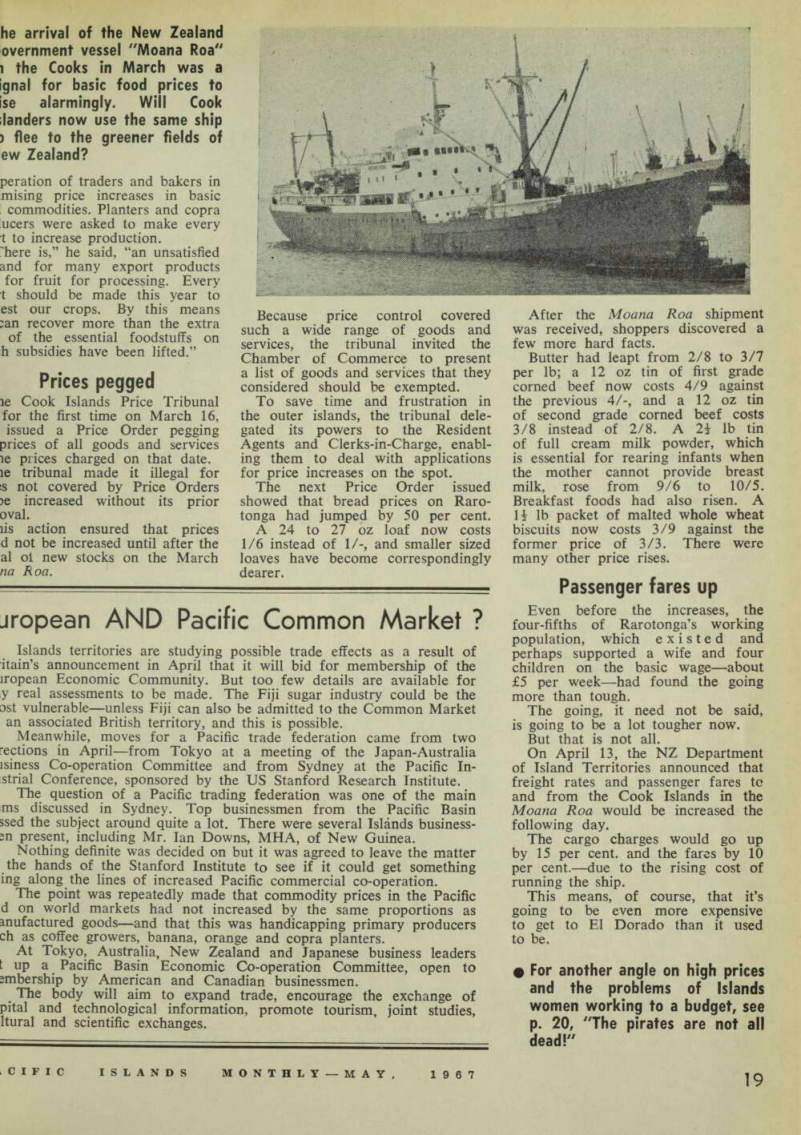
he arrival of the New Zealand overnment vessel "Moana Roa" [?] the Cooks in March was a [?]gnal for basic food prices to
se alarmingly. Will Cook
landers now use the same ship ) flee to the greener fields of ew Zealand?