Will a grading system help
pp. 147-148 · Read in the full issue
Bixsiness sljcicX
Will a grading system help New Guinea contractors?
From a staff writer in Port Moresby A plea made in the P-NG House of Assembly in March, aimed at solving the problem of territory building contractors “devouring each other”, highlights some of the difficulties of the local building industry.
HE call was made by an elected member, Mr. lan Downs, who is o a member of the Administrator’s uncil. Speaking on the Appropri >n Bill, he criticised the waste of ilic money on the territory’s road Iding programmes and asserted t road and building contractors re not being properly used by the vernment. ie said the attitude of “most per is” in both the Commonwealth partment of Works and the P-NG partment of Public Works was to it contractors “compete against h other as much as possible, to :p them on the run, keep them off ance, exploit them as much as isible”.
Multiple tenders were offered to ake the thing as confusing and as : icult as possible”, said Mr. Downs, ling that on the slightest excuse Government then often decided do the work on day labour or else rt another contractor up from Aus lia”.
Mr. Downs said there was urgent •d for the Administration to get ether with the contractors. It uld be surprised at the potential the contractors once the Works >ple took them into their confi ice and worked out a proper pro mme.
Plenty of work
‘There is more than enough work every contractor in this country t it is not being properly used,” d Mr. Downs. “And some of them ! without work because specifica ns and designs are not ready for m.
He added: “I believe that you will a lot more done here if you make ; of your contractors and stop m devouring each other.”
Ferritory contractors would agree h Mr. Downs. There are too many milt snares for contractors in the ritory’s current building boom.
Some leading builders are pressing for a graded system of contractors, and they are talking of making an approach direct to the Minister for Territories, Mr. Barnes.
There are also moves for more selective tendering to be adopted in the territory, and there is some hope that statutory bodies will give a lead on this, such as the P-NG University.
Graded systems are not new, nor is the current argument in the terri tory about whether they are good or not.
One man who would support a graded system is Mr. H. H. Stubbs, managing director of John Stubbs and Sons Pty. Ltd., a company which established itself in Papua in 1940.
The company employs 70 Europeans and 350 New Guineans and is cur rently building sections of the new Administrative College in Port Moresby.
“The basis of a graded system,” says Mr. Stubbs, “is that before a builder is allowed to tender for a contract he must have proved that he
has the assets and the backing to carry the job through. This way clients aren’t let down by carpenters with a kit of tools under their bed claiming to be contractors.”
There are those who point out that many big contractors started with a kit of tools under their bed, and that the grading system can be an unfair method of control.
Under a typical grading system con tractors are graded according to the size of contract work they have the finances and equipment to handle and they cannot go above their grad ings.
The bigger contractors can come down one or two grades to tender for work they might need to keep their teams together. But they are not allowed to drop further than this, nor in fact would it usually be possible for them to do so because smaller contractors with lower overheads are better placed to handle smaller con tracts.
Overstretching
For all those who say this system prevents the smaller man from ex pand i n g, there are others who point out that it also prevents the smaller man from over-expanding, or the big man from devouring him.
Overstretching is one of the weak nesses of the territory’s building in dustry.
It was probably at its worst four or five years ago, when many leading foremen and small sub-contractors who were brought to the territory by big firms engaged in multi-million dollar projects, started tendering on their own account in the hope of making real money.
Most soon went broke, or decided the game wasn’t worth the candle, but they caused a lot of trouble in the process. Some of those who sur vived, survived because of luck. As one experienced territory builder put it, “We’ll never know how many
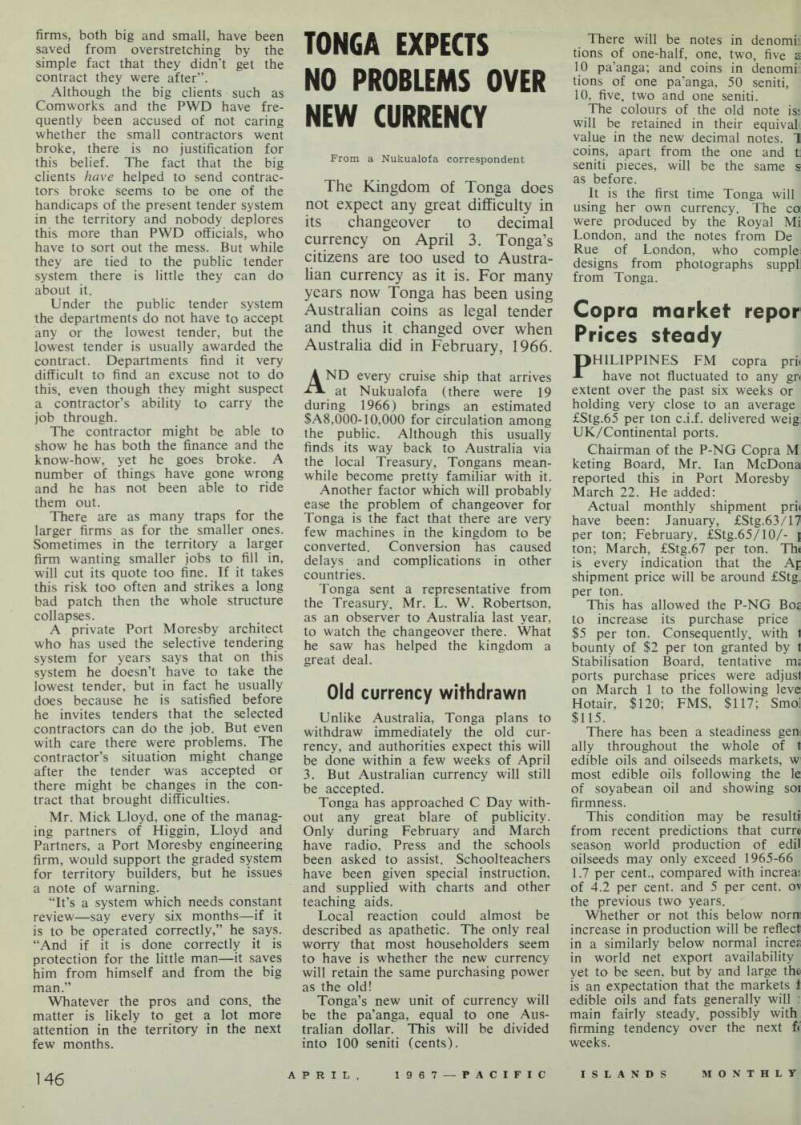
Mr. lan Downs
firms, both big and small, have been saved from overstretching by the simple fact that they didn’t get the contract they were after”.
Although the big clients such as Comworks and the PWD have fre quently been accused of not caring whether the small contractors went broke, there is no justification for this belief. The fact that the big clients have helped to send contrac tors broke seems to be one of the handicaps of the present tender system in the territory and nobody deplores this more than PWD officials, who have to sort out the mess. But while they are tied to the public tender system there is little they can do about it.
Under the public tender system the departments do not have to accept any or the lowest tender, but the lowest tender is usually awarded the contract. Departments find it very difficult to find an excuse not to do this, even though they might suspect a contractor’s ability to carry the job through.
The contractor might be able to show he has both the finance and the know-how, yet he goes broke. A number of things have gone wrong and he has not been able to ride them out.
There are as many traps for the larger firms as for the smaller ones.
Sometimes in the territory a larger firm wanting smaller jobs to fill in, will cut its quote too fine. If it takes this risk too often and strikes a long bad patch then the whole structure collapses.
A private Port Moresby architect who has used the selective tendering system for years says that on this system he doesn’t have to take the lowest tender, but in fact he usually does because he is satisfied before he invites tenders that the selected contractors can do the job. But even with care there were problems. The contractor’s situation might change after the tender was accepted or there might be changes in the con tract that brought difficulties.
Mr. Mick Lloyd, one of the manag ing partners of Higgin, Lloyd and Partners, a Port Moresby engineering firm, would support the graded system for territory builders, but he issues a note of warning.
“It’s a system which needs constant review—say every six months —if it is to be operated correctly,” he says.
“And if it is done correctly it is protection for the little man—it saves him from himself and from the big man.”
Whatever the pros and cons, the matter is likely to get a lot more attention in the territory in the next few months.