Where Things Are Still As They Were
p. 107 · Read in the full issue
ALTHOUGH many time-honoured cultural traditions have disappeared in the main centres of Polynesia, in the out-of-the-way islands the people still do some things in much the same way as they have for centuries.
On Raivavae in the scattered Austral Islands of French Polynesia, 400 miles south of Tahiti, the Polynesians still make their elaborate dugout canoes without using a single metal fastening.
David Fletcher, of the New Zealand yacht Matatua, discovered this when he called at the island last year. He told PIM about it when he visited Sydney in March.
“The islanders use the trunk of a large tree for the hull of their canoes,” he said. “The canoe is shaped by adzing and burning out the trunk. Then they cut small holes in the sides of the boat and lash extra pieces of timber on to give more freeboard. They make the lash ings from long strips of coconut leaves which can be up to eight feet long. These strips are hand-plaited and are invaluable as very strong lengths of rope.
“Outriggers are shaped out of smaller trees and attached to the canoe with braces and further lashings. The whole canoe, about 20 feet long with accommodation for a dozen people, or more if they are children, is held together by hand-made lashings.”
Mr. Fletcher said there were about 300 people on Raivavae and every family had a canoe to paddle across the lagoon or collect coco nuts from the many motus (islands) on the reef surrounding Raivavae.
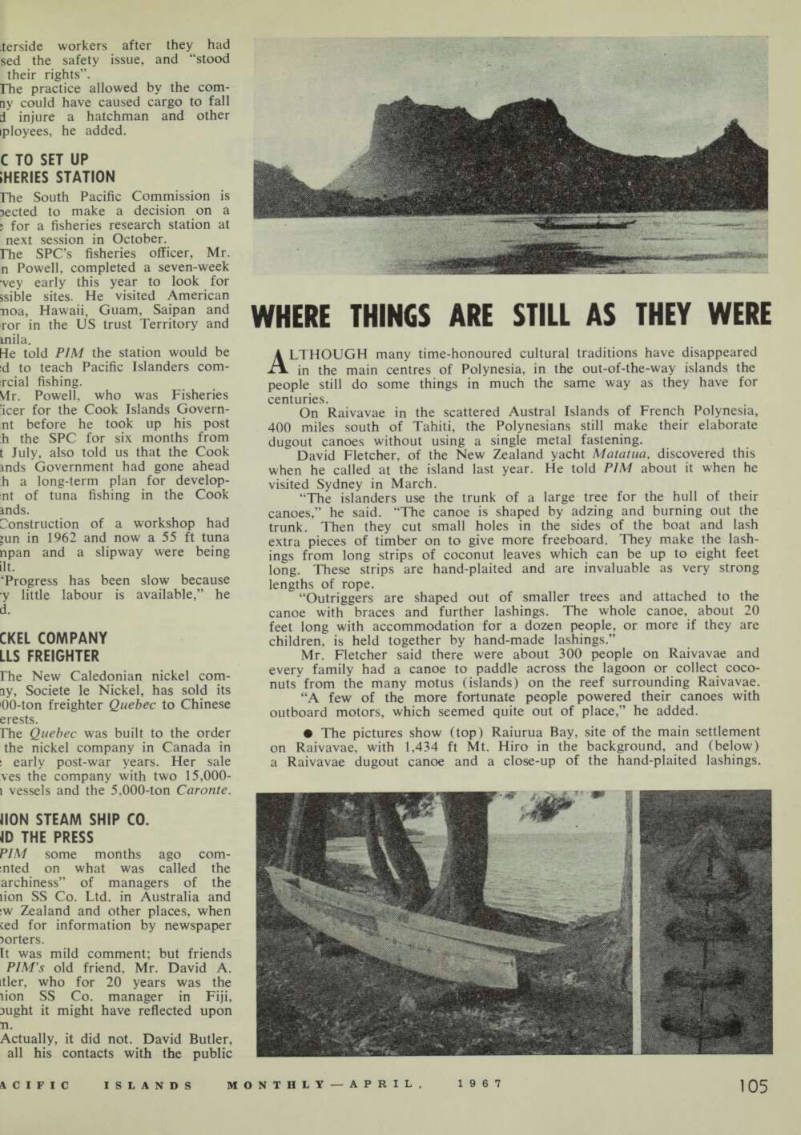
“A few of the more fortunate people powered their canoes with outboard motors, which seemed quite out of place,” he added. • The pictures show (top) Raiurua Bay, site of the main settlement on Raivavae, with 1,434 ft Mt. Hiro in the background, and (below) a Raivavae dugout canoe and a close-up of the hand-plaited lashings.