Knows Everybody, And
pp. 85-87 · Read in the full issue
Levuka: Where Everybody
Old Memories Linger On
There was a time when the trip from Suva to Levuka, the old Fiji capital on the island of Ovalau, was somewhat more difficult and adventurous than it is now.
j'IRST, there was a drive of 30 or so miles over an extremely wind g, but picturesque, road, to Lodoni .ondon) on the Tailevu coast of iti Levu. Then, if the tide was un vourable, one was carried by a isky Fijian across the squelching ud flats, running the risk of being opped en route into the murky iny.
Finally, one was dumped un remoniously into a dinghy and rried to the waiting launch.
Then came PROGRESS.
Marvellous innovation
There was still the winding drive t went even further, to Natovi) but > longer the delicious uncertainty the pick-a-back.
Instead, there was a very long tty with a waiting-room at the end, pable of sheltering two and a half ople with their suitcases.
Erstwhile mud-hoppers considered is a marvellous innovation, and icerfully trudged with their belong gs along the long, long jetty.
But the inward and outward flow passengers increased, and the jetty as considered inadequate—“an in-
By Lema Low, author of “A Family in Fiji”
finitesimal finger of concrete” was the way one MLC referred to it.
So there was MORE PROGRESS.
In Fiji, it is wonderful what progress takes place when the right person waves a magic wand.
The jetty was widened, with a suit able turnaround to accommodate cars and buses.
So now—apart from the temporary but inevitable hitch which occurs when embarking and disembarking passengers mill around in a glorious tangle with cases of vegetables, bags of mail, sides of meat, bundles of taro and passengers and their luggage battling for priority—there is no waiting; no lingering for a last swig of lemonade at the Chinese store.
Progress has hit Natovi.
Meanwhile, there is a lot to be said for the launch journey. Not, perhaps, in the uncomfortable old Jubilee (in which we went) with its inadequate seating and noisy engine. But the Ovalau (in which we returned) is (to coin a phrase) a different kettle of fish.
Plenty of seats are provided in the main cabin, facing the bows, and set high so that one can enjoy the breeze.
There’s a seat across the stern for those who want to trail a fishing line, and seats up top under an awning for camera fiends and those who enjoy the full blast of the wind.
We could also trace our course on a chart on the wall.
Air of mystery
Besides the Jubilee and Ovalau, there is also the Blue Lagoon, a launch in which we have not yet travelled.
The island of Ovalau, its brief, narrow foreshore rising steeply to a jagged crown of mountains, has a Bali-Hai quality, an air of mystery and romance—something of Tahiti or Pago Pago.
As the launch swept along the coast, through brilliant blue seas
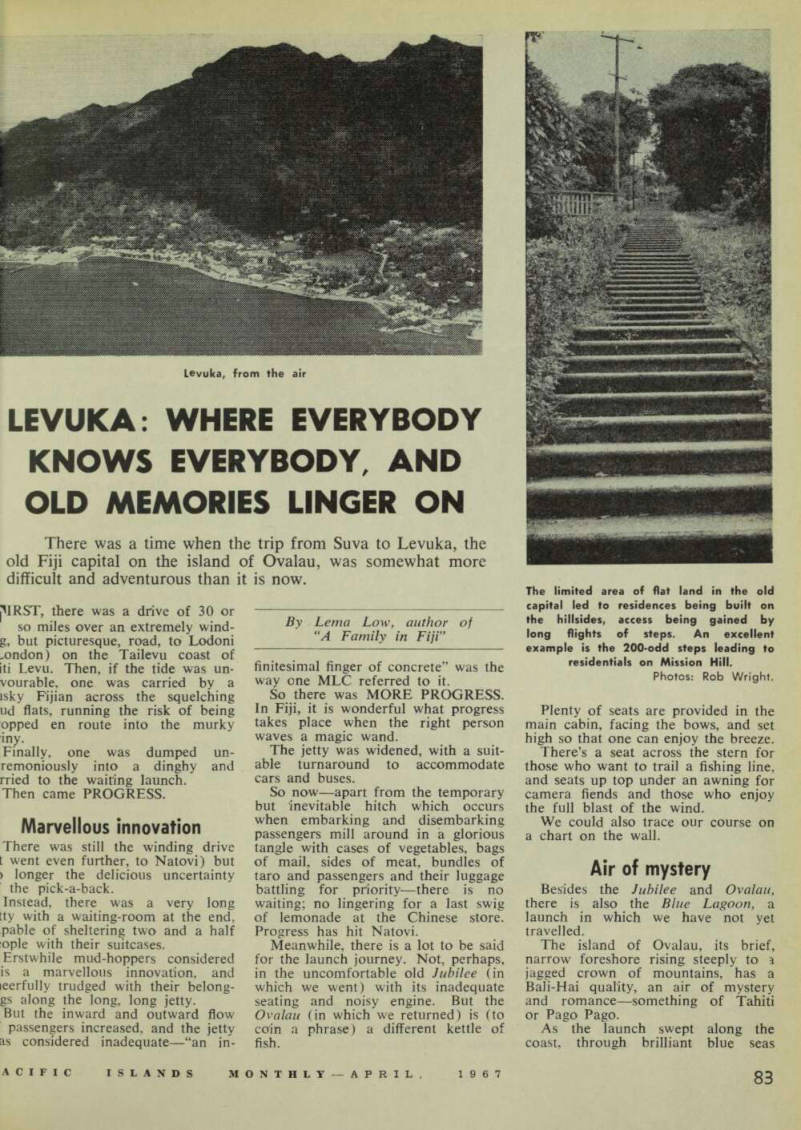
Levuka, from the air
The limited area of flat land in the old capital led to residences being built on the hillsides, access being gained by long flights of steps. An excellent example is the 200-odd steps leading to residentials on Mission Hill.
Photos: Rob Wright.
tipped with scampering spray, ws could see the arms of a sunny valle; reaching up to its towering peaks.
The bare faces of rock resemble< the stern faces of the gods of Haste Island.
Villages, homes and settlement nestled snugly near the beaches.
The launch nudged against thi Levuka wharf after a trip of 2i houn from Natovi. We had reached historii Levuka, its buildings sprinkling thi lower skirts of the mountains abov the town, like flowers on a crinc line.
A waiting taxi scooped us up am took us grandly a few hundred yard to the Royal Hotel, Levuka’s onll hotel, a large, two-storey, ramblim wood and concrete building, of a styll reminiscent of bygone years, and ye so in harmony with Levuka’s old world atmosphere which persist even today.
As yet, no sky-scrapers ador Levuka’s waterfront, which is, pei haps, even more peaceful than it wa in its heyday, when cargo boats plie: between Levuka and Auckland am Sydney, and sailing ships brough seafarers from everywhere.
Next to creek
The Royal Hotel is built on curve of the Totogo Creek whic': brushes its walls when torrential rain send the creek foaming out to sea., It is presided over by Mr. Eddi Ashley, helped by his charming wifi and a bevy of pretty daughters, whi display a variety of skills.
Mrs. Ashley is as adept with pair brush and carpenter’s tools as she i at the culinary arts, while the Ashle girls, in the twinkling of an eye, cai switch from routine household task to the presentation of an entrancim floor show of Islands songs and dance: Each morning at the Royal, a sh hibiscus girl sat in a corner of th upstairs verandah fitting her gorgeou multi-coloured blooms on to a sasi stems. Each morning she went aroum gathering the withered heads. Ho* sad that the life-span of thes beautiful flowers is so short!
Ovalau’s big days are during th Easter sports carnival and Octobe Cession Day, when the island is in undated with visitors from all ove Fiji and the three launches run non-stop shuttle service, and accom modation is taxed to the utmost.
But, on the whole, except for Satui day market day, when the whol island comes to town, Levuka mostly heavenly quiet.
On arriving from noisy Suva, on feels that, in a few hours, one ha stepped back 60 years into Fiji’s pas?
True, Levuka’s past was not realll
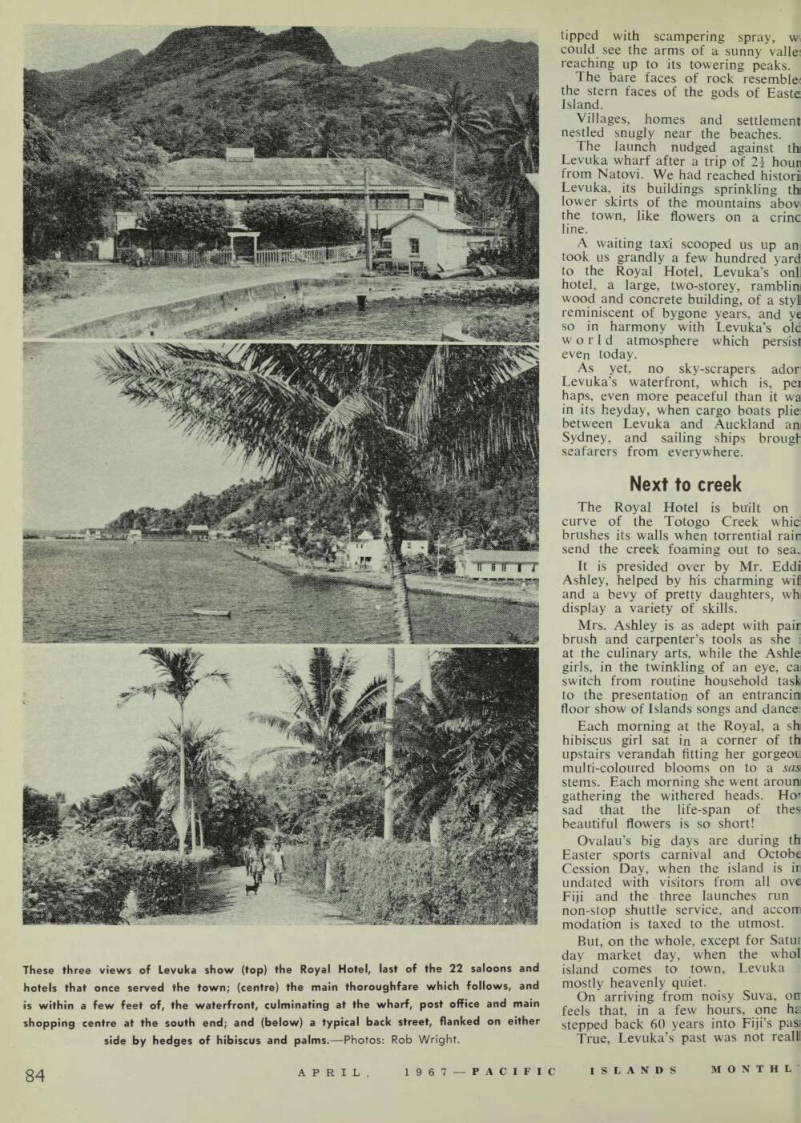
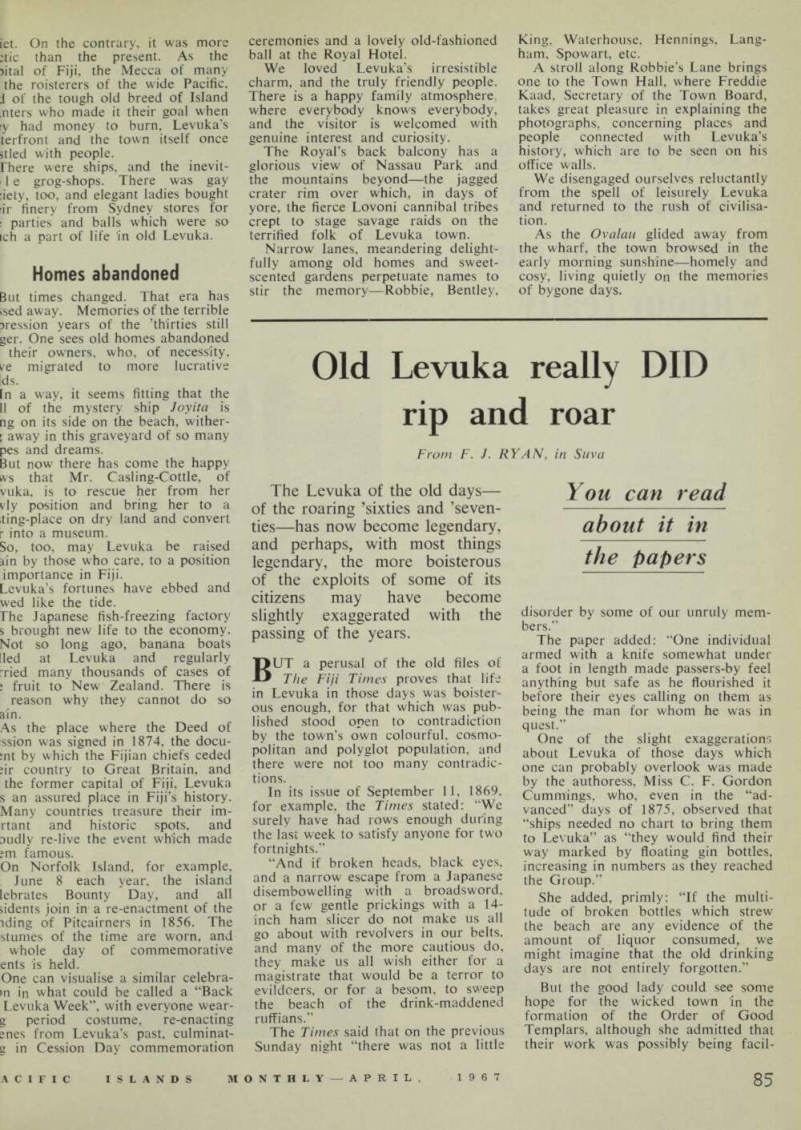
These three views of Levuka show (top) the Royal Hotel, last of the 22 saloons and hotels that once served the town; (centre) the main thoroughfare which follows, and is within a few feet of, the waterfront, culminating at the wharf, post office and main shopping centre at the south end; and (below) a typical back street, flanked on either side by hedges of hibiscus and palms. — Photos: Rob Wright.
iet. On the contrary, it was more :tic than the present. As the dtal of Fiji, the Mecca of many the roisterers of the wide Pacific, i of the tough old breed of Island jiters who made it their goal when iy had money to burn, Levuka’s terfront and the town itself once stled with people.
Phere were ships, and the inevit -1 e grog-shops. There was gay :iety, too, and elegant ladies bought iir finery from Sydney stores for : parties and balls which were so ich a part of life in old Levuka.
Homes abandoned
But times changed. That era has ised away. Memories of the terrible session years of the ’thirties still ger. One sees old homes abandoned their owners, who, of necessity, ye migrated to more lucrative ids.
In a way, it seems fitting that the II of the mystery ship Joy it a is ng on its side on the beach, wither ; away in this graveyard of so many pes and dreams.
But now there has come the happy ws that Mr. Casling-Cottle, of vuka, is to rescue her from her vly position and bring her to a ting-place on dry land and convert r into a museum.
So, too, may Levuka be raised ain by those who care, to a position importance in Fiji.
Levuka’s fortunes have ebbed and wed like the tide.
The Japanese fish-freezing factory s brought new life to the economy.
Not so long ago, banana boats lied at Levuka and regularly fried many thousands of cases of t fruit to New Zealand. There is reason why they cannot do so ain.
As the place where the Deed of ssion was signed in 1874, the docu ;nt by which the Fijian chiefs ceded dr country to Great Britain, and the former capital of Fiji, Levuka s an assured place in Fiji’s history.
Many countries treasure their im rtant and historic spots, and audly re-live the event which made :m famous.
On Norfolk Island, for example, June 8 each year, the island lebrates Bounty Day, and all ddents join in a re-enactment of the iding of Pitcairners in 1856. The stumes of the time are worn, and whole day of commemorative ents is held.
One can visualise a similar celebra >n in what could be called a “Back Levuka Week”, with everyone wear g period costume, re-enacting enes from Levuka’s past, culminat g in Cession Day commemoration
ceremonies and a lovely old-fashioned ball at the Royal Hotel.
We loved Levuka’s irresistible charm, and the truly friendly people.
There is a happy family atmosphere where everybody knows everybody, and the visitor is welcomed with genuine interest and curiosity.
The Royal’s back balcony has a glorious view of Nassau Park and the mountains beyond—the jagged crater rim over which, in days of yore, the fierce Lovoni cannibal tribes crept to stage savage raids on the terrified folk of Levuka town.
Narrow lanes, meandering delightfully among old homes and sweetscented gardens perpetuate names to stir the memory—Robbie, Bentley,
King, Waterhouse, Hennings, Lang ham, Spowart, etc.
A stroll along Robbie’s Lane brings one to the Town Hall, where Freddie Kaad, Secretary of the Town Board, takes great pleasure in explaining the photographs, concerning places and people connected with Levuka’s history, which are to be seen on his office walls.
We disengaged ourselves reluctantly from the spell of leisurely Levuka and returned to the rush of civilisa tion.
As the Ovalau glided away from the wharf, the town browsed in the early morning sunshine—homely and cosy, living quietly on the memories of bygone days.