For Tropical Pastures
pp. 79-81 · Read in the full issue
Two Major Factors In
Preparing Your Land
By W. F. Ritchie
Early working and a good fallowing. These are key factors in land preparation if you want successful establishment of a new tropical pasture.
TROPICALS have a much longer sowing season than temperate pastures and this gives a better chance for good land preparation.
Any new plant being introduced to a paddock is going to have to battle it out with the old plant inhabitants which have been there
for generations.
Their very existence there proves that they like these conditions and that they can stand off competition.
They have to be jolted out of this if they are to be replaced with more productive pasture.
Seed bed preparation
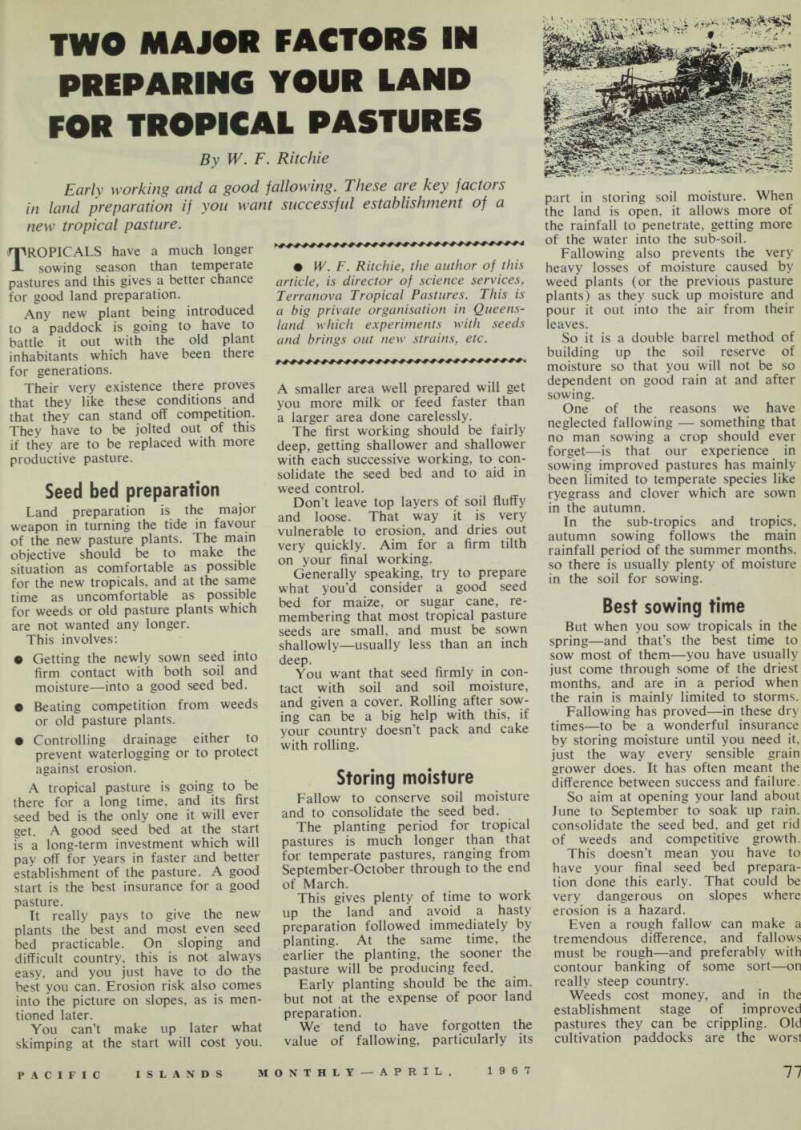
Land preparation is the major weapon in turning the tide in favour of the new pasture plants. The main objective should be to make the situation as comfortable as possible for the new tropicals, and at the same time as uncomfortable as possible for weeds or old pasture plants which are not wanted any longer.
This involves: • Getting the newly sown seed into firm contact with both soil and moisture —into a good seed bed. • Beating competition from weeds or old pasture plants. • Controlling drainage either to prevent waterlogging or to protect against erosion.
A tropical pasture is going to be there for a long time, and its first seed bed is the only one it will ever get, A good seed bed at the start is a long-term investment which will pay off for years in faster and better establishment of the pasture. A good start is the best insurance for a good pasture.
It really pays to give the new plants the best and most even seed bed practicable. On sloping and difficult country, this is not always easy, and you just have to do the best you can. Erosion risk also comes into the picture on slopes, as is men tioned later.
You can’t make up later what skimping at the start will cost you.
• W. F. Ritchie, the author of this article, is director of science services, Terranova Tropical Pastures. This is a big private organisation in Queens land which experiments with seeds and brings out new strains, etc.
A smaller area well prepared will get you more milk or feed faster than a larger area done carelessly.
The first working should be fairly deep, getting shallower and shallower with each successive working, to con solidate the seed bed and to aid in weed control.
Don’t leave top layers of soil fluffy and loose. That way it is very vulnerable to erosion, and dries out very quickly. Aim for a firm tilth on your final working.
Generally speaking, try to prepare what you’d consider a good seed bed for maize, or sugar cane, re membering that most tropical pasture seeds are small, and must be sown shallowly—usually less than an inch deep.
You want that seed firmly in con tact with soil and soil moisture, and given a cover. Rolling after sow ing can be a big help with this, if your country doesn’t pack and cake with rolling.
Storing moisture
Fallow to conserve soil moisture and to consolidate the seed bed.
The planting period for tropical pastures is much longer than that for temperate pastures, ranging from September-October through to the end of March.
This gives plenty of time to work up the land and avoid a hasty preparation followed immediately by planting. At the same time, the earlier the planting, the sooner the pasture will be producing feed.
Early planting should be the aim. but not at the expense of poor land preparation.
We tend to have forgotten the value of fallowing, particularly its
part in storing soil moisture. When the land is open, it allows more of the rainfall to penetrate, getting more of the water into the sub-soil.
Fallowing also prevents the very heavy losses of moisture caused by weed plants (or the previous pasture plants) as they suck up moisture and pour it out into the air from their leaves.
So it is a double barrel method of building up the soil reserve of moisture so that you will not be so dependent on good rain at and after sowing.
One of the reasons we have neglected fallowing something that no man sowing a crop should ever forget—is that our experience in sowing improved pastures has mainly been limited to temperate species like ryegrass and clover which are sown in the autumn.
In the sub-tropics and tropics, autumn sowing follows the main rainfall period of the summer months, so there is usually plenty of moisture in the soil for sowing.
Best sowing time
But when you sow tropicals in the spring—and that’s the best time to sow most of them—you have usually just come through some of the driest months, and are in a period when the rain is mainly limited to storms.
Fallowing has proved—in these dry times—to be a wonderful insurance by storing moisture until you need it, just the way every sensible grain grower does. It has often meant the difference between success and failure.
So aim at opening your land about June to September to soak up rain, consolidate the seed bed, and get rid of weeds and competitive growth.
This doesn’t mean you have to have your final seed bed prepara tion done this early. That could be very dangerous on slopes where erosion is a hazard.
Even a rough fallow can make a tremendous difference, and fallows must be rough—and preferably with contour banking of some sort—on really steep country.
Weeds cost money, and in the establishment stage of improved pastures they can be crippling. Old cultivation paddocks are the worst
for this, as weed seeds have been building up under the ground for years.
Land that has been under grass is nowhere near the problem, although it’s bad enough. There is the existing grass to get rid of.
On these cultivation paddocks you have to be more thorough with fallowing, and you will probably need to add potash to your fertiliser treatment as well.
Weeds have two natural advantages that have to be overcome. For a start, the number of weed seeds sitting underground waiting for a chance is probably many, many times the number of pasture plant seeds grow ing.
Secondly, most of these will be annual weeds which are very fast growing. Generally speaking, annual plants make growth faster than perennial plants. Annuals have to grow to maturity and set seed in a few short weeks or months at the most, compared with the perennial which takes a whole year for its annual growth cycle.
Weed control
Progressive cultivations, right through from the first break to the final harrowing, all aid in weed control. If you can get the weed seeds to germinate between each working, the next working kills the young weeds and you have fewer seeds to bother you at planting time.
Picture what’s going on in the top layers of soil as you get to your final workings. There’s a band of weed seeds waiting to be turned up into the zone where they will germinate. The ones that do get into this zone germinate and are killed by the next working, but if the next working is deep, it merely turns some more weed seeds up in the germina tion zone.
If each working is shallower than the previous ones, you get rid of many of the weed seeds in the top zone without turning up many more, and you are left with a top layer of soil fairly free of weed seeds when you are ready to plant. Plant with the minimum of soil disturbance, and you avoid turning up many new weed seeds to germinate.
All these moves help to cut weed competition to a minimum, and to prevent the weeds from stealing light —and tremendous amounts of soil water and plant food—from the young pasture seedlings, and to tilt the balance in favour of the new sowings.
Chemicals like Dalapon are also very effective in some instances in wiping out competition before plant
ing, with minimum soil disturbances —the so-called chemical fallowing.
Whatever happens, aim at wiping out 80 per cent, of the competitive growth and give the new seedlings a chance to fight when they are young and weak. When they get going, they can look after most of the com petition themselves. It’s the good start they really need.
Drainage control
Poorly Drained Flats: Many a drowned pasture testifies to poor drainage on flats. One of the real advantages of the tropicals, particu larly the legumes, is their deep root ing system which lets them draw food and moisture from deep down once they are established. They can’t do that if the water table is close to the surface.
Here again, cultivation can be a major tool. Laying out bays intc “lands” and ploughing the soil pro gressively towards the centre when preparing the seed bed gives strips with shallow humps, and hollows in between them for drainage. More drastic drainage may have to come
into the picture in more swampy land.
Slopes: When cultivating slopes, you need to control drainage for a different reason—erosion risk. Land being worked for the first time is usually held together fairly well by old grass roots, but there’s always risk. Depending on the slope, the area, and so on, your protective measures will vary. Consult your local agricultural officers on this one.
When you plant tropical pastures, you are going to expect a great deal from them. They are not miracle plants, but they have proved that they can be tremendously produc tive—if given a proper chance.
No one can do much about the weather, but there are many other things that can be done to give them the best chance to fulfil their role as highly productive pasture.
Like most things, they respond to good treatment. Give them the sort of start any valuable crop deserves.
Where this has been done, there have been few failures, even in the dry reason, but you can’t expect them to help you unless you help them. ■