They're well worth finding
pp. 67-69 · Read in the full issue
Shoes from Paris (but not at Paris irices), objets d’art from the Orient, fid-fashioned toys like wooden tops . . they’re all there for those with :yes to see.
My own loves are the slightly arger “emporia” where richly :oloured Chinese bowls and ladles ostle gaudy enamel basins, sturdy ools and a few yards of lace or a lundle of pencils, all within a foot ir two of each other.
At first sight, you might think there
tru' 11 u"a which iiiik.hi mciyv CTT^xnT made to measure for my feet and my pocket book, both!
Materials, too, can be deceptive.
Stacked together in bright, if dusty bales, we walk past thinking of them as “cheap”.
That they often are, in price, but not, for the discerning buyer, in style, design or texture. Get a length away from its multi-coloured mates, and it can look striking.
The same thing applies to the market selling native goods. You
0 seeing wooden bowls, es, cannibal forks and it is easy to overlook fistic pieces of real skill. % time but, as the poet, h, says: ‘s life, if, full of care, » time to stand and stare? tanding and staring” has ne charming satin baby ;d with swansdown, for Id; a tiny kerosene lamp bogey-men away” all r of Chinese figurines pd among some cheap bile of Indian cosmetics, 1 overlooked, but which, [l of flowers on a low tally elegant; a Spanish piy fevered brow when
goes wild; and a host of foodstuffs which I at one time thought were unprocurable in Suva.
Take bay leaves, for instance. As a greenhorn, I found that none of the more obvious stores possessed any. But talking to a Kai-Viti soon put me right.
They are used as wrapping for licorice, which some chemists use in prescriptions . . .
To claim a score for that, is, of course, cheating, somewhat. To play
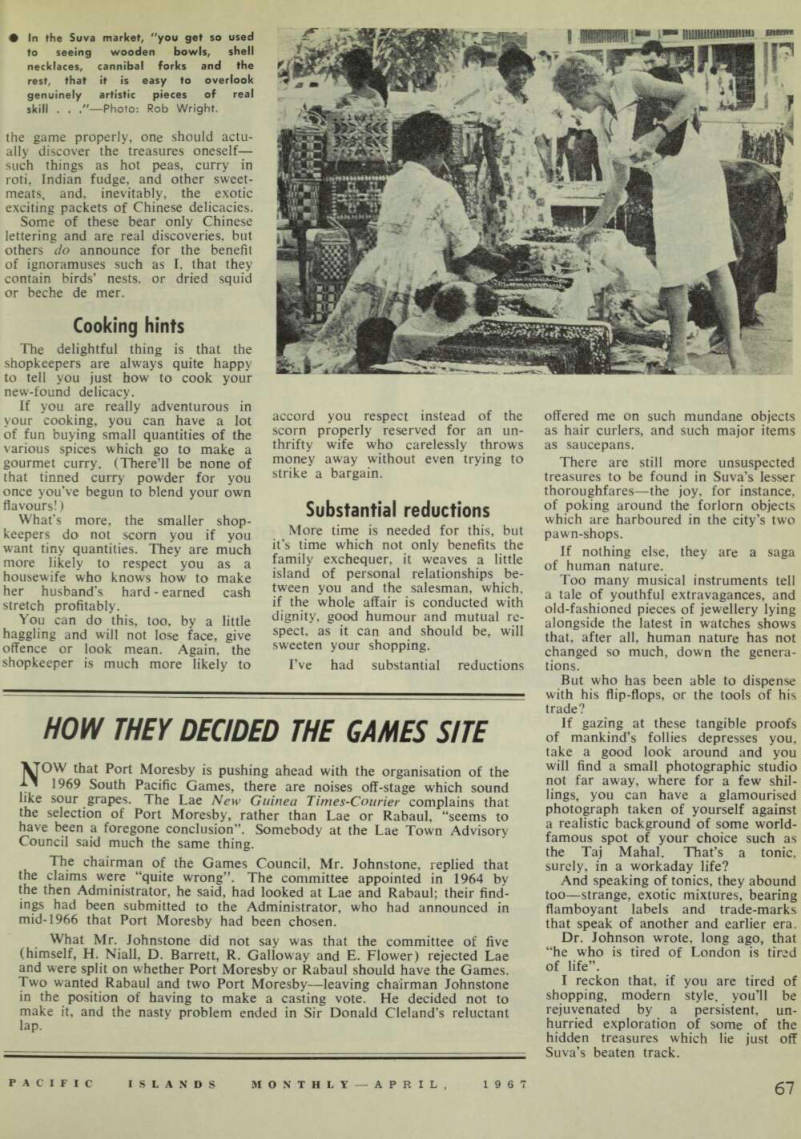
• In the Suva market, "you get so used to seeing wooden bowls, shell necklaces, cannibal forks and the rest, that it is easy to overlook genuinely artistic pieces of real skill . . ."—Photo: Rob Wright. the game properly, one should actu ally discover the treasures oneself— such things as hot peas, curry in roti, Indian fudge, and other sweet meats, and, inevitably, the exotic exciting packets of Chinese delicacies.
Some of these bear only Chinese lettering and are real discoveries, but others do announce for the benefit of ignoramuses such as I, that they contain birds’ nests, or dried squid or beche de mer.
Cooking hints
The delightful thing is that the shopkeepers are always quite happy to tell you just how to cook your new-found delicacy.
If you are really adventurous in your cooking, you can have a lot of fun buying small quantities of the various spices which go to make a gourmet curry. (There’ll be none of that tinned curry powder for you once you’ve begun to blend your own flavours!) What’s more, the smaller shop keepers do not scorn you if you want tiny quantities. They are much more likely to respect you as a housewife who knows how to make her husband's hard - earned cash stretch profitably.
You can do this, too, by a little haggling and will not lose face, give offence or look mean. Again, the shopkeeper is much more likely to
. . . accord you respect instead of the B f o . rn P ro .P er ly reserved for an un tlmft V Wlfe who carelessly throws mo " e y a " a V without even trying to strike a bargain,
Substantial reductions
x . , , , , . . , M 9 re tin ? 9 18 needed for this, but 118 time wblcb not only benefits the family exchequer, it weaves a little lsland of Personal relationships be tween y° u and the salesman, which, if the whole affair is conducted with di B nit y, good humour and mutual res P ect ’ as 11 can and should be, will sweeten your shopping, I’ve had substantial reductions
offered me on such mundane objects as hair curlers, and such major items as saucepans.
There are still more unsuspected treasures to be found in Suva’s lesser thoroughfares—the joy, for instance, of poking around the forlorn objects which are harboured in the city’s two pawn-shops.
If nothing else, they are a saga of human nature.
Too many musical instruments tell a tale of youthful extravagances, and old-fashioned pieces of jewellery lying alongside the latest in watches shows that, after all, human nature has not changed so much, down the genera tions.
But who has been able to dispense with his flip-flops, or the tools of his trade?
If gazing at these tangible proofs of mankind’s follies depresses you, take a good look around and you will find a small photographic studio not far away, where for a few shil lings, you can have a glamourised photograph taken of yourself against a realistic background of some world famous spot of your choice such as the Taj Mahal, That’s a tonic, surely, in a workaday life?
And speaking of tonics, they abound too —strange, exotic mixtures, bearing flamboyant labels and trade-marks that speak of another and earlier era.
Dr. Johnson wrote, long ago, that “he who is tired of London is tired of life”.
I reckon that, if you are tired of shopping, modern style, you’ll be rejuvenated by a persistent, un hurried exploration of some of the hidden treasures which lie just off Suva’s beaten track.