Expedition to Taveuni finds
pp. 47-53 · Read in the full issue

exciting traces of Fiji's past
By Jane Gregor
Exciting traces of Fiji’s early inhabitants have been found on Taveuni, the third largest island in the colony, east of Vanua Levu.
relics were discovered by Miss L Elizabeth Shaw, while she was ding director of the Fiji Museum iring the absence on leave of Mr. ruce Palmer.
Her discoveries far exceeded her :pectations when she and a party t out to search for traces of the icient past early in February. I icompanied Miss Shaw’s party on e first week of their trip.
Mr. Palmer made the first investi itions on Tavenui two years ago id found a number of traces of imitive civilisation.
But Miss Shaw’s expedition has und so much more that it is to be >ped that more money will be forth uning from some enlightened source > that Taveuni can be explored uch more intensively.
On the first two days of Miss laws expedition, it rained so hard at some areas became unreachable id all tracks were extremely muddy id treacherous.
We began by staying in the
village of Vuna, with Tui Vuna and his delightful family. But every where we went we found great in terest in our search, together with open-handed hospitality, practical offers of help and a rich wealth of knowledge of local flora, fauna and ways of life.
Many people, such as Mr. Reggie Douglas, of Qacavulo, knew of sites on their own plantations to which they were only too willing to lead us.
As in Mr. Douglas’ case, their own interest had been stimulated by find ing stone adzes and fragments of primitive pottery.
And we found that, whether we stayed in Fijian villages or with plantation owners, sooner or later relics of the past would be handed around, memories would be dredged for sites glimpsed, and the talk would steer its way around to: “You’d better meet old so-and-so. He remembers a lot about the old days and likely he’ll know some of the bush places where you might find things.”
Sometimes these clues led to im
portant discoveries, sometimes they all d part b of IhTgame h '^ k archaLl t ogy S It - S a profession which combines a variety of curious characteristics. of^a^detective! 16 a 10 good 1S dea? 6 !)^! scholar, and he is usually a skilled workman when it comes to piecing together fragments of pottery or artifacts found on a site “ louna on a Slle ' . , I J eeds ’ -T o ®’ 1 . stamma an( J knowledge of terrain, maps and weather which make an explorer, combined with the interest m people and t^e ) r .^ a^s w l? ic h will accurately interpret the reminders which long ®one P eo Pl e have left behind them,
vvaV tO do it
1 Where do you begin when looking for the past?
Often by reading, thinking, follow jn g a hunch and asking endless,
patient questions.
0 t Sometimes, as at Deuba, on Viti Le ™- f, stre . am cha "B es “j. c , ourae and pottery fragments are disclosed, lf j adln E archaeologists to dig and ex plore further in the area.
Field exploration in Fiji is very
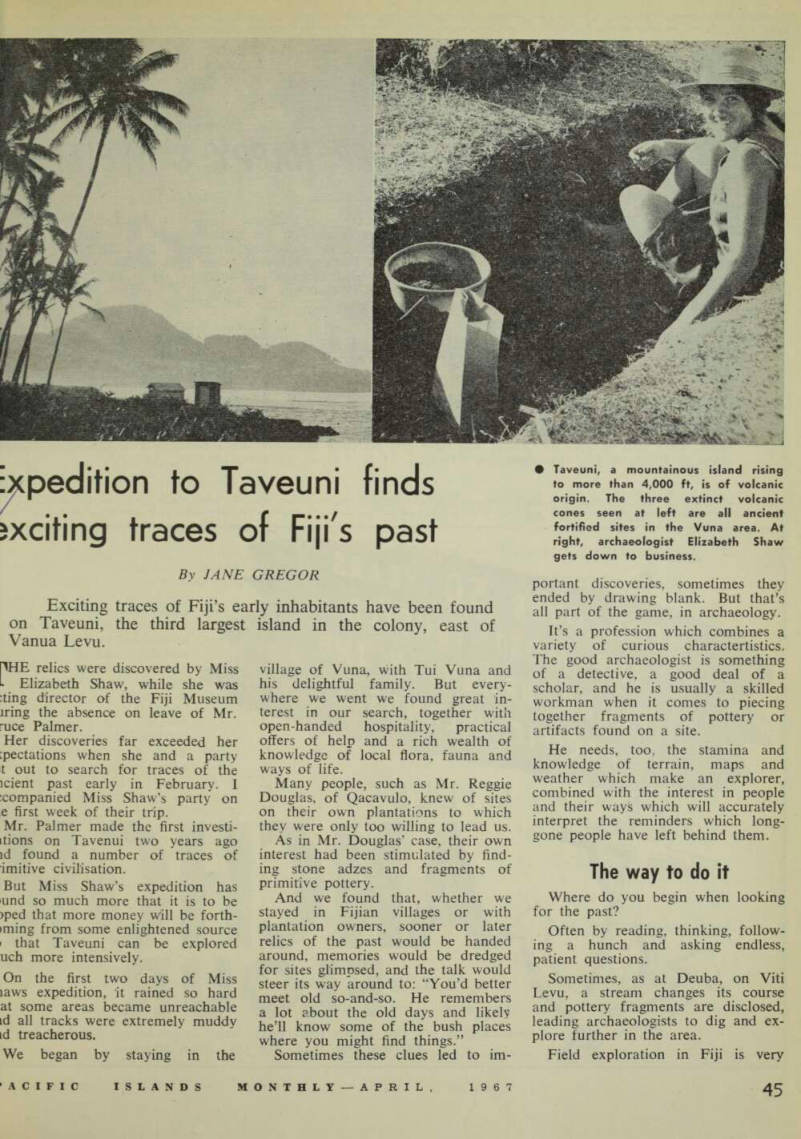
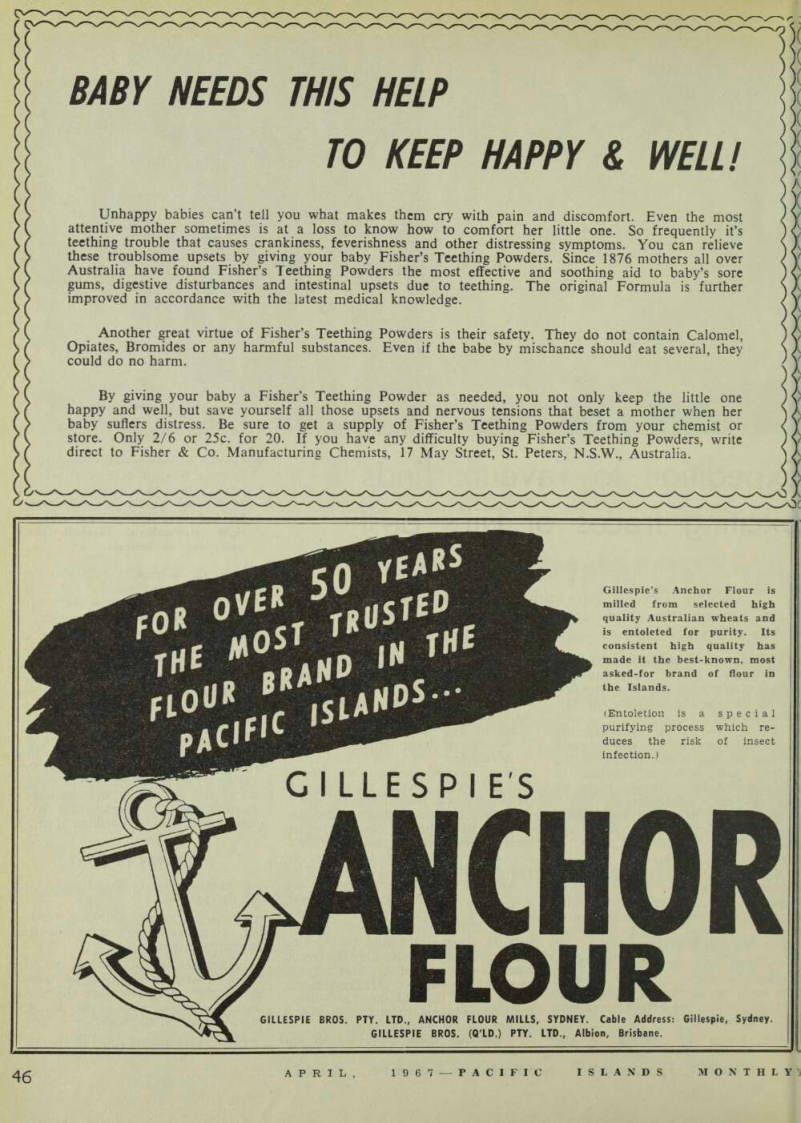
Taveuni, a mountainous island rising to more than 4,000 ft, is of volcanic origin. The three extinct volcanic cones seen at left are all ancient fortified sites in the Vuna area. At right, archaeologist Elizabeth Shaw gets down to business.
ifferent from that in the ancient mds of Egypt and Mesopotamia, here great mounds or “tells” in the indy wastes provide tell-tale clues > long-abandoned, sand-covered dtlements.
In Fiji the habitations are more :attered; they endured for a shorter me, and were rarely on a large scale ith the exception of forts.
They have been swallowed up by ic quick-growing bush, so that un ss a hunter or a local walker appens to chance on a pile of stones id realises it is not merely Nature’s andiwork, there is little to guide ic beginner.
However, it is astonishing how any people begin to remember lings seen once interest is aroused, ; it has been on Taveuni, where xhaeology is now the newest “sport” id where collections of stone imple lents and pottery shards are begin ing to rival the more common lace ones of shells!
Still, for the present, an expedition [ust rely on chance encounters with ic few who do know. For example, lost villagers near Qacavulo knew isolutely nothing of certain rocks i the shore-line bearing carvings and auged holes.
But Mr. Douglas and his sons knew F them and one local inhabitant re embered seeing something which ad struck him as not quite natural.
So we waded through shallow ater to discover what were, clearly, allows where adzes had been ground.
One was so deep that it must have sen the receptacle which held the
water to cool the stone as it was being worked.
The other stone we examined lay back from the sea a little, a black, lava lump.
The children from nearby houses watched fascinated as we clambered over it; and then Elizabeth Shaw began scrubbing some dimly-seen hieroglyphs on its side with a stiff wire orush. , c . ' u cn a ■ j Afterwards she filled in the depress,ons with white chalk before photographing the strange almost mathematical-looking symbols.
That was a day of easy going. But most days involved strenuous walking and climbing into the bush.
Plantation owners were uncommonly generous in driving us in their Land Rovers to places where even a Land Rovei ‘ must stop. After that, it was very mucb a case of Shanks pony. 9 ne m 9. st ex . cß mg °. ur unds was a large fort site, clearly m dicated by its ditch, some 30 ft deep, encircling a high conical mound which, » n lts da V> would have been P ahsaded for B reater protection.
The whole area was thick with bush and traili vines The immed i ate fort area which interested us rejoiced in a coveri ng of tall, cutting-edged grass Huge spiders had hung their webs between lantana bushes; and some how these webs always managed to
e just at mouth level as we paused 0 take a deep breath.
At each site we discovered, Miss haw was kept busy taking notes, larking contour maps, taking photo raphs, and keeping her eyes open for hards and artifacts.
On top of our fortress mound her oung Fijian assistant, Moce Qalo, icked up several large pottery pieces rom the rubble of small stones lying n the damp earth.
These were carefully put into paper ags, marked with the site number nd a record of their discovery made 1 Miss Shaw’s notebook.
On some days our searchings took s high above the coconut planting ne, into the forest towards the olcanic peaks.
In some ways the going was easier lere, for although there were river eds to cross whose boulders were npleasantly slimy to slither over, and [though thick creepers constantly ipped us up, the trees gave dappled lade and the going was pleasantly iringy on the leaf-mould underfoot.
Now and again we stopped to drink le cool water which lies inside the rey creeper stems, and I was stonished at the delicate, pale-pink, eshy inside hidden within these un ttractive plants.
Again and again we were lucky. At bout 1,000 ft above sea-level we >und more yavus —small stone lounds —which had clearly been welling houses.
When we dug underneath one of
[?]t may not look terribly exciting to a [?]ayman, but it's the sort of thing that
[?]ets an archaeologist's pulse racing—
tone paving on a house mound at a fortified village site on Taveuni.
Wealth of sites
ie mounds, surely enough, we found irge fragments of smooth, black ottery.
What astonished and delighted us uring the whole expedition was the r ealth of sites we came across. In 11, some 70 were recorded, ranging om small, family dwelling places > fortresses extending for several undred feet.
Both the homes and the forts were sually on ridges or spurs of land hich gave the ancient Fijians a >mmanding view of any invaders.
Some of the yarns were found in roups of two or three; others were ustered close together and numbered ? many as would be found in any llage today.
Quite clearly, the island had once jen far more thickly populated than is today.
Those people of earlier times had jen stout climbers, for many of the tes we came across were as high as 000 ft up the mountainsides.
On the north side of the island, Dtably near Bouma, was a remark )le concentration of yarns.
Pottery was plentiful there, too; id from a site which appeared most like a present-day city dump, zeable shards were brought to Suva ir study and identification.
It was at Bouma that a Fijian, lone ola, gave Miss Shaw an artifact therto unknown in this part of the orld —a large, stone implement, ith one sharpened edge, bearing a int resemblance to a cricket bat. 1 was anxious to know just how d the Taveuni settlements might be. it Miss Shaw with the true caution the scientist, hesitated to put an :act date to them.
Plainer pottery
“They are not as early as some e have previously found at Yanuca, i Viti Levu,” she said.
“The pottery found on Tavenui is ainer and not so fine as the very rly pieces which we found at anuca and which have been dated about 490 BC.
“The Taveuni shards more closely semble those found by Mr. and Mrs. rks, at Sigatoka, a couple of years :o, although what they found was ually impressed with designs made \ shells, or by the potter’s thumb iil, or had leaf imprints on it.
“These newest finds are quite plain, icy don’t even bear the marks hich ‘paddle ware’ has, from be g patted into shape with an imple ent rather like a butter-pat.
“The Taveuni pottery is, in fact,
very similar to what is still being made today at Sigatoka, and at Nasilai and I doubt if it is more than, say, 500 years old.”
No matter how old, or how young, those early settlements on Taveuni eventually prove to be, what is still supremely exciting is the fact that so many clues are being uncovered in the fascinating mystery of who the earliest Pacific settlers were, where they came from, how they lived.
Miss Shaw planned to return to Taveuni again before she went back to lecture at the university. But some thing tells me that she’ll not be able to leave alone for long the quest for old Fiji.