And Who Else But Quiros?
pp. 42-43 · Read in the full issue
Correspondence Invited!
An article in PIM last month by PIM's assistant editor, Robert Langdon, suggesting that a mysterious stone wall found at Big Bay, Espiritu Santo, might be a relic of the Quiros expedition of 1606, brought a number of comments from interested readers. The wall is about three miles east of the River Jordan and about 200 yards from the coast. It was reported to PIM by a Sydney man, Mr. Ted Hebblewhite, whose family has had links with the New Hebrides for nearly 100 years.
What exactly is this mysterious wall in Santo—who built it and when? There were a number of different opinions avail able in March—and apparently some more to come.
CAPTAIN Brett Hilder, master of the Burns Philp flagship Bulolo, said he “could not see that the wall could have been built by anyone else but Quiros”. • Dr. Dorothy Shineberg, a re search fellow at the Research School of Pacific Studies at the Australian National University, said the wall may be the remains of a sandalwood station. Dr. Shineberg made a study of the New Hebrides sandalwood trade for her PhD thesis and is to bring out a book based on this later this year called They Came For Sandalwood. • Mr. Reece Discombe, of Vila, New Hebrides, also a noted student of early New Hebrides’ history, said he had seen the ruins about 17 years ago, and he had always believed they were left by the Melanesian Mission in the old days. • Mr. E. W. Lamberty, who has been a leaseholder of the Societe Agricole et Elevage plantation in Big Bay since 1956, came out flat-footed with the statement that the ruins are the remains of a trading store built in 1902 or 1903. • Robert Langdon, who was on vacation when this issue went to press, says further research into New Hebrides history, plus a better know ledge of the topography of Big Bay, has strengthened his belief that the strange wall is a relic of the Quiros expedition. More will be heard from him.
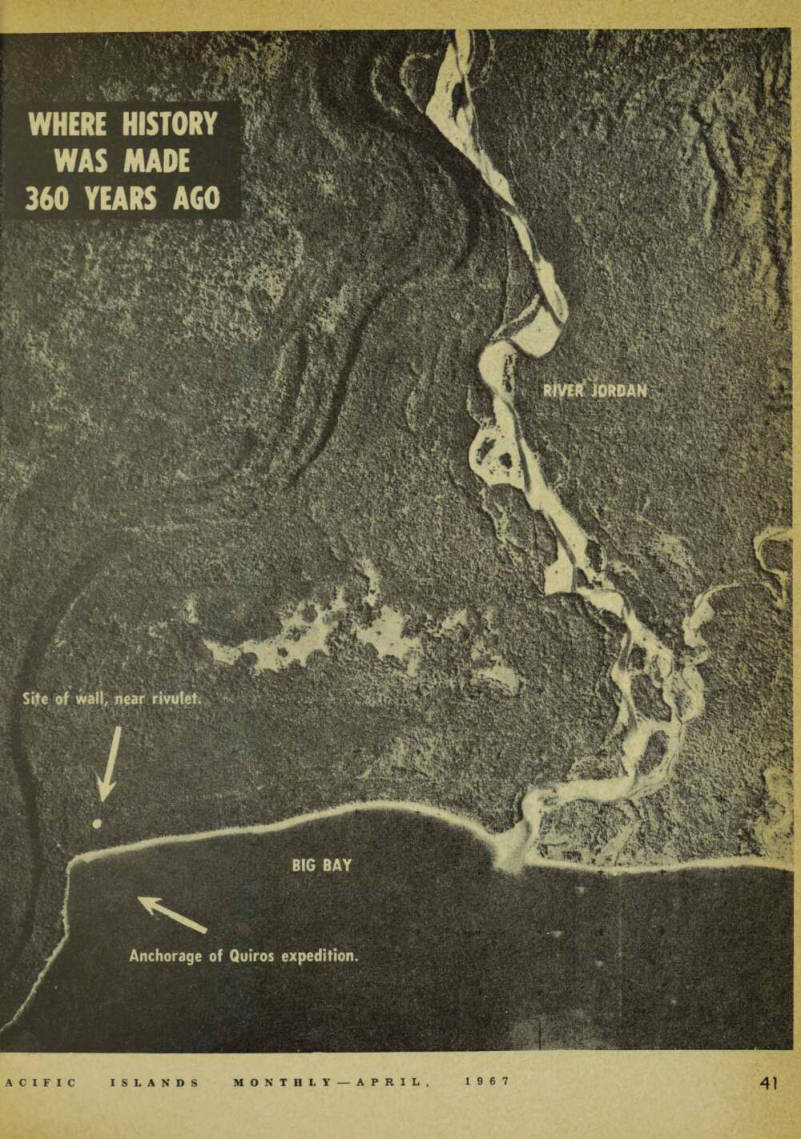
To make it easier for the general reader, PIM has printed opposite a wartime RAF aerial photograph of the south-eastern corner of Big Bay.
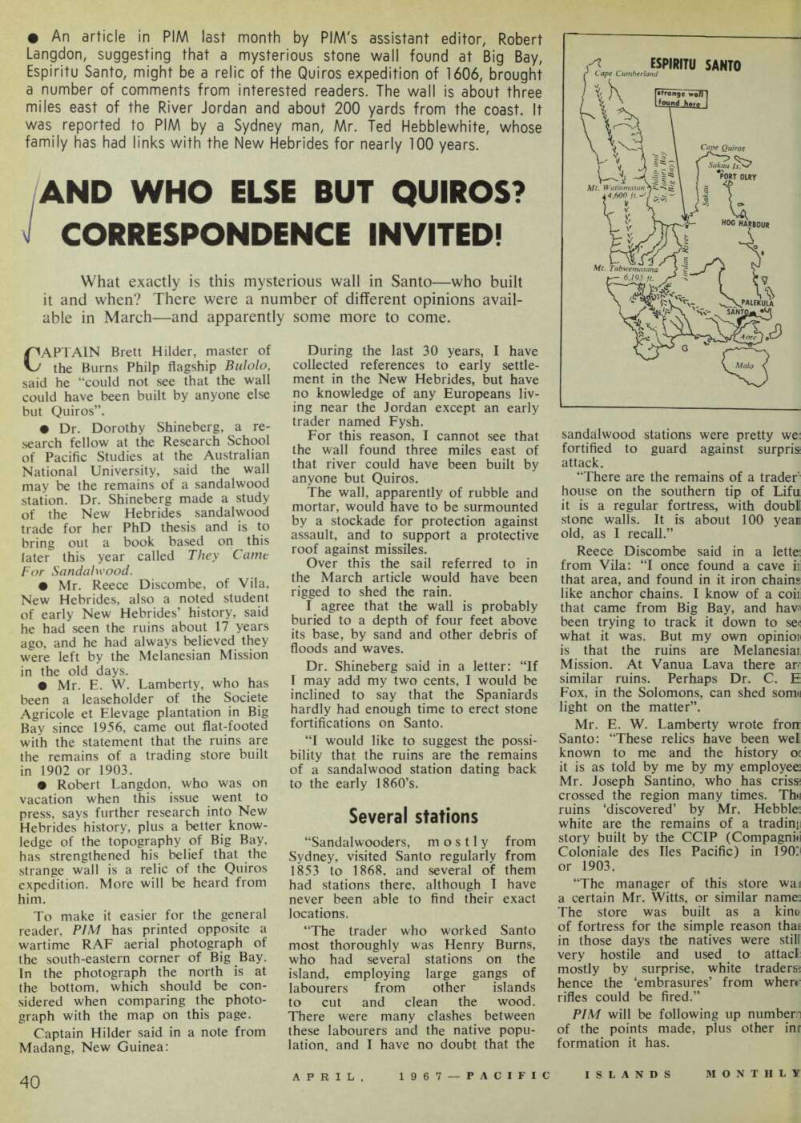
In the photograph the north is at the bottom, which should be con sidered when comparing the photo graph with the map on this page.
Captain Hilder said in a note from Madang, New Guinea;
During the last 30 years, I have collected references to early settle ment in the New Hebrides, but have no knowledge of any Europeans liv ing near the Jordan except an early trader named Fysh.
For this reason, I cannot see that the wall found three miles east of that river could have been built by anyone but Quiros.
The wall, apparently of rubble and mortar, would have to be surmounted by a stockade for protection against assault, and to support a protective roof against missiles.
Over this the sail referred to in the March article would have been rigged to shed the rain.
I agree that the wall is probably buried to a depth of four feet above its base, by sand and other debris of floods and waves.
Dr. Shineberg said in a letter: “If 1 may add my two cents, I would be inclined to say that the Spaniards hardly had enough time to erect stone fortifications on Santo.
“I would like to suggest the possi bility that the ruins are the remains of a sandalwood station dating back to the early 1860’s.
Several stations
“Sandalwooders, mostly from Sydney, visited Santo regularly from 1853 to 1868, and several of them had stations there, although I have never been able to find their exact locations.
“The trader who worked Santo most thoroughly was Henry Burns, who had several stations on the island, employing large gangs of labourers from other islands to cut and clean the wood.
There were many clashes between these labourers and the native popu lation, and I have no doubt that the
sandalwood stations were pretty we; fortified to guard against surprise attack.
“There are the remains of a trader house on the southern tip of Lifu it is a regular fortress, with doubll stone walls. It is about 100 yean old, as I recall.”
Reece Discombe said in a lette; from Vila: “I once found a cave iii that area, and found in it iron chains like anchor chains. I know of a coiii that came from Big Bay, and haw been trying to track it down to se< what it was. But my own opinion is that the ruins are Melanesia!.
Mission. At Vanua Lava there ar-‘ similar ruins. Perhaps Dr. C. E Fox, in the Solomons, can shed som« light on the matter”.
Mr. E. W. Lamberty wrote frorr Santo: “These relics have been wel known to me and the history oc it is as told by me by my employee Mr. Joseph Santino, who has crisa crossed the region many times. Thd ruins ‘discovered’ by Mr. Hebble; white are the remains of a tradinji story built by the CCIP (Compagni«i Coloniale des lies Pacific) in 19(U or 1903.
“The manager of this store wai a certain Mr. Witts, or similar name; The store was built as a kino of fortress for the simple reason thaf in those days the natives were still very hostile and used to attack mostly by surprise, white traders hence the ‘embrasures’ from wherr rifles could be fired.”
PIM will be following up numbern of the points made, plus other inr formation it has.