He guides Fijians to athletics victory
p. 39 · Read in the full issue
athletics victory
From MATT WILSON, in Suva The scene is Buckhurst Park, Suva, on a fine February evening nearly seven years ago. A superbly muscled Fijian, moving with the grace that marked him as a natural athlete, is loping round the field on one of his regular training sessions.
UDDENLY he becomes aware of 1 strange eyes watching, and sees fair-haired young Englishman with red beard gazing intently in his ■ection.
Soon the two men begin to talk and for the Fijian a turning point his career has arrived, and for iletics in Fiji a driving new rsonality has appeared on the scene.
Today the Fijian, Jo Navusolo, has ssed his peak but he can look back an illustrious career in Fiji aletics —thanks to the guidance ft n to him by the young English an who now occupies the top post Fiji athletics.
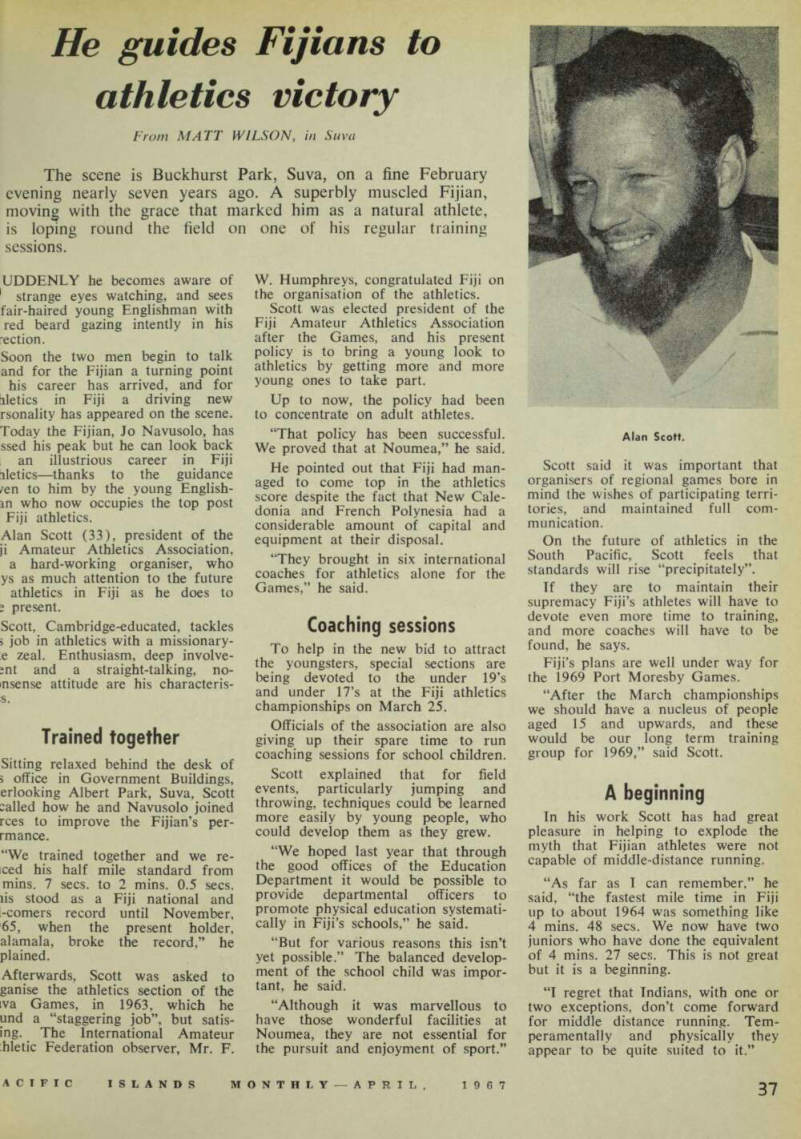
Alan Scott (33), president of the ji Amateur Athletics Association, a hard-working organiser, who ys as much attention to the future athletics in Fiji as he does to ; present.
Scott, Cambridge-educated, tackles 5 job in athletics with a missionary e zeal. Enthusiasm, deep involve ;nt and a straight-talking, no msense attitude are his characteris s.
Trained together
Sitting relaxed behind the desk of » office in Government Buildings, erlooking Albert Park, Suva, Scott called how he and Navusolo joined rces to improve the Fijian’s per rmance.
“We trained together and we re ced his half mile standard from mins. 7 secs, to 2 mins. 0.5 secs, lis stood as a Fiji national and -comers record until November, 65, when the present holder, alamala, broke the record,” he plained.
Afterwards, Scott was asked to ganise the athletics section of the iva Games, in 1963, which he und a “staggering job”, but satis ing. The International Amateur hletic Federation observer, Mr. F.
W. Humphreys, congratulated Fiji on the organisation of the athletics.
Scott was elected president of the Fiji Amateur Athletics Association after the Games, and his present policy is to bring a young look to athletics by getting more and more young ones to take part.
Up to now, the policy had been to concentrate on adult athletes.
“That policy has been successful.
We proved that at Noumea,” he said.
He pointed out that Fiji had man aged to come top in the athletics score despite the fact that New Cale donia and French Polynesia had a considerable amount of capital and equipment at their disposal.
“They brought in six international coaches for athletics alone for the Games,” he said.
Coaching sessions
To help in the new bid to attract the youngsters, special sections are being devoted to the under 19’s and under 17’s at the Fiji athletics championships on March 25.
Officials of the association are also giving up their spare time to run coaching sessions for school children.
Scott explained that for field events, particularly jumping and throwing, techniques could be learned more easily by young people, who could develop them as they grew.
“We hoped last year that through the good offices of the Education Department it would be possible to provide departmental officers to promote physical education systemati cally in Fiji’s schools,” he said.
“But for various reasons this isn’t yet possible.” The balanced develop ment of the school child was impor tant, he said.
“Although it was marvellous to have those wonderful facilities at Noumea, they are not essential for the pursuit and enjoyment of sport.”
Scott said it was important that organisers of regional games bore in mind the wishes of participating terri tories, and maintained full com munication.
On the future of athletics in the South Pacific, Scott feels that standards will rise “precipitately”.
If they are to maintain their supremacy Fiji’s athletes will have to devote even more time to training, and more coaches will have to be found, he says.
Fiji’s plans are well under way for the 1969 Port Moresby Games.
“After the March championships we should have a nucleus of people aged 15 and upwards, and these would be our long term training group for 1969,” said Scott.
A beginning
In his work Scott has had great pleasure in helping to explode the myth that Fijian athletes were not capable of middle-distance running.
“As far as T can remember,” he said, “the fastest mile time in Fiji up to about 1964 was something like 4 mins. 48 secs. We now have two juniors who have done the equivalent of 4 mins. 27 secs. This is not great but it is a beginning.
“I regret that Indians, with one or two exceptions, don’t come forward for middle distance running. Tem peramentally and physically they appear to be quite suited to it.”
Alan Scott.