Being a census officer
pp. 31-33 · Read in the full issue

is no sinecure in the rugged New Hebrides
By Robert Langdon
Once upon a time, when Britain’s colonial empire was so vast that the sun never set on it, there were plenty of jobs offer ing for rugged young Englishmen who were prepared to hack their way through virgin forests, climb mountains, live off the land, be bitten by ferocious insects, and hand out justice and census forms to friendly and unfriendly natives.
with the empire shrunken to only a few small iland groups here and there, young Englishmen of the old “go anywhere, o anything” school do not have the ime opportunities.
Up in the wild, mountainous, multi ngual, Anglo-French New Hebrides, owever, there are still a few open igs for men of that type; and among lose who has found one is 31-year- Id John Yaxley, who has been with le British Administration since 1961.
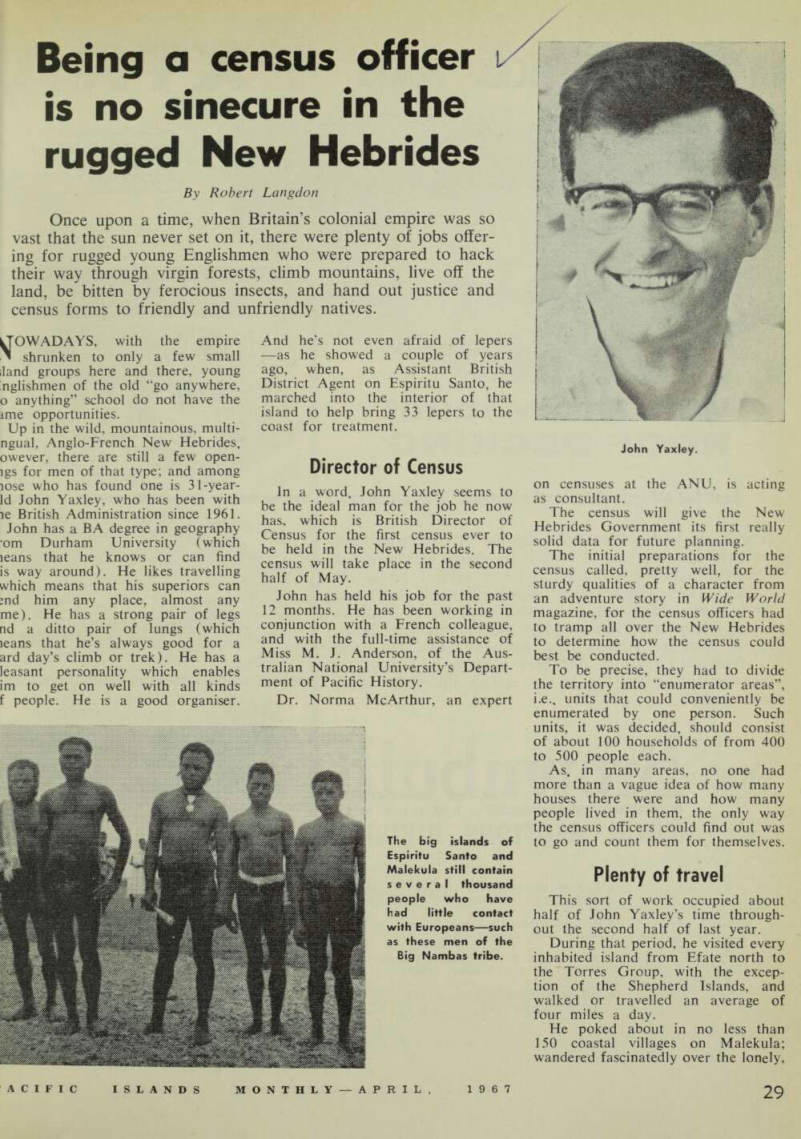
John has a BA degree in geography om Durham University (which leans that he knows or can find is way around). He likes travelling which means that his superiors can md him any place, almost any me). He has a strong pair of legs nd a ditto pair of lungs (which leans that he’s always good for a ard day’s climb or trek). He has a leasant personality which enables im to get on well with all kinds f people. He is a good organiser.
And he’s not even afraid of lepers —as he showed a couple of years ago, when, as Assistant British District Agent on Espiritu Santo, he marched into the interior of that island to help bring 33 lepers to the coast for treatment.
Director of Census
In a word, John Yaxley seems to be the ideal man for the job he now has, which is British Director of Census for the first census ever to be held in the New Hebrides. The census will take place in the second half of May.
John has held his job for the past 12 months. He has been working in conjunction with a French colleague, and with the full-time assistance of Miss M. J. Anderson, of the Aus tralian National University’s Depart ment of Pacific History.
Dr. Norma McArthur, an expert
on censuses at the ANU, is acting as consultant.
The census will give the New Hebrides Government its first really solid data for future planning.
The initial preparations for the census called, pretty well, for the sturdy qualities of a character from an adventure story in Wide World magazine, for the census officers had to tramp all over the New Hebrides to determine how the census could best be conducted.
To be precise, they had to divide the territory into “enumerator areas”, i.e., units that could conveniently be enumerated by one person. Such units, it was decided, should consist of about 100 households of from 400 to 500 people each.
As, in many areas, no one had more than a vague idea of how many houses there were and how many people lived in them, the only way the census officers could find out was to go and count them for themselves.
Plenty of travel
This sort of work occupied about half of John Yaxley’s time through out the second half of last year.
During that period, he visited every inhabited island from Efate north to the Torres Group, with the excep tion of the Shepherd Islands, and walked or travelled an average of four miles a day.
He poked about in no less than 150 coastal villages on Malekula; wandered fascinatedly over the lonely.
The big islands of Espiritu Santo and Malekula still contain several thousand people who have had little contact with Europeans—such as these men of the Big Nambas tribe.
John Yaxley.
spopulated Torres Islands; and made intact with the little-known bush ;ople in the interior of Espiritu into.
When John and his French col ague had established the where louts of the various villages, the hole of the New Hebrides was vided into 188 enumerator’s areas, hen work began on preparing in ructions in English, French and idgin for the enumerators, and in loosing and training them.
As the success of the census will timately depend on the enumera rs, every effort has been made to id active young people of the ghest calibre for the job.
Most of those who finally were losen are graduates of Kawenu ;acher Training College in Vila, French moniteurs. Their ages are nerally between 18 and 25.
Special training courses extending 'er several days were held for the mmerators in Vila a few months ;o when an education conference ithered many of them in the town the same time.
To obtain the greatest possible iblic co-operation in the census, e reasons behind the census have en publicised over Radio Vila and the government newsletters; and here opposition to it can be expected ■as in parts of the cargo cult island Tanna—the census team has done best to allay the people’s fears of xation or military draft.
Biggest problem
Now, with only a few weeks to before the census is held, most the groundwork of preparation s been done, and the census officers obably have a better idea of how tackle their biggest problem than ey did when I spoke to John Yaxley Vila late last year.
“Our chief problem,” he told me 1 that occasion, “is going to be king a census of the bush people the interior of Espiritu Santo.
“The trouble is that the bush ople live right on the crests of 2 mountains [which reach a height several thousand feet], and to get am one of their villages to another, u have to climb down one moun n and up another.
“We don’t quite know how we’re ing to deal with those people yet. ice the rains finish about February March, they go walkabout.
“We therefore can’t hope to census ;m in the normal census period, d we might have to do it with lice patrols.
“One suggestion is that we hold a I feast and get them all together at way.
“The bush people—there are about 1,800 of them—are scattered over an area of about 400 square miles. It takes you two to three days to reach that area from the coast, and in some parts—from Tasariki to Pic Santo, for example—it can take two days to cover 15 miles . . .”
That, of course, sounds like pretty tough going. But I got the im pression that when John Yaxley climbed the peak last year, he en joyed every minute of it.
“From the top of Pic Santo, which is just under 6,000 ft,” he told me with a faraway look in his eyes, “you can see Aoba, the whole of Espiritu Santo, and both the Torres and Banks Groups. It is a marvellous sight . . .”
Such a panorama has certainly not been seen by many Europeans, for few Europeans have ever climbed the peak.
Probably few of the few who have done so would care to do it twice.
But I fancy that John Yaxley might.
If so, there shouldn’t really be any difficulty about finding out just who is who among those Santo bush people, for John will just go off to the interior and census them all him self.
Footnote: Because of the generally backward nature of the New Hebrides, the census questionnaires will be confined to a minimum num ber of useful questions, i.e., name, relationship to the head of the house hold, sex, age, marital status, details of children (in the case of women), ethnic origin, place of birth, religion and occupation.
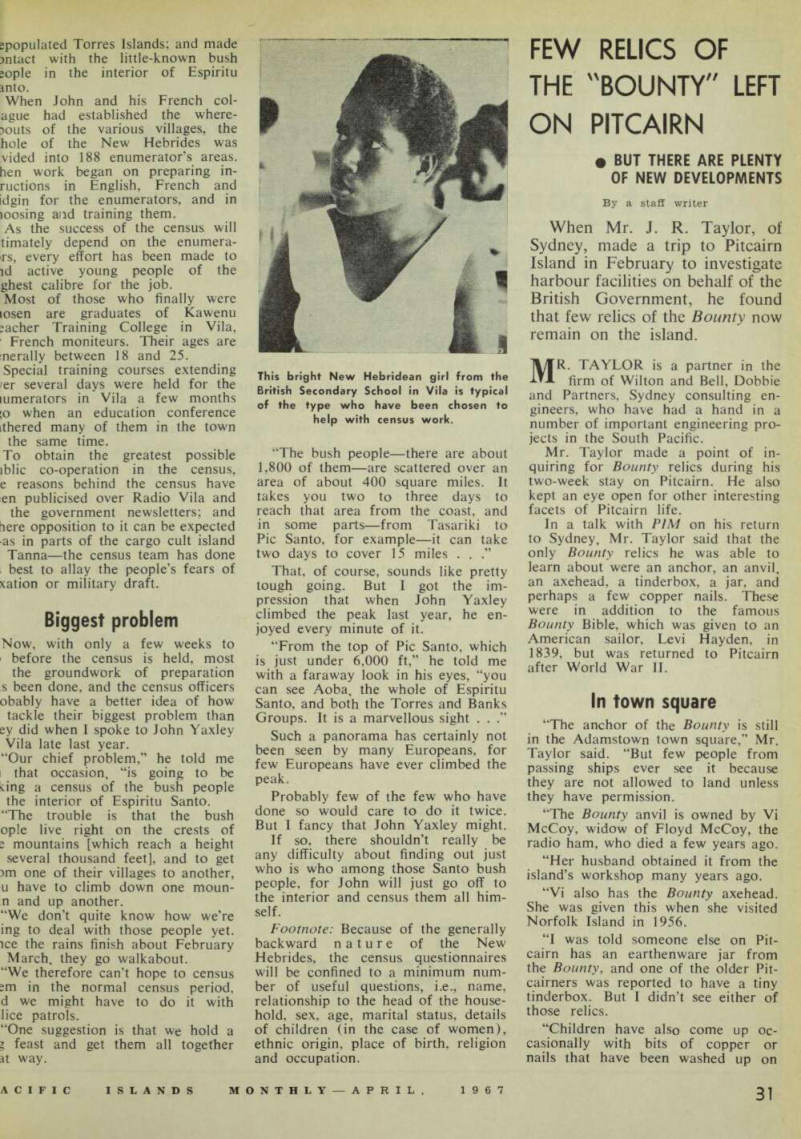
This bright New Hebridean girl from the British Secondary School in Vila is typical of the type who have been chosen to help with census work.