Tropicalities
pp. 23-27 · Read in the full issue

When it comes to cashing in on postage stamp issues and souvenir coins, there is no government in the South Pacific with a keener eye for business than the Government of Tonga.
DNGA’S circular stamps on gold foil, its heart-shaped stamps, its nps in the shape of the island of igatapu, and its gold coins of a years ago, were all issued solely collectors’ items, and all brought handsome profits to the Tongan asury. low Tonga is poised to set its i registers ringing again, with the oduction of decimal currency in kingdom on April 3 (see p. 146). or the coin collectors of the Id. the government has had 5,000 :imens of each of its new coins ck by the Royal Mint in London n “special high mirror-finish dies”, ch were destroyed as soon as the ting was completed, hese coins, along with the regular is, will go on sale to collectors on Day, as will crisp, mint copies he kingdom’s new banknotes, here are seven coins and five knotes in Tonga’s new currency, unit of which is the pa’anga □ivalent to the old 10/-). The uga is divided into 100 seniti its).
Unusual date
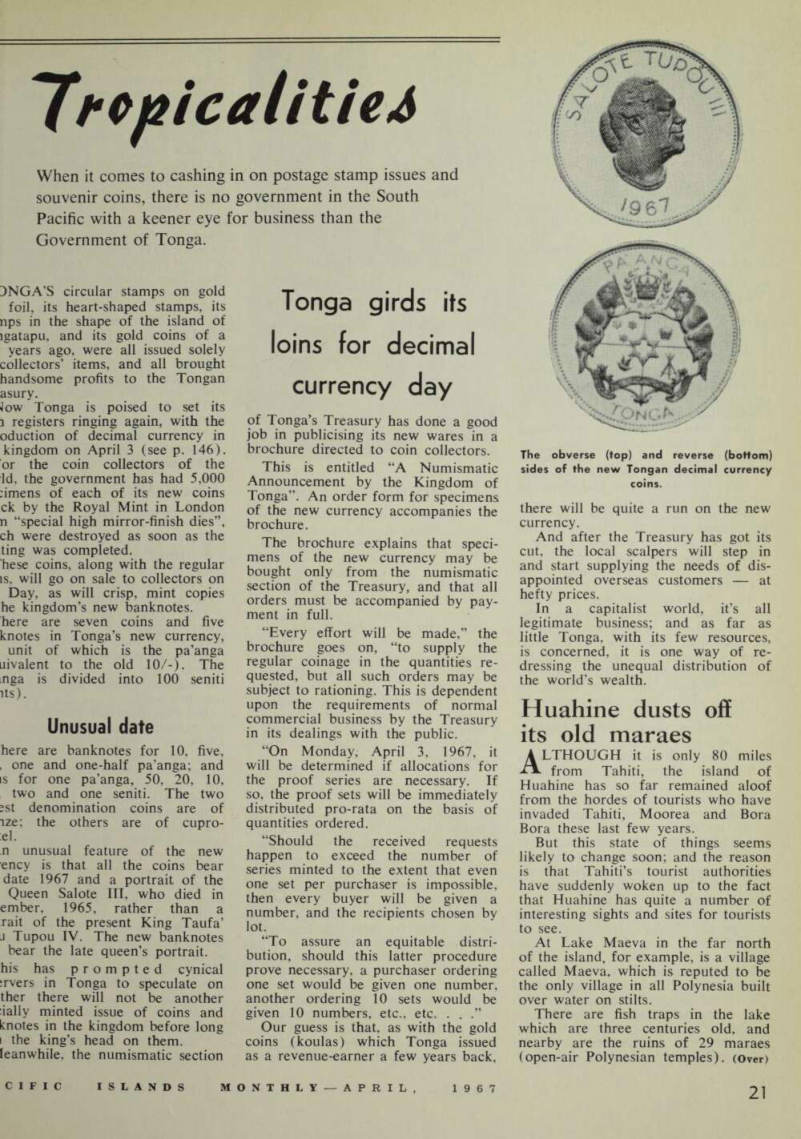
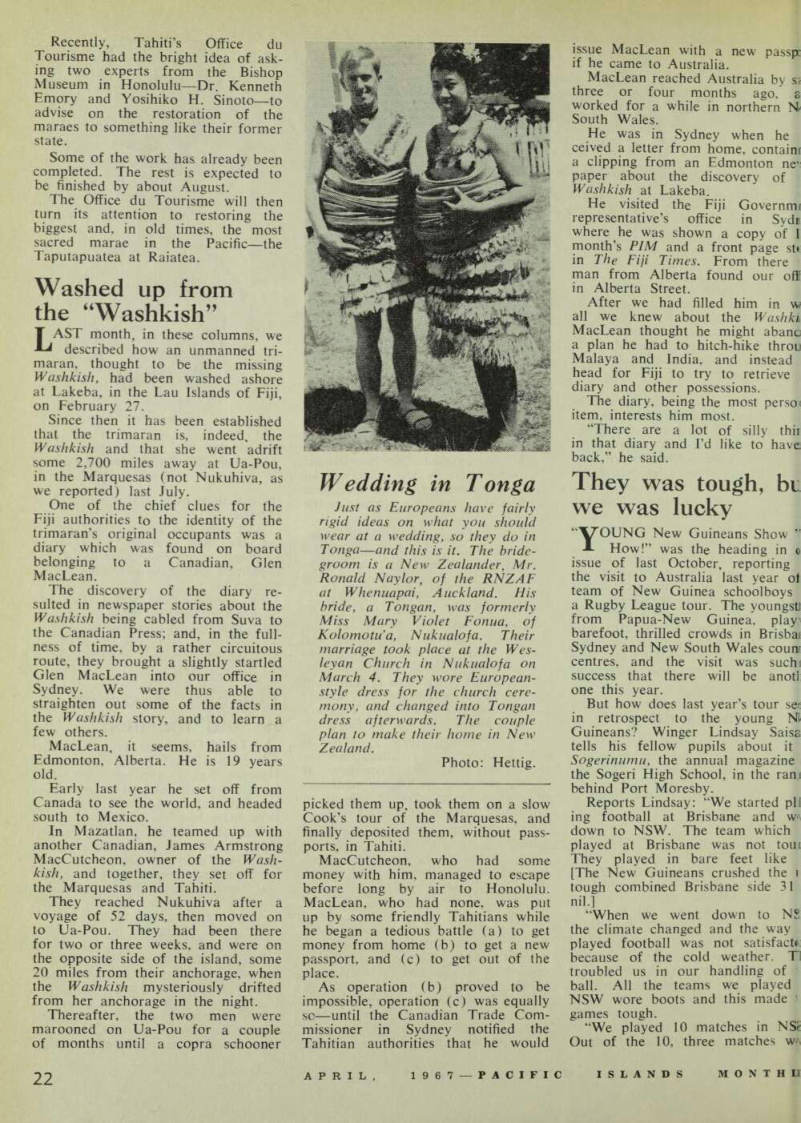
here are banknotes for 10, five, , one and one-half pa’anga; and is for one pa’anga, 50, 20, 10, two and one seniti. The two ;st denomination coins are of ize: the others are of cupro ;el. n unusual feature of the new ency is that all the coins bear date 1967 and a portrait of the Queen Salote 111, who died in ember, 1965, rather than a rail of the present King Taufa’ j Tupou IV. The new banknotes bear the late queen’s portrait, his has prompted cynical :rvers in Tonga to speculate on ther there will not be another :ially minted issue of coins and knotes in the kingdom before long i the king’s head on them, leanwhile, the numismatic section
Tonga girds its loins for decimal currency day
of Tonga’s Treasury has done a good job in publicising its new wares in a brochure directed to coin collectors.
This is entitled “A Numismatic Announcement by the Kingdom of Tonga”. An order form for specimens of the new currency accompanies the brochure.
The brochure explains that speci mens of the new currency may be bought only from the numismatic section of the Treasury, and that all orders must be accompanied by pay ment in full.
“Every effort will be made,” the brochure goes on, “to supply the regular coinage in the quantities re quested, but all such orders may be subject to rationing. This is dependent upon the requirements of normal commercial business by the Treasury in its dealings with the public.
“On Monday, April 3, 1967, it will be determined if allocations for the proof series are necessary. If so, the proof sets will be immediately distributed pro-rata on the basis of quantities ordered.
“Should the received requests happen to exceed the number of series minted to the extent that even one set per purchaser is impossible, then every buyer will be given a number, and the recipients chosen by lot.
“To assure an equitable distri bution, should this latter procedure prove necessary, a purchaser ordering one set would be given one number, another ordering 10 sets would be given 10 numbers, etc., etc, . , .”
Our guess is that, as with the gold coins (koulas) which Tonga issued as a revenue-earner a few years back,
there will be quite a run on the new currency.
And after the Treasury has got its cut, the local scalpers will step in and start supplying the needs of dis appointed overseas customers at hefty prices.
In a capitalist world, it’s all legitimate business; and as far as little Tonga, with its few resources, is concerned, it is one way of re dressing the unequal distribution of the world’s wealth.
Huahine dusts off
its old maraes
ALTHOUGH it is only 80 miles from Tahiti, the island of Huahine has so far remained aloof from the hordes of tourists who have invaded Tahiti, Moorea and Bora Bora these last few years.
But this state of things seems likely to change soon; and the reason is that Tahiti’s tourist authorities have suddenly woken up to the fact that Huahine has quite a number of interesting sights and sites for tourists to see.
At Lake Maeva in the far north of the island, for example, is a village called Maeva, which is reputed to be the only village in all Polynesia built over water on stilts.
There are fish traps in the lake which are three centuries old, and nearby are the ruins of 29 maraes (open-air Polynesian temples). (Over)
The obverse (top) and reverse (bottom) sides of the new Tongan decimal currency coins.
Recently, Tahiti’s Office du Tourisme had the bright idea of ask ing two experts from the Bishop Museum in Honolulu—Dr. Kenneth Emory and Yosihiko H. Sinoto—to advise on the restoration of the maraes to something like their former state.
Some of the work has already been completed. The rest is expected to be finished by about August.
The Office du Tourisme will then turn its attention to restoring the biggest and, in old times, the most sacred marae in the Pacific—the Taputapuatea at Raiatea.
Washed up from
the “Washkish”
LAST month, in these columns, we described how an unmanned tri maran, thought to be the missing Washkish, had been washed ashore at Lakeba, in the Lau Islands of Fiji, on February 27.
Since then it has been established that the trimaran is, indeed, the Washkish and that she went adrift some 2,700 miles away at Ua-Pou, in the Marquesas (not Nukuhiva, as we reported) last July.
One of the chief clues for the Fiji authorities to the identity of the trimaran’s original occupants was a diary which was found on board belonging to a Canadian, Glen Mac Lean.
The discovery of the diary re sulted in newspaper stories about the Washkish being cabled from Suva to the Canadian Press; and, in the full ness of time, by a rather circuitous route, they brought a slightly startled Glen Mac Lean into our office in Sydney. We were thus able to straighten out some of the facts in the Washkish story, and to learn a few others.
Mac Lean, it seems, hails from Edmonton, Alberta. He is 19 years old.
Early last year he set off from Canada to see the world, and headed south to Mexico.
In Mazatlan, he teamed up with another Canadian, James Armstrong MacCutcheon, owner of the Wash kish, and together, they set off for the Marquesas and Tahiti.
They reached Nukuhiva after a voyage of 52 days, then moved on to Ua-Pou. They had been there for two or three weeks, and were on the opposite side of the island, some 20 miles from their anchorage, when the Washkish mysteriously drifted from her anchorage in the night.
Thereafter, the two men were marooned on Ua-Pou for a couple of months until a copra schooner
picked them up, took them on a slow Cook’s tour of the Marquesas, and finally deposited them, without pass ports, in Tahiti.
MacCutcheon, who had some money with him, managed to escape before long by air to Honolulu.
Mac Lean, who had none, was put up by some friendly Tahitians while he began a tedious battle (a) to get money from home (b) to get a new passport, and (c) to get out of the place.
As operation (b) proved to be impossible, operation (c) was equally so—until the Canadian Trade Com missioner in Sydney notified the Tahitian authorities that he would
issue Mac Lean with a new passpc if he came to Australia.
Mac Lean reached Australia by s< three or four months ago, s worked for a while in northern N< South Wales.
He was in Sydney when he ceived a letter from home, containr a clipping from an Edmonton ne 1 ; paper about the discovery of Washkish at Lakeba.
He visited the Fiji Governrm representative’s office in Sydn where he was shown a copy of 1 month’s PIM and a front page st« in The Fiji Times. From there man from Alberta found our off in Alberta Street.
After we had filled him in w all we knew about the Washki Mac Lean thought he might abano a plan he had to hitch-hike throu Malaya and India, and instead head for Fiji to try to retrieve diary and other possessions.
The diary, being the most person item, interests him most.
“There are a lot of silly thii in that diary and I’d like to haves back,” he said.
They was tough, bu
we was lucky "3LTOUNG New Guineans Show A How!” was the heading in o issue of last October, reporting the visit to Australia last year of team of New Guinea schoolboys a Rugby League tour. The youngstf from Papua-New Guinea, play' barefoot, thrilled crowds in Brisbat Sydney and New South Wales count centres, and the visit was sucht success that there will be anotl: one this year.
But how does last year’s tour sec in retrospect to the young M Guineans? Winger Lindsay Saiss tells his fellow pupils about it Sogerinumu, the annual magazine the Sogeri High School, in the rant behind Port Moresby.
Reports Lindsay: "We started pi; ing football at Brisbane and w\ down to NSW. The team which played at Brisbane was not tout They played in bare feet like [The New Guineans crushed the i tough combined Brisbane side 31 nil.] "When we went down to NS the climate changed and the way played football was not satisfacto; because of the cold weather. TI troubled us in our handling of ball. All the teams we played NSW wore boots and this made ‘ games tough.
“We played 10 matches in NSe Out of the 10, three matches w«v
ists against the State team. We won i first and third Tests, while NSW m one.
“We were the curtain-raiser to the istralia v. Great Britain Third Test ■ies. This was the first time we d seen such a crowd at the Sydney icket Ground. We were nervous icn we ran out on to the field be tse of the crowd. The attendance that day was about 80,000, which more than the population of Port Dresby. ‘The NSW team was very tough 1 they were better than us but we srwhelmed them in this game, le result was 13 to 5.] The worst game we played in W was in Wagga Wagga. It was ning and freezing when we were ying. We couldn’t feel the ground our legs were numb. We just n the game, 3 to nil.” )ur comment is, God help the stralians if this year’s weather is rmer!
he case of the
issing governor
fITH TV lawyer Perry Mason (alias Raymond Burr) living y a few hundred miles away on tauba Island, Fiji, the people of icrican Samoa will not have to far for expert advice if they should denly decide to make an inquiry ) what has become of their No. 1 linistrator. Governor H. Rex Lee. iver since his arrival in Pago Pago May, 1961, Governor Lee has er exactly been chair-bound.
At the flick of one of those cere monial fly-whisks that Samoan talk ing chiefs carry, he has been ready to dash off to Apia, Hawaii, Wash ington, Antarctica, or anywhere else to discuss the business of State.
American Samoans have long ago grown accustomed to the periodical absences of their Governor. But never in the past six years have they seen so little of him as they have in the past 15 months, A correspondent reports, rather gloomily we feel, that in the 365 days of last year, Governor Lee was absent from home base for no less than 200-odd of them; and in the first 12 weeks of this year, he did not spend a single day in the territory.
Governor Lee’s absences last year included trips to the United States, one to New Delhi, and several brief visits to neighbouring territories.
One of his US visits lasted 83 days, and one lasted a month. His seventh visit to the States for the year—to attend talks on hearings in the Pacific Air Routes case—began on December 19 and hadn’t ended when these pages went to press.
He was in Paris in March, attend ing a conference on broadcasting and television.
But meanwhile there is speculation in American Samoa about when Governor Lee will take another post elsewhere—for he has been in the territory now for six years, longer than any other Governor.
And there is speculation on whether the Territorial Secretary, Owen S. Aspinall, really will get the
Governor’s job if and when Governor Lee finally goes.
Aspinall, the locals say, has been keeping Governor Lee’s seat warm for so long now that he must have begun to think that the chair is his.
Those new people in
Government House
ft LACK and White, a small Port Moresby satirical magazine, put its finger on it when it reported the public welcome to Papua-New Guinea’s new Administrator, Mr.
David Hay. “The social climbers were out in force”, said Black and White, “hoping that the New Boss would notice their eager faces in the crowd”.
After 14 years in Government House, Sir Donald and Lady Cleland had close friends as well as also rans; hobbies, interests and pet or ganisations. And everybody knew of them.
But what of Mr. and Mrs. Hay?
What and who are their likes and dislikes? Who will be the in-crowd?
Does one give up golf and take up tennis? Does one join the Yacht Club?
Port Moresby’s active social set
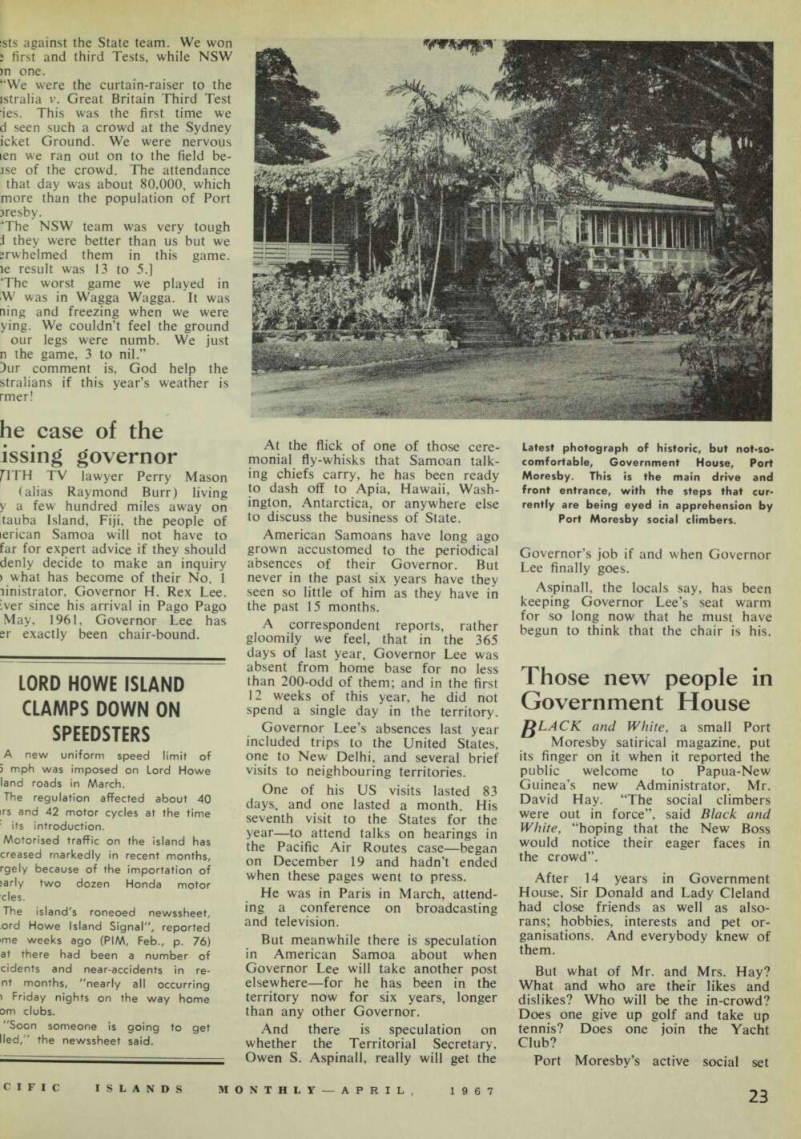
Latest photograph of historic, but not-so comfortable, Government House, Port Moresby. This is the main drive and front entrance, with the steps that cur rently are being eyed in apprehension by Port Moresby social climbers.
currently surveying the possible ;cking order with some appre msion. A close eye has been kept 1 all signals from Government ouse. But Mr. Hay and his wife, ith long diplomatic experience (the :w Administrator was once Aus alia’s Ambassador to the UN, and Bangkok, and High Commissioner Canada) have given no clues, bviously they are playing it by ear.
But it has not gone without notice at Mrs. Hay (see photo on p. 42) kes a closer look at standards of ess for Government House nctions than did the Clelands. And at there will be some changes side GH.
The Clelands were at home in the mbling old house which dates from acGregor’s day, but it will be rprising if the Hays settle down easily to its lack of modern con niences. It has little but at- Dsphere and might in fact make a tier museum.
Why not a museum?
And, as a matter of fact, why ouldn’t it?
The Papua-New Guinea Museum s already outgrown its allotted ace beneath the House of Assembly lambers in Port Moresby.
And the Assembly itself will need are room with the enlargement of numbers following next year’s actions.
Set on an historic hill overlooking 2 harbour, surrounded by gardens at could well be the nucleus of an erdue Botanic Gardens for Port oresby, Government House could come a superb museum, and a w Government House could rise the hills behind.
Not that we are suggesting that is will solve the Port Moresby cial set’s current dilemma. Only ne will do that!