Independence
p. 13 · Read in the full issue
For Nauru?
By a Staff Writer
Showdown talks to decide whether the Jauruans will achieve their aim of in ependence by January 31 next will be in in Canberra on April 12. The lauruans are taking part with only one ertainty—that they will be offered
ouble the phosphate royalties they are
t present being paid for their rich hosphate. But independence? Who nows!
E Canberra talks will involve Nauru’s three trusteeship powers istralia, Britain and New Zea- —and a Nauruan delegation led ammer Deßoburt, and including economic advisers. e delegates will discuss Nauru’s itutional future and the future 2 phosphate industry. e full talks have been scheduled ipril only as a result of pressure the Nauruans, who have been / irate at delays so far. early March, Deßoburt com- ;d to the president of the UN eeship Council that he was ed at the continued postponeof the talks, which were ad- 2d from July last year, and which to be held last October or last ■ary. He asked for help. hough he got his help, March 1 out to be a bad one f<pr burt, who has been living in )urne for several months while lally negotiating on the resump- )f the talks. >t, Australia s national newsthe Australian, came out with elusive page one story claiming he three trusteeship powers had 1 among themselves to give i independence by January 31 and that Deßoburt would be rime Minister of Nauru. eked, Deßoburt wired the Ausi Department of Territories deng to know why such an imit announcement should have given to the Press without i also being told. embarassed department replied tie newspaper’s story had noth-
ing to do with them, and that there was absolutely no basis for it anyway.
Hardly had this blown over when Deßoburt was outraged to learn from Nauru that Canberra had told the Nauruan Local Government Council that portion of the talks would be re sumed in April, and that the partner ship governments would offer 35/- a ton royalties for phosphate, instead of the present 17/6.
Not surprisingly the Head Chief saw this direct offer to the council while he was already in Australia as being aimed at driving a wedge be tween the council and himself as Nauruan leader. In a letter to the Minister for Territories, Mr. Barnes, he called for an apology and an as surance that this serious breach in protocol would never be repeated.
Another protest to UN
A copy of his protest went to the president of the Trusteeship Council, who was told that “very serious de terioration” had set in over Deßoburt’s relations with the partner governments.
This then is the position on the eve of the important Canberra talks.
The Nauruan view has hardened, and they are prepared to go all out to gain their main objectives—which are: full independence by January, 1968; rehabilitation of Nauru by the importation of soil, or alternatively, resettlement on another island; ad mission that the phosphate industry is legally theirs.
Above all they want independence, and like Soekarno’s demand on West
Irian, it has become a principle with them that they should achieve it on the date they have asked for. If not they will certainly put further pressure on the UN.
They have meanwhile invited Pro fessor J. W. Davidson, Professor of Pacific History at the Australian National University—who is a con stitutional expert—to advise them on matters affecting independence. Pro fessor Davidson has not yet decided whether he will accept the offer.
What will partners offer?
The most important unknown quantity to be revealed in the April talks is the extent to which the part nership governments are prepared to go to meet the Nauruan demand for independence.
Undoubtedly the three govern ments have settled on their brief, but despite the Australian's exclusive re port it is most improbable that the three governments will offer independ ence outright by next January.
If under heavy pressure, they could be expected to offer a limited form of internal self-government, with ad ministrative safeguards which they think the Nauruans need.
The partners do not feel the Nauruans are capable of running their own affairs by next January —nor are they. Nauru has not enough men of Deßoburt’s calibre.
The sticking point could well be that Head Chief Deßoburt is adamant that no offer of limited self-govern ment will be accepted. For him it is either independence or nothing.
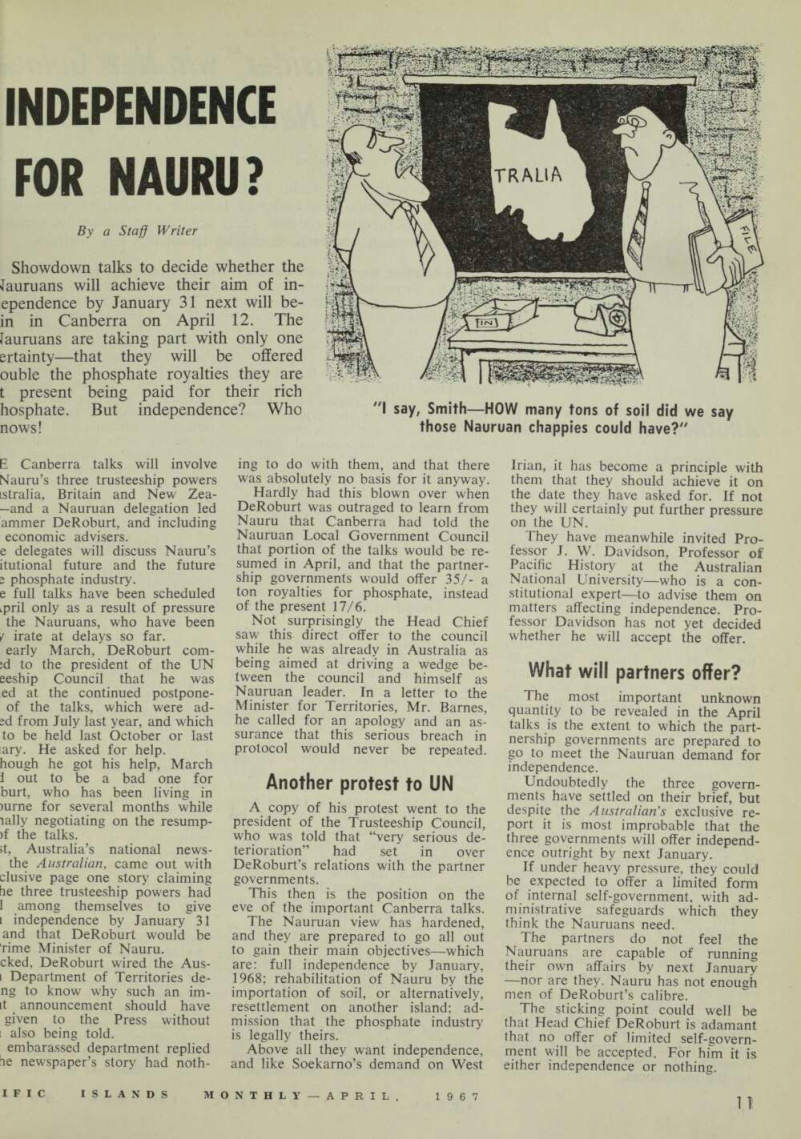
"I say, Smith—HOW many tons of soil did we say those Nauruan chappies could have?"