P-NG "watch dog" keeps an eye
pp. 145-146 · Read in the full issue
eye on public's money
From a Port Moresby correspondent Papua-New Guinea alone among South Pacific territories has an active parliamentary public accounts committee designed as a watch-dog on the spending of public money. It takes evi dence on oath and in public.
THE committee was established late ia 1965 following growing public dissatisfaction with the operations of the territory’s Public Works Depart ment, An elected member of the House of Assembly moved for a select committee to investigate the department’s activities.
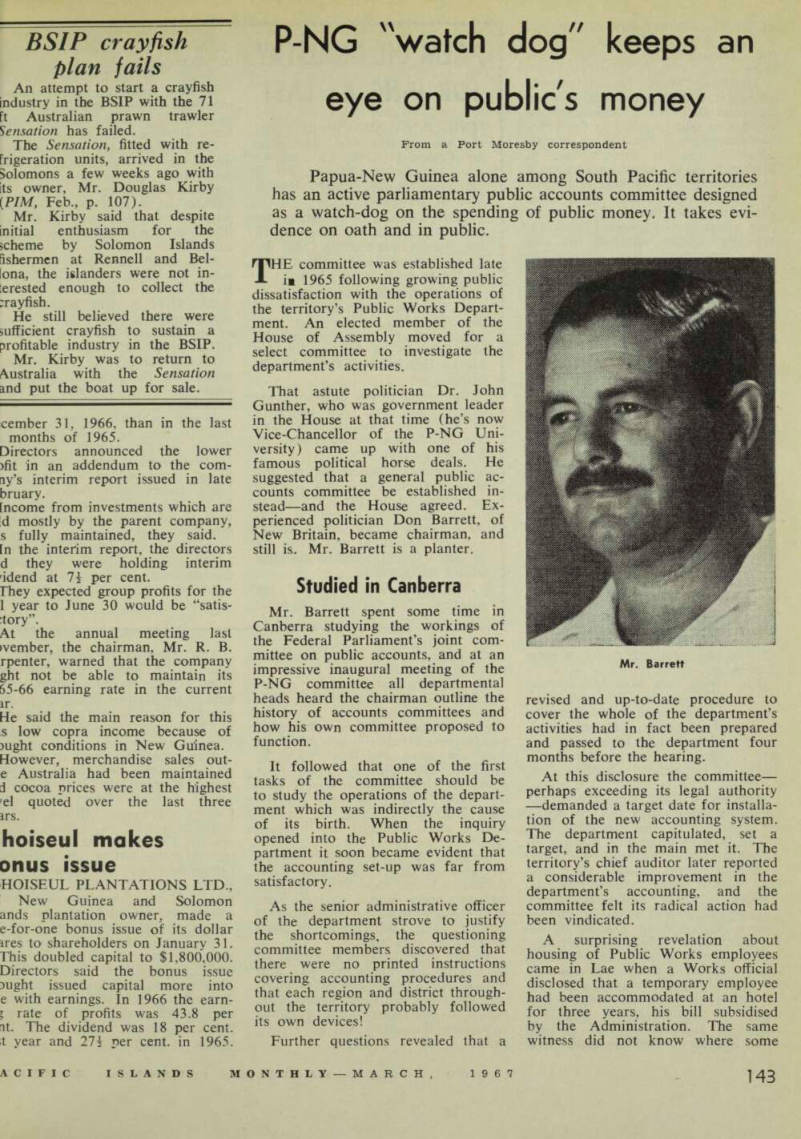
That astute politician Dr. John Gunther, who was government leader in the House at that time (he’s now Vice-Chancellor of the P-NG Uni versity) came up with one of his famous political horse deals. He suggested that a general public ac counts committee be established in stead—and the House agreed. Ex perienced politician Don Barrett, of New Britain, became chairman, and still is. Mr. Barrett is a planter.
Studied in Canberra
Mr. Barrett spent some time in Canberra studying the workings of the Federal Parliament’s joint com mittee on public accounts, and at an impressive inaugural meeting of the P-NG committee all departmental heads heard the chairman outline the history of accounts committees and how his own committee proposed to function.
It followed that one of the first tasks of the committee should be to study the operations of the depart ment which was indirectly the cause of its birth. When the inquiry opened into the Public Works De partment it soon became evident that the accounting set-up was far from satisfactory.
As the senior administrative officer of the department strove to justify the shortcomings, the questioning committee members discovered that there were no printed instructions covering accounting procedures and that each region and district through out the territory probably followed its own devices!
Further questions revealed that a
revised and up-to-date procedure to cover the whole of the department’s activities had in fact been prepared and passed to the department four months before the hearing.
At this disclosure the committee— perhaps exceeding its legal authority —demanded a target date for installa tion of the new accounting system.
The department capitulated, set a target, and in the main met it. The territory’s chief auditor later reported a considerable improvement in the department’s accounting, and the committee felt its radical action had been vindicated.
A surprising revelation about housing of Public Works employees came in Lae when a Works official disclosed that a temporary employee had been accommodated at an hotel for three years, his bill subsidised by the Administration. The same witness did not know where some
Mr. Barrett
of the New Guinean officers employed by the department lived—certainly the Administration did not house them.
The Public Works Department was again unfavourably in the news when the committee did a “lightning” in vestigation into spending in the 1965- 66 financial year. Head office officials admitted that an over-spending of $lOO,OOO in the road maintenance vote for the New Guinea Highlands region was not known until after June 30, 1966, when the financial year ended. A somewhat reluctant Treasury official admitted that his own department was equally in ignorance.
Reddest face at the lightning in quiry was that of the Secretary for Labour, Mr. D. Parrish, who had been asked whether his department bore in its vote the costs of the Administration’s advocate at the lengthy arbitration hearing into local officers’ salaries.
“No,” said Mr. Parrish. “But, I’m sorry, yes,” said the Treasury official present at the hearing. “It has been decided that your department will bear these costs.”
Someone had forgotten to pass along the message!
Report accepted
First major report tabled in the House of Assembly by the commit tee was one on the Department of Education. To get first-hand evi dence for this report the committee had taken evidence in Port Moresby and 10 other centres, visited nu merous Administration and mission schools and received many written submissions.
The report was accepted by the House. It called for the people to carry a greater share in the financial burden of education, and one direct result is the recently announced sys tem of charging direct fees for pri mary and secondary schooling (see P- 39).
Another of the committee’s re commendations which will no doubt get attention by the Administration is one to have secondary students at Administration boarding schools contribute more towards their up keep, just as those at most missions schools do. The committee com mented that it had found it impos sible to arrive at an accurate figure for the cost of keeping one student for one year at an Administration school, because of varying methods of assessing costs, and because of the odd system operating in the ter ritory of absorbing all airfreight costs to Highlands centres in a general vote. This means that a pound of rice
is the same price in Mount Hagen as it is at coastal Lae.
In its investigations into educa tion the committee noted that stan dards of building design had been set so low that structural weaknesses had appeared before some buildings were completed, and they had to be modified. No allowance had been made for climatic conditions so that the same design was used for the cold Highlands as for the humid coastal areas, with obvious disadvan tages.
Perhaps the most obvious bungle was noted at Goroka and Lae, where dormitory blocks were completed with built-in wooden bunks. But these were removed as soon as the buildings were handed over, and two-decker steel bunks were installed.
Works officials estimated that at least S2OO per dormitory was thus wasted, but nobody seemed to know why there had not been closer liaison between departments. The accounts committee thought it was all a poor show.
This question of housing has s interested the six committee member (who include two Government menr hers of the House) that they are noc engaged in a full-scale investigatioc of the subject, together with tende and supply.
The committee seems to have di:i covered so far that the Administrs tion pays more attention to housim for its overseas officers than it do©» for New Guinean officers, and rm doubt this will be stressed in tbi report. The committee has criticises the delay in setting up a Housim Commission, as recommended by thi World Bank report, and it is likeli that a bill establishing the commissioc will be introduced before long at meeting of the Assembly.
Mr. Barrett says he is satisfied thsi his committee is serving a worth while purpose, and that disclosure already made, and the committees detailed reports, will do somethinn towards increasing the Administra tion’s efficiency. There can be lit® reason to doubt it.