850 tourists in one day
pp. 129-135 · Read in the full issue

—and the New Hebrides is ready for more
Prom a Vila correspondent About 850 cruise passengers from the Chandris Line cruise ship Queen Frederica disembarked for the day in Vila, Slew Hebrides, on January 27. It was a gala day for the town, vith the visitors outnumbering the entire resident European Dopulation. It was the first time that so many tourists had
arrived together.
VREFUL planning by tourist
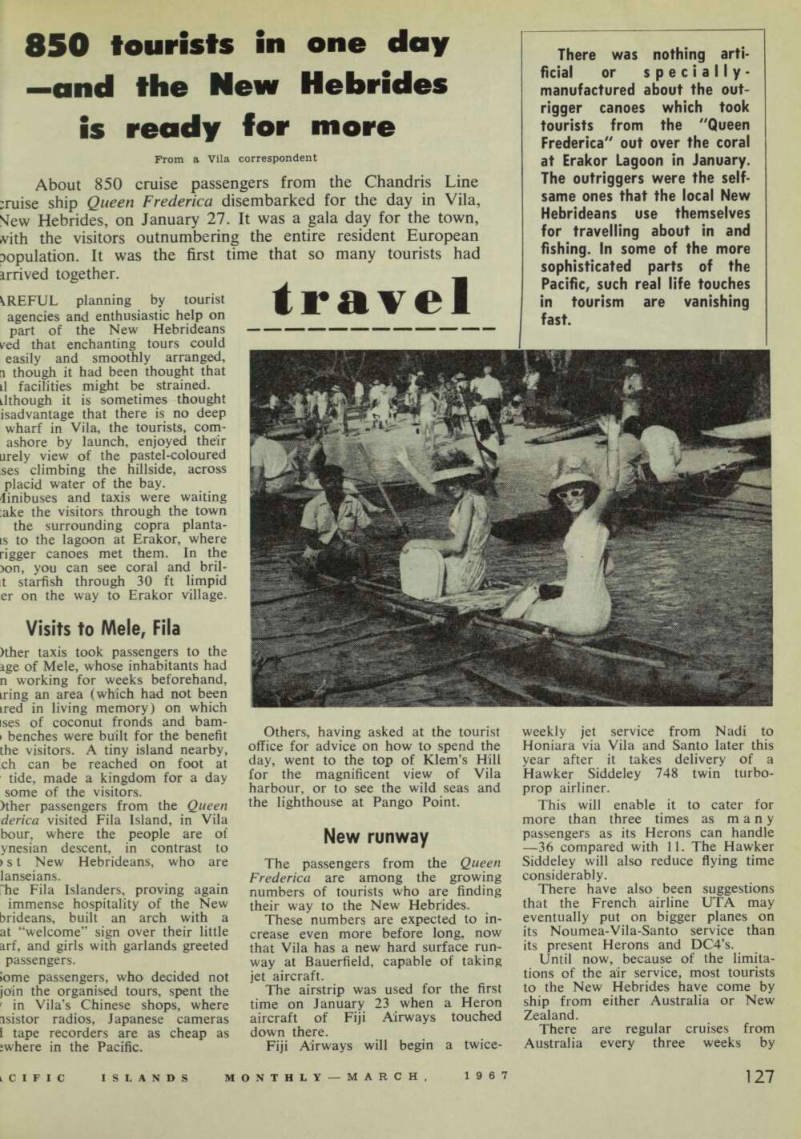
agencies and enthusiastic help on part of the New Hebrideans yed that enchanting tours could easily and smoothly arranged, n though it had been thought that il facilities might be strained, dthough it is sometimes thought isadvantage that there is no deep wharf in Vila, the tourists, com ashore by launch, enjoyed their Lirely view of the pastel-coloured ses climbing the hillside, across placid water of the bay. linibuses and taxis were waiting ;ake the visitors through the town the surrounding copra planta is to the lagoon at Erakor, where rigger canoes met them. In the x>n, you can see coral and bril t starfish through 30 ft limpid er on the way to Erakor village.
Visits to Mele, Fila
)ther taxis took passengers to the age of Mele, whose inhabitants had n working for weeks beforehand, iring an area (which had not been ired in living memory) on which ises of coconut fronds and bam . benches were built for the benefit the visitors. A tiny island nearby, ch can be reached on foot at tide, made a kingdom for a day some of the visitors, hher passengers from the Queen derica visited Fila Island, in Vila hour, where the people are of ynesian descent, in contrast to > s t New Hebrideans, who are lanseians.
'he Fila Islanders, proving again immense hospitality of the New brideans, built an arch with a at “welcome” sign over their little arf, and girls with garlands greeted passengers.
Jome passengers, who decided not join the organised tours, spent the r in Vila’s Chinese shops, where isistor radios, Japanese cameras I tape recorders are as cheap as iwhere in the Pacific.
Others, having asked at the tourist office for advice on how to spend the day, went to the top of Klem’s Hill for the magnificent view of Vila harbour, or to see the wild seas and the lighthouse at Pango Point.
New runway
The passengers from the Queen Frederica are among the growing numbers of tourists who are finding their way to the New Hebrides.
These numbers are expected to in crease even more before long, now that Vila has a new hard surface run way at Bauerfield, capable of taking jet aircraft.
The airstrip was used for the first time on January 23 when a Heron aircraft of Fiji Airways touched down there.
Fiji Airways will begin a twice
weekly jet service from Nadi to Honiara via Vila and Santo later this year after it takes delivery of a Hawker Siddeley 748 twin turbo prop airliner.
This will enable it to cater for more than three times as many passengers as its Herons can handle —36 compared with 11. The Hawker Siddeley will also reduce flying time considerably.
There have also been suggestions that the French airline UTA may eventually put on bigger planes on its Noumea-Vila-Santo service than its present Herons and DC4’s.
Until now, because of the limita tions of the air service, most tourists to the New Hebrides have come by ship from either Australia or New Zealand.
There are regular cruises from Australia every three weeks by
There was nothing arti ficial or specially manufactured about the out rigger canoes which took tourists from the “Queen Frederica" out over the coral at Erakor Lagoon in January.
The outriggers were the self same ones that the local New Hebrideans use themselves for travelling about in and fishing. In some of the more sophisticated parts of the Pacific, such real life touches in tourism are vanishing fast.
ssageries Maritimes and every ; weeks by Burns Philp; and three sssageries Maritimes passenger go ships pay week-long visits to New Hebrides on their way every weeks between Sydney and irseilles via Panama, fhe number of cruise ships—of China Navigation Co., Chandris le, Cogedar Line, etc.—has in ased steadily in recent years, n 1967, about 6,000 tourists are >ected to visit the New Hebrides ship. rhrough passengers entering and ving the New Hebrides on the ae ship are not required to pre it travel documents. But other itors must have a valid passport, visa unless they are British or mch, a smallpox vaccination tificate, and a return or onward ket to another country.
Pourists usually spend two or three in and around Vila, a sleepy onial town, set in the curve of a ignificent bay, with superb views sr the changing colours of the sea.
Although Vila lies in the tropics, itors in the cool season (from iril to October) are often surprised find that they must sleep under blanket, and that, although it is t generally too cold to swim at dday, the daytime climate is quite figorating.
The rest of the year, the pace of i is slower, with the temperature >und 80 deg., but still pleasant.
Casual clothes
Men wear shorts and Hawaiian irts in the daytime, and slacks and nilar shirts in the evening.
Women wear shorts, even in town, bright cotton prints, usually of ihitian inspiration.
The informality of the clothing is lected in friendly informality in ery aspect of life.
Visitors are usually interested to id that they are in the only con minium in the world, and enjoy the /id contrasts between sophisticated ench, staid British and exotic icific Islanders.
The medley of races gives a special arm to an evening spent dancing ider the stars near the thatched ofs of Vila’s night clubs.
It is fun to enjoy the French mbiance” and at the same time ive the convenience of finding that rtually everyone speaks English.
The multiplicity of currency is nusing and confusing. Australian Hinds, Australian dollars, French
cific francs all circulate together i payment is often made in a con ►meration of them all.
In the Post Office, to make it rder, there is another fictional trency, the gold franc, just for mps. This fiction, along with the e designs of New Hebrides stamps, viously appeals to collectors, since : sale of stamps is most profitable i could count as one of the New ;brides’ major exports!
Two hotels
Hotel accommodation is good, hough not really of international
Iss.
The Hotel Vate, built in 1964 to ;er for the increasing tourist ffic, is in the centre of town, and s 22 rooms with bath and toilet about SAB single and SAII double • the room only.
The Hotel Rossi is just across the id on the waterfront. It has a randah lounge built out over the i with a fine view of the harbour, ere are 12 rooms with shower and let at about SA6 single or SAB üble for room only.
Both hotels have restaurants with e French cooking—described by Dorters visiting the New Hebrides it year with General de Gaulle “some of the best cooking in the
Pacific”. Prices vary according to the Visitors’ choice, from about 5A1.70 upwards. There is a wide choice of good French wine.
At La Pagode, Vietnamese and Chinese dishes are served to order.
In the past five years, Vila has acquired most modern amenities.
There is a chemist shop, a bookshop, and a hairdresser who charges city prices (5A3.40 for a shampoo and set) but whose results are dis tinguished enough to justify the prices, French perfumes, cosmetics and wines are found in elegant display in the shops, and for the visitor shopping is fun because of the inter national atmosphere and the vestiges of quaint colonialism. j n t jj e biggest store in Vila, Comptoirs Francais des Nouvelles- Hebrides, you can buy everything, from liqueur-filled chocolates and Christian Dior lipsticks to cement mixers and farm machinery, Vila’s museum is the Cultural Centre, where there is a collection of stuffed birds, mats, skulls, prim itive carvings and a few shells. (The New Hebrides is a shell collector’s paradise and the exhibition in the museum does not really do justice to what can be found), If the visitor finds his interest in the early history of the New Hebrides is aroused, he can browse in the Cultural Centre’s library, which has a collection of books on the subject, long out of print and difficult to find elsewhere.
And if his visit to the Cultural
entre whets his appetite for prim ve art, he should visit the Tourist nquiries Office, further along the aterfront, where ritual masks and figies, of the kind once used in the iremonies concerned with promotion . a new rank in the village hierarchy, e for sale.
To some these weird objects are erely hideous, for others they have strange and compelling fascination, rices are reasonably low, SAS for mask for instance.
At present tours in Vila are only -ganised when a ship is in harbour, he half-day tour to Erakor (as ak e n by some of the Queen redericrfs passengers) costs SAS; lat to Fila, SA3.
Varied scenery
Many travellers, but usually the aunger ones, make the all-day ex irsion round the island of Efate.
The road is fairly rough, and at >me points watercourses must be >rded, so it does not appeal to those ho like to take things in comfort, ut it is an interesting trip with smarkably varied scenery for the lort distance.
A trip which can be arranged for nail groups through the Tourist nquiries Office in Vila is by sail ig canoe to the island of Lelepa ff the north coast of Efate.
It is an hour’s drive from town, ver the mountains behind Vila, up dem’s Hill, and on to Lelepa land ig. From there it is about an hour’s iil to the island, with its sleepy bite village and friendly New lebrideans. A handful of sweets isures popularity with the children.
On Lelepa are some magnificent ives, in which some ancient picto raphs have recently attracted the ttention of a French archaeologist.
Many tourists take a day trip to Tanna, a lush green island south of Vila, which is connected with it by Air Melanesia, the New Hebrides internal airline.
The trip enables visitors to see Mount Yasur, one of the most accessible active volcanoes in the world, ,and the pagan Tannese, who go about their everyday business in traditional grass skirts.
One of the best ways to spend a longer holiday in the New Hebrides is on board the Manutai, Burns Philp’s “seagoing store”, which goes on month-long cruises to 65 anchor ages in the islands. The fare is about $4 a day.
It provides a wonderful oppor tunity to meet the New Hebrideans in their own primitive villages.
Young and athletic visitors should
walk for four or five hours into the interior of Malekula to visit the Big Nambas, a people who have forgotten nothing of the Stone Age, and ac quired little from their contacts with civilisation.
The trip on the Manutai can be broken at any of the islands with an airfield, from which the tourist can return to Vila or Santo by plane.
To cater for the growing number of tourists to the New Hebrides, the Chamber of Commerce has re cently produced an informative brochure and has established the Tourist Enquiries Office, mentioned above.
In addition, representatives from the New Hebrides recently visited both Sydney and Fiji to meet travel agents and tell them what the New Hebrides has to offer; and Mr.
Marvin Plake, executive director of the Pacific Area Travel Association visited the New Hebrides for the first time.
On Efate, the main island in the New Hebrides and site of Vila, the New Hebrideans have long been wearing Western clothes. But in other parts of the Condominium, particularly on the big islands of Espiritu Santo and Malekula, some of the people are only just getting around to it. The picture at right, showing various degrees of acceptance of Western dress (or undress) was taken on Malekula in September last year at the opening of Lamap airfield, on the south-east side of the island. The natives are Big Nambas, whose territory is on the north-west side of Malekula. To reach Lamap, they had to travel some 40 miles. The lower picture shows the verandah lounge at the Hotel Rossi in Vila, one of the most popular eating and meeting places in the New Hebrides. The lounge is built over Vila Harbour.