Cruising Yachts
pp. 103-113 · Read in the full issue

Pacific Shipping And
Rabaul shipping mishaps show need for tighter regulations
From a Rabaul correspondent
The year 1967 has started badly for small ships operating out of Rabaul, and it seems that it is high time for a general overhaul of coastal shipping regulations in Papua-New Guinea.
REGULATIONS are needed that \ will allow a good deal of eedom of operation and will suit >cal conditions, but which will also aarantee maximum safety and can e readily enforced.
Small ships operating out of :abaul, which have come to grief so ir this year are: • The 16 ft cabin launch Ambess, r hich foundered in rough seas be veen the Gazelle Peninsula on anuary 5. Thirteen people are known a have drowned (PIM, Feb., p. 103). • The 20 ft motor launch Leo, 'hich was carried into the open sea nth seven people aboard on January 6 while travelling the 18 miles from labaul to the Duke of York Islands, he seven people on board, with little aod and no water, drifted 300 miles a the Solomons.
• The coastal cargo vessel Loatta, which was burned to the water line when a fire broke out while she was moored near a Rabaul slipway on January 22. o The Leilani, another coastal vessel with the same owners, which broke down on February 3 near Cape St. George, at the bottom end of New Ireland, and had to be towed to Rabaul. It was the second time the ship had broken down in a month.
The Ambess disaster occurred when the launch, which was owned by a Watom Islander and was in the charge of a teenage Tolai lad, was swamped in very rough seas while returning to Watom Island from the New Britain mainland.
The magnitude of the disaster was not clear for some days, nor was the total number of passengers who had
been in the launch at the time of the mishap.
Many people swam ashore when the vessel was swamped and Rabaul police experienced great difficulty in ascertaining the full passenger list.
Exhaustive inquiries eventually re vealed that more than 40 people had crowded into the launch. Moreover, the police found that less than an hour before the tragedy another 16footer, also grossly overloaded, had made the trip.
The Ambess was not registered with the marine authorities, hence it was not liable to the normal regula tions governing the operations of coastal vessels.
It is certain that no proper life-, saving equipment was carried.
It is equally certain that lifesaving equipment is not carried by most of the other small launches that ferry passengers between Watom, the Duke of York Islands and the New Britain mainland.
Tolai leaders expressed their con cern at the tragedy during a meeting of Gazelle Peninsula Local Govern ment Council and decided to ask the Administration to find means immedi ately of regulating the number of passengers carried in small vessels operating between Rabaul and off-, shore islands.
The councillors said they were
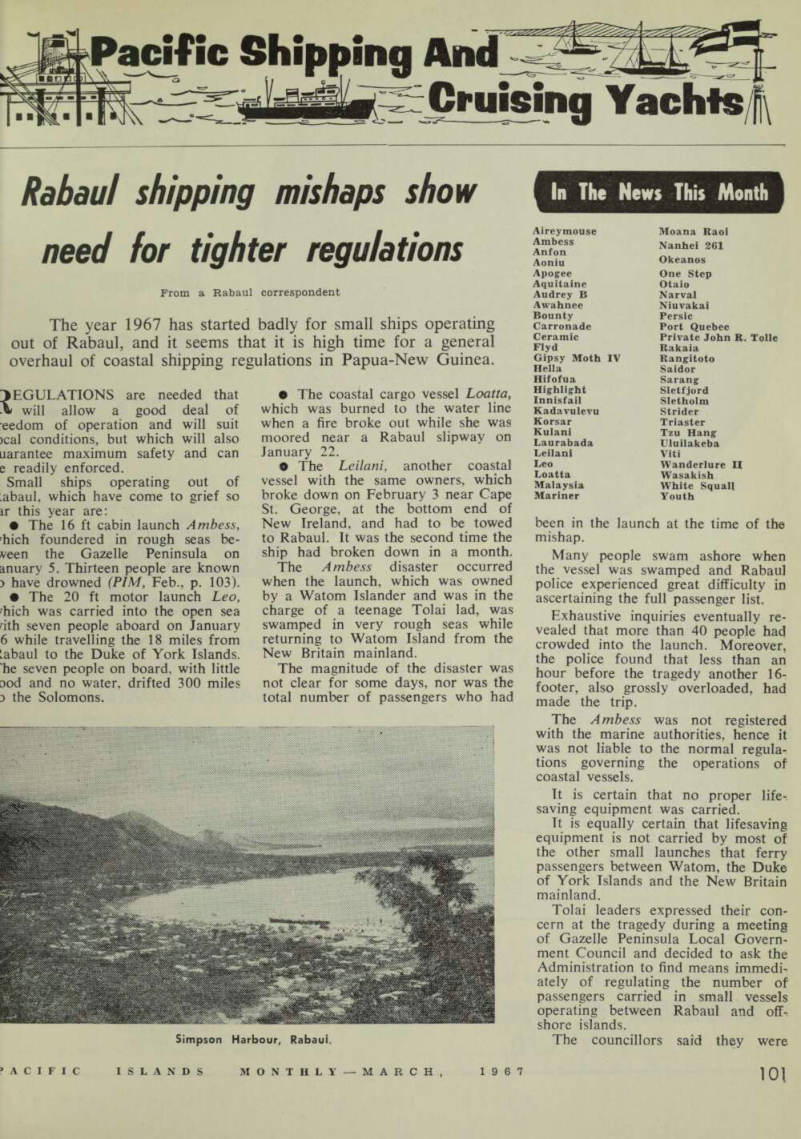
Simpson Harbour, Rabaul.
vund unharmed
ware of the problems of adequately [dicing regulations, but they still felt lat action was necessary.
The seven people aboard the Leo hen she was carried out to sea on muary 26 were found unharmed on omai Island, a remote island off uin, Bougainville, on February 9.
They had drifted 300 miles in 11 iys with only 20 cans of fish (but d tin opener), 25 lb of raw rice, id no water.
A massive sea and air search of aters around Rabaul had failed and e seven people, comprising an old oman, four men and two children, ere considered drowned.
Heavy seas were running at the ne.
According to preliminary reports, e engine of Leo failed three miles om Rabaul and the launch was Tried out to sea.
After 11 days under a blazing sun, e launch was washed ashore at omai Island at 6 p.m. on February The crew and passengers were dis ivered by an agricultural officer, jter Steele, on an infrequent patrol the island from Buin.
They were taken to Buin aboard eele’s yacht and were to be flown ick to Rabaul on the first available rcraft.
Their launch was a write-off.
111-fortune
111 fortune has dogged the owners the coastal ships Loatta and dlani. The Loatta, of 250 tons, id been lying at anchor for some seks awaiting a berth on a Rabaul ipway and had moved close to e slipway only 24 hours before e was gutted.
Nothing was salvaged from the ip, which burned fiercely for several >urs. Her charred hull rests in a w feet of water.
The only person on the ship when e broke out was a New Guinean atchman who rowed ashore in a ngy to give the alarm.
However, by the time Rabaul fire igade reached the scene, the Loatta as alight from stem to stern and yond saving.
No cause of the fire was apparent, marine board of inquiry will in stigate the fire.
Only a few hours before the loss the Loatta, her owners received 3rd that their other vessel, the nlani, was adrift in the Solomon ;a with an engine breakdown.
She later got under way and reached Rabaul under her own power.
Less than two weeks later the same vessel again broke down and was towed to Rabaul.
Fiji Acts On Excess
Passengers
The Fiji Government is to legislate for stiffer penalties for carrying excess passengers, following a recom mendation from the 1964 Safety-at- Sea Commission headed by Mr.
Justice Knox-Mawer.
The commission was set up after the Kadavulevu disaster in which 89 of the 92 people on board lost
their lives. The ship, grossly over loaded, capsized and sank in the Koro Sea while on the way from Nairai to Suva (PIM, May, 1964, p. 95).
The Attorney-General, Mr. Justin Lewis, explaining a bill to amend shipping regulations, said existing pro visions had proved inadequate in practice, and were to be replaced by more comprehensive provisions “carrying a more realistic penalty to ensure against infringement”.
The Government proposes a fine not exceeding £5O for breaches, with additional fines, not exceeding £2O, for each excess person.
An offender may also be sent to
101 for a period not exceeding six lonths, and may be fined and nprisoned.
Picking up excess passengers at ight after leaving port with no more lan the legal number of passengers as been widely practised in Fiji in ic past.
It took a disaster of the magnitude f the Kadavulevu to raise a cry for litable action against it.
Orean Ships For
Evuka
A fleet of five Korean fishing ships ill be stationed at Levuka, Fiji, ader contract to the Pacific Fishing o. to fish for tuna.
The first of the five, the Nanhei 51, arrived in January, and was ton out in the fishing grounds.
With the addition of the Korean ups, the Pacific Fishing Co. has lore than 20 fishers based at Levuka.
Ew Ship For New
Uinea-Australia Run
The Kariander Line has bought its »urth ship for the Australia-New uinea run. It is a 264 ft ship with speed of 13 knots and a capacity : 3,000 tons. Called Saidor, after e port of Saidor between Madang id Lae, the ship was formerly used the European trade. Her name ien was Kon Ring.
Beginning in March, Saidor will ipplement the regular service be /een Sydney, Brisbane and Port Moresby provided by the company’s her ships, Sletholm, Sletfjord and irang.
Her master will be Captain Charles [acDonald, of Sydney, a former SW Maritime Services Board senior lot, and, since last year, master of e Sarang.
Ig Shipments For
Itcairn Island
Two unusually large shipments of ail and people arrived at Pitcairn land late last year.
On November 30, the ships Port uebec and Rakaia reached the island ith its second biggest mail delivery -40 bags. This rivalled the record of ) bags brought by a steamer during r orld War 11.
On December 9, 20 people, the rgest party of people to disembark the island from one ship since 156, arrived in the liner Ceramic. his beat the previous record set by
the Rangitoto in November, 1952, when 17 people arrived from Auck land.
The party in the Ceramic consisted mainly of Pitcarners returning home after short visits to New Zealand for vacations and medical treatment.
There was also a representative of the Crown Agents in England, Miss J. Toombs, who was to gather ideas for a new set of Pitcairn postage stamps.
Footnote: As far as PIM knows, the largest group of people to dis embark at Pitcairn at one time were the Pitcairners (the exact number does not seem to have been recorded) who returned to the island in the ship Charles Daggett in 1831 after an unsuccessful attempt to settle in Tahiti. Eighty-seven Pitcairners were involved in the Tahiti settlement scheme; 17 died; and a number returned in ships other than the Charles Daggett.
New Life For
"Viti"
The former Fiji motor-ship Viti sailed from Whangarei, North Auck land, early in February to become a refrigerated cargo ship in South-East Asia.
Now known as the Audrey B, she has been registered in Panama and will sail under the Panamanian flag.
For many years she lay derelict at an Auckland wharf. A writ against the ship was cleared in January.
Lae Wharf Facilities
"Abused"
A report by a special committee on wharf conditions at Lae charges some importers in Lae and the High lands with abusing the storage facilities.
The committee was set up after a public meeting in Lae in October, 1966.
The members, Messrs. P. D. W, Stedman, J. Moorhouse and R.
Phillips, said in their report that the only way to remedy cargo congestion at the wharf was to increase demurrage rates.
The committee also stated that: • It was clear that no funds would be available to improve the wharf storage position before 1968. • The increase in tonnage handled throungh Lae severely taxed the present facilities, ® The section of the community most vitally effected should examine every facet of cargo handling and their own record to see how changes could be brought about. 9 There was no tangible evidence to show that the present space avail able for storage on the wharf was inadequate, provided cargo was cleared quickly. • Unsystematic piling of cargo made it difficult for importers to identify their goods and remove them.
Explosives For Asau
The United States Antarctic supply vessel Private John R. Tolle arrived in Apia at the end of January with 1,000 squid bombs and 50 cases of gelignite from New Zealand to blast an entrance to a new deep water wharf at Asau on Savaii.
As a gesture of goodwill to Western Samoa, the United States bore the cost of the trip, estimated at over £lO,OOO.
The squid bombs were towed to Asau by barge in three shipments.
A team of New Zealand Navy divers is to carry out the blasting work at Asau, (over)
The Kariander Line has a new ship, "Saidor", to go on the Australia-New Guinea run (see below).
C Ship Rescues
Inese Seamen
Ihe 10,000-ton ship Triaster, longing to the British Phosphate mmissioners, picked up 18 seamen January 26 from the 80-ton inese fishing boat Anfon, which s drifting helplessly in big seas i high winds, some 270 miles east Honiara, BSIP.
Die Anfon was disabled and began sink when she broke a crank ift the previous day while fierce clone Dinah was raging.
Phe Triaster took the rescued sea n to Geelong, Victoria.
Phe Anfon foundered.
*Ect Shipping Service
0M Uk To Rarotonga
Phe Otaio arrived at Rarotonga ect from London in January with ;r 300 tons of sheet piling and A channel for Rarotonga’s Avatiu *bour. There were also 48 tons of nforcing steel, 55 tons of galvanised el pipe, Land Rovers and Mini ikes for the PWD, and almost 300 ;es of whisky. [t was the second direct consign nt from the UK to Rarotonga ce the advent of internal self /ernment.
Hie first was in August last year en the Shaw Savill Line’s Persic ived with a cargo of tin plate for md Foods Ltd. and a similar cargo the Otaio’s for the PWD. ( PIM, it., 1966, p. 101).
Panese Release Drift
Ttles In Pacific
lapanese tuna fishing vessels crating in the vicinity of Hawaii /e been dropping drift bottles over ard recently in an effort to study Tents in the area.
The bottles are being released der a programme sponsored by : Federation of Japan Tuna Fisher in’s Co-operative Associations.
Bottles have also been released off : west and east coasts of Australia 1 adjacent to New Zealand.
All areas are fished for tuna by 5 Japanese longline fleet.
Two types of plastic bottles are id. One is cylindrical, about 7 dies high and 3 inches in diameter, is red and white and has a yellow i. The other bottle is rectangular, out 6 inches long and 3 inches de. It is red and blue and also has yellow cap. Both bottles carry mbered postcards.
Persons finding the bottles on the aches are requested to fill out i postcard and return it to the US ireau of Commercial Fisheries □logical Laboratory, Honolulu,
THE Uluilakeba (head of Lakeba), built in Japan for the Lau Province of Fiji, arrived in Suva on her delivery voyage on Feb ruary 4.
She is owned by the Maritime Shipping Co-operative Association, which in turn, is owned by Lau Province, as principal shareholders, and various co-operative societies in the Lau Group.
The Uluilakeba is expected to trade between Suva and Lau ports.
Captain Don Wendt, who has had extensive marine experience in Fiji, will be master.
The ship has accommodation for 10 saloon passengers, and can carry about 70 deck passengers.
A crowd of about 2,000 welcomed the Uluilakeba when she arrived at the King’s Wharf (top picture).
About 300 women from Lau performed the traditional “cere” (welcome) ceremony, which included the presentation of gifts of tabua, masi, mats, clothing material and oil for officers and crew of the ship.
The “cere” ceremony is performed when a ship arrives from overseas for the first time.
The lower picture shows the women pouring oil over two members of the crew, while others prepare gifts for presentation.—Photos: Stan
Whippy.
I/Loana Raoi" To
: Sold
The GEIC Wholesale Society ship oana Raoi (232 net tons) arrived Suva in February for a pre-sale rvey.
The ship was advertised for sale PIM in January (p. 110), The crew which sailed the Moana wi to Suva left later for Hamburg Germany to take over her replace mt, also the Moana Raoi.
They expect to reach Tarawa on e delivery voyage in May.
The new Moana Raoi will be about ice as big as the old one, and will rry a crew of 30.
Captain E. V. Ward, a former aster of the old Moana Raoi, will master of the new ship.
Eta Wharf Almost Finished,
Ewak's Starts Soon
The $400,000, 218 ft by 38 ft wharf r Kieta, Bougainville, is to be lished in April, and transit sheds e expected to be erected on it by iptember. It is Bougainville’s first rerseas wharf. Most of Bougain- Ile’s annual 16,000 tons of copra handled through Rabaul, but 50 ir cent, of it is expected to be indled through Kieta in future.
Test piles are to be driven in April r Wewak’s new $500,000 wharf, be 150 ft by 40 ft. Designs will : finalised when the results of the st piles have been tabulated, inimum depth of water will be > ft.
)L0 Yachtsman Passes
.Ose To Norfolk Island
English yachtsman Sir Francis bichester, who set out from Sydney the end of January on the second g of his solo voyage round the □rid in his 53 ft yacht Gipsy Moth r , passed somewhat closer to Lord owe Island and Norfolk Island than ; originally intended {PIM, Feb., 17).
Sir Francis had only been gone om Sydney a couple of days when : ran into a fierce cyclone that most capsized his boat. The cyclone tused him to abandon his plan to ?ad for Cape Horn via the south r New Zealand and to go via the irth of New Zealand.
His new course took him less than )0 miles from Lord Howe Island id Norfolk, where he made aviation story 36 years ago by landing there a Gipsy Moth aircraft en route om Auckland to Sydney. The ipsy Moth was the first plane to iuch down at the two islands.
As Sir Francis sailed past Norfolk i Gipsy Moth IV on February 9,
;re was an exchange of radio jssages between the sea and the ore.
Sir Francis set the ball rolling by riding his best wishes to all his old ends on the island and to anyone 10 remembered him when he landed > plane there in 1931. He regretted at he could not call at the island, it said he had a job to do and had get on with it.
Later that day, the Administrator, r. Reg Marsh, sent Sir Francis the setings of the people of Norfolk, as congratulations on his recent ighthood.
Sir Francis replied that he was lighted and moved to receive the Iministrator’s message.
H)Io Operator
Ist Overboard
The radio operator on the Tongan ssel MV Aoniu was lost overboard the early hours of February 10.
The Aoniu was steaming from moa towards Vavau when, shortly ;er midnight, the third officer re rted that he thought he heard a out as if a man was falling over ard.
The ship’s course was reversed to ver her own track.
An immediate search aboard re aled that the radio operator was ssing, but a thorough search of the ja proved unsuccessful.
The radio operator was Tali lukeiaho, married with a family jident on Tongatapu. He was in > mid-thirties.
4D A Few Brief
Ems
• Mr. R, Speary, formerly master the Tonga tug, Hifofua, resigned me weeks ago and is to take up a ister’s appointment with Burns lilp (SS) Co. Ltd., at Suva. • Captain Peter Hough, who has en Acting Harbour Master in Fiji ice the retirement of Captain E. L. mes last year, has been appointed the newly-created post of Assistant rector of Marine and Senior arbour Master. • Captain R. L. Stringer, formerly ief officer in the Malaysia, has been pointed shipping inspector in the irine division of the Department of ade and Industry in Papua-New ainea. • Mr. C. F. Kerr, a harbour pert made available to the GEIC der the Australian South Pacific chnical Assistance Programme, rived in Tarawa in February for a o-week stay. Mr. Kerr was to make survey of the layout of the port at Betio.