everyday
pp. 87-91 · Read in the full issue

Using Nature's remedies for everyday ills
By Jane Gregor, in Suva
As naturally as a European would go to the medicine chest for an aspirin tablet, so the Fijian nips off into the bush and picks himself a leaf or two to cure his ills.
i LTHOUGH this practice goes back i. into the mists of time, it is just ; widespread and as matter-of-fact part of Fijian life today as ever it as. Fijians and part-Europeans, as ell as many of the older Kai-Vitis, rear by Nature’s remedies for the 'eryday ills of the family.
For instance, a Fijian friend of ine coming to visit me one day, alked in with a bunch of small, ;ht-green, rounded leaves.
“I saw them by your garden path,” e said, “and they’re just what I :ed.”
She asked for boiling water and ade an infusion of the leaves. The suiting liquid she drank.
“Very good for my sore stomach,” she said, with obvious delight.
The Fijian name of the plant was totodro. Being no botanist, I have been unable to discover either its English equivalent or its Latin name, but the leaves looked, to my untrained eye, not unlike wild violet leaves.
Vast catalogue
Stimulated by this experience, further inquiries led me to discover a vast catalogue of remedies obtained straight from nature, and, what is even more amazing, taken almost straight—often simply crushed in cold water, sometimes boiled, or, in the
case of stems or bark, scraped and pounded.
The whole art of curing ills by using the medical properties of the plants around you is known as drau ni kau, which means “leaves of the trees”.
At one time this meant specifically black magic, but today, although it can still have this connotation, it is generally used in the sense of nature healing or, shall we say, white magic.
Certainly, to the European newly encountering the subject, there is a hint of magic in the work of the wise men and women who practise the more advanced cures. And in the powerful massage, masi-masi, which I, myself, have experienced.
Following an operation some 10 years ago, I continually suffered backache with little relief from a variety of treatments.
But, recently, a part-European friend brought along to the house an elderly Fijian woman famed locally for her healing skills. She had the shrewd, small eyes of a monkey and although a bulky woman her hands were remarkably slim and fine.
While we talked, the “witch doctor”, as my friend designated the old lady, eyed me closely. Smoking almost non-stop, and enjoying a glass of beer, she asked various questions about my past medical history; my friend acted as interpreter.
“She will only be able to help if you truly believe she can do so,” I was told, “and if you will do as she says in every way.”
I agreed to this.
First, the three of us sat upon a mat; a small packet of kava powder
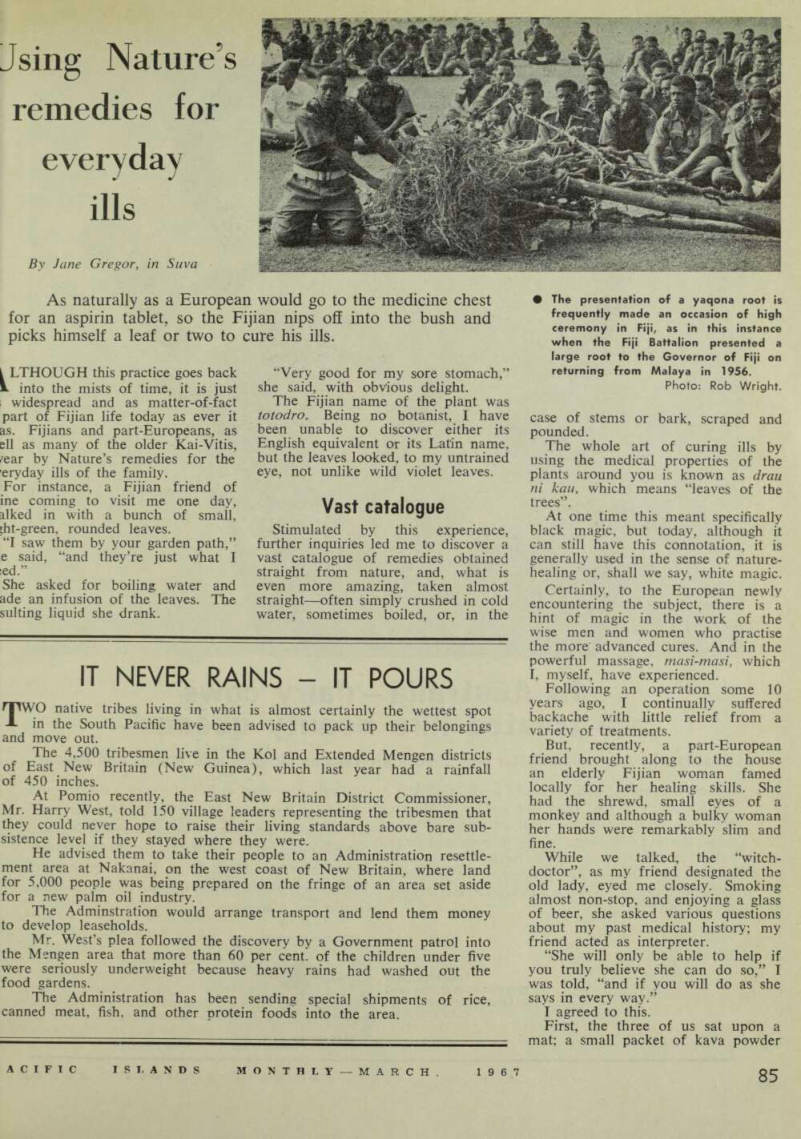
The presentation of a yaqona root is frequently made an occasion of high ceremony in Fiji, as in this instance when the Fiji Battalion presented a large root to the Governor of Fiji on returning from Malaya in 1956.
Photo: Rob Wright.
as placed between us while a prayer as offered up by the Fijian woman.
Then she gave me a cursory ex nination pressing particularly •ound the spot where the pain was ost marked. A few more questions ere asked. Then the old lady ■unted and got to her feet.
“Yes,” my friend nodded. “She inks she can help you. Go with sr.”
Into the bedroom we went, the d lady first pausing at the bath iom to wash her hands.
Soon, the whole of my body below e waist was being smoothed with ented coconut oil and the slim, own fingers began digging and mnding into me.
Both my back and my front were ven a thorough going over and I as hard put to it not to let out me undignified yells, but at the end some 20 minutes massage I had to Imit I felt less “knotted-up” than lual.
For the next two days the massage as given again and I was also given i assortment of pounded leaves hose juices I drank; it was not an ipleasant draught ... fresh and rthy ... tasting, in fact, rather ce a garden smells after fain.
I have to be honest; my backache considerably lessened.
Help for childless
There are many tales of the powers these “witch-doctors”. I have heard >w childless women have come om as far afield as New Zealand here every conventional help had iled, and the treatment by a Fijian ise woman has often enabled them have the babies they wanted.
An interesting sidelight is that these d women can often correctly pre ct the sex of the coming child. But ey won’t tell how they know!
Generally, the “witch-doctors” are Dmen, and the remedies for women’s irticular complaints are many, ime of them, incidentally, are kept ry strictly secret.
There are men with the knowledge nature-cures, too. One near Suva reputed to be exceptionally skilled deep massage.
Sprains, torn ligaments, rheumatic tins, are all cured by his skilful igers. Both men and women “witch >ctors” seem to have an excellent lowledge of anatomy and a tremend is self-confidence when it comes to sating their fellows.
Generally, the higher skills are ;reditary and kept within the family. ) far as my inquiries have led, there ems little practice of actual surgery, ;hough boils and abscesses are lanced ith splinters of bamboo or glass. In iys gone by, umbilical cords were
f The preparation of kava (yaqona) for ceremonial drinking is a business that Fijians always take great pains with.
Here it was being prepared by men of Malomalo for a visit by the Governor. —Photo: Rob Wright. so cut by bamboo, circumcision as carried out by the same instru ent, and no doubt emergency opera ans were attempted in times of real ;ed.
But what strikes the inquirer into ie Fijians’ remedies is the totally iselfconscious daily use of them by rery family.
Just as most country children in urope grow up knowing that a sting om a nettle will be eased if it is ibbed promptly by a leaf from the nghbouring dock plant, so every ijian seems to be born knowing a >od deal of the healing properties of e bushes and trees of his native nd.
Cure for dysentery
Dysentery is, in one form or lother, a widespread disease in this imp climate. Its Fijian name is ilou ni wai, meaning Spirit of the r ater, and the Fijians believe that breeds in the swamps and w-lying, damp places.
There are few of them who do not iffer its miseries every now and *ain.
But do they go to the chemist for cure? No, they simply drink an [fusion of the candle-nut (mulo ulo) tree. They also know that for ising an attack of neuralgia, there’s athing like mulo-mulo bark boiled i sea-water.
Fijian women quickly give their lildren papaw juice for upset omachs, adding a few of the seeds they suspect a vermifuge (drug » expel intestinal parasitic worms) needed.
And if they want an antiseptic, lere is a borage-like leaf called ote-bote to which they turn. There re a variety of laxative plants— a vuti being a mild one and moli ana another. There are soothing lices for inflamed eyes and there a tree whose twigs make splendid eaners and polishers for teeth.
A friend of mine habitually goes ito the garden and pulls a little ark from a shrub which I’ve so far een unable to identify or name, his she boils to produce a bright red quid which, in various dilutions, le administers to any of her brood ho may be in need of a tonic.
It has an astringent taste and looks ery like some of those spring-time >nics we are accustomed to buy •om our pharmacists. It seems to ave precisely the same effect, too, erking up a jaded appetite and
putting back some zing into the patient.
There is a wealth of nature lore stored in the everyday health practices of a Fijian. Some of it— a very little—has been recorded over the years.
But I hope that one day some learned soul will compile a detailed treatise on the Fijians’ folk-medicine, for it is a fact that European doctors freely accept that there are native cures for cases which they, in their up-to-date hospitals— vale ni mate or “house of death” to the older Fijians —have been unable to treat.
More of us might then know just which leaves to pick from which tree or bush and so enjoy that state of shining good health which is so en viable a characteristic of the Fijians.