To The Point
pp. 55-61 · Read in the full issue


With
Percy
Chatterton
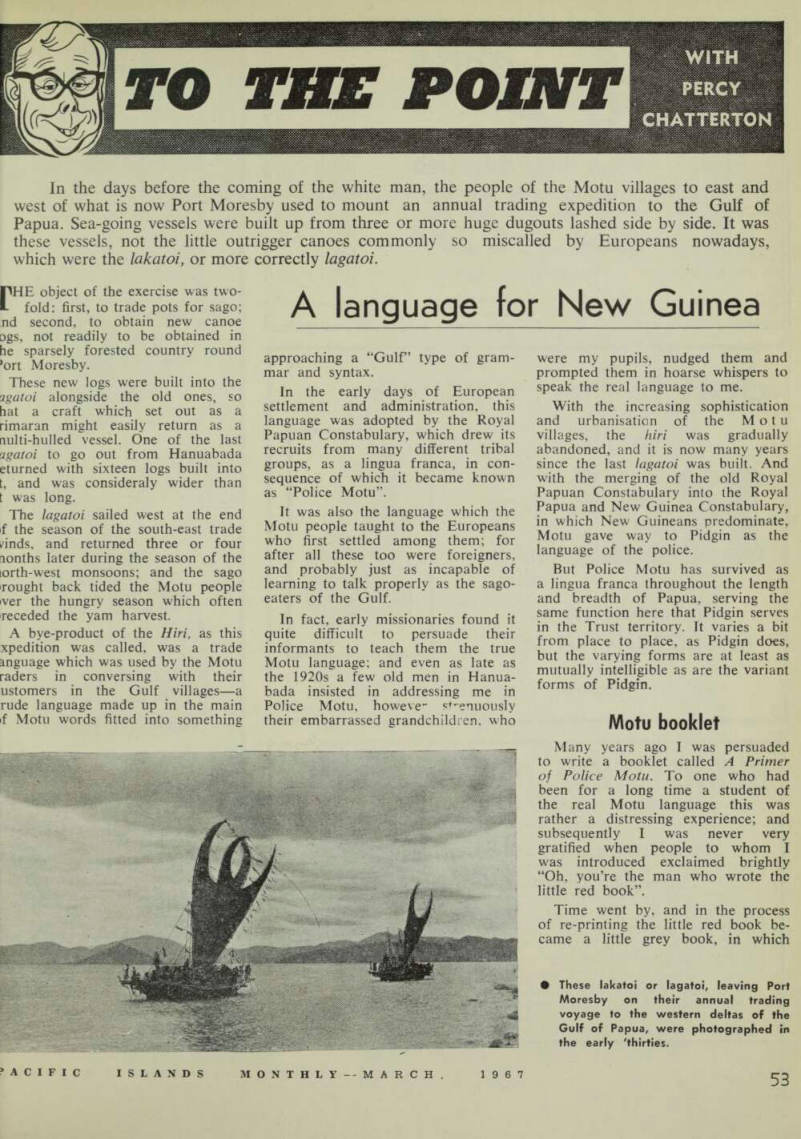
In the days before the coming of the white man, the people of the Motu villages to east and west of what is now Port Moresby used to mount an annual trading expedition to the Gulf of Papua. Sea-going vessels were built up from three or more huge dugouts lashed side by side. It was these vessels, not the little outrigger canoes commonly so miscalled by Europeans nowadays, which were the lakatoi, or more correctly lagatoi.
rHE object of the exercise was two fold; first, to trade pots for sago; nd second, to obtain new canoe ogs, not readily to be obtained in he sparsely forested country round ’ort Moresby.
These new logs were built into the agatoi alongside the old ones, so hat a craft which set out as a rimaran might easily return as a aulti-hulled vessel. One of the last agatoi to go out from Hanuabada eturned with sixteen logs built into t, and was consideraly wider than t was long.
The lagatoi sailed west at the end f the season of the south-east trade rinds, and returned three or four nonths later during the season of the lorth-west monsoons; and the sago rought back tided the Motu people iver the hungry season which often receded the yam harvest.
A bye-product of the Hiri, as this xpedition was called, was a trade anguage which was used by the Motu raders in conversing with their ustomers in the Gulf villages—a rude language made up in the main if Motu words fitted into something
A language for New Guinea
approaching a “Gulf” type of gram mar and syntax.
In the early days of European settlement and administration, this language was adopted by the Royal Papuan Constabulary, which drew its recruits from many different tribal groups, as a lingua franca, in con sequence of which it became known as “Police Motu”.
It was also the language which the Motu people taught to the Europeans who first settled among them; for after all these too were foreigners, and probably just as incapable of learning to talk properly as the sago eaters of the Gulf.
In fact, early missionaries found it quite difficult to persuade their informants to teach them the true Motu language; and even as late as the 1920 s a few old men in Hanua bada insisted in addressing me in Police Motu, however strenuously their embarrassed grandchildren, who
were my pupils, nudged them and prompted them in hoarse whispers to speak the real language to me.
With the increasing sophistication and urbanisation of the Mo t u villages, the hiri was gradually abandoned, and it is now many years since the last lagatoi was built. And with the merging of the old Royal Papuan Constabulary into the Royal Papua and New Guinea Constabulary, in which New Guineans predominate, Motu gave way to Pidgin as the language of the police.
But Police Motu has survived as a lingua franca throughout the length and breadth of Papua, serving the same function here that Pidgin serves in the Trust territory. It varies a bit from place to place, as Pidgin does, but the varying forms are at least as mutually intelligible as are the variant forms of Pidgin.
Motu booklet
Many years ago I was persuaded to write a booklet called A Primer of Police Motu. To one who had been for a long time a student of the real Motu language this was rather a distressing experience; and subsequently I was never very gratified when people to whom I was introduced exclaimed brightly “Oh, you’re the man who wrote the little red book”.
Time went by, and in the process of re-printing the little red book be came a little grey book, in which
These lakatoi or lagatoi, leaving Port
Moresby on their annual trading voyage to the western deltas of the Gulf of Papua, were photographed in the early 'thirties.
Open official ears!
3rm it has recently gone out of rint.
On the whole this very minor opus ras well received, but on one oc asion a man complained that it was )0 difficult, and asked me if I Duldn’t produce something simpler.
On learning that he was a member f the staff of what is now called le Department of District Admin tration (I can’t remember which of s numerous aliases was being used t the time), I said that I could rovide him with a simple one-lesson lurse.
I did. It consisted of three English mtences with their Police Motu juivalents. The sentences were: Come back tomorrow.
Come back next week.
Go home and wait till we send for IU.
“This,” I said bitterly, “is all the lotu you need to know for your b.”
This wasn’t quite fair, of course; it our local Assistant District Officer tid I were a little estranged at le time. Nevertheless, if only a nail part of what I am told by apuan constituents who come to my ame to pour their troubles into their [HA’s ear are true, these phrases e still fairly frequently heard ound district and sub-district offices.
Have they gone mad?
This is not necessarily the kiap’s iult. The more I see of the fantastic ly multifarious duties which POs id ADCs have to cope with, the [ore surprised I am that they don’t ) mad. Perhaps they do. This is an tractive hypothesis which would fit >me of the observable facts pretty ell.
But somehow, somewhere, there lould be someone whose primary b it is to listen and to explain; to iswer the “hows”, whats” and vhys” of native people bewildered y the multiplicity of regulations and ic complexity of procedures.
It is encouraging to note that our 2W Administrator has spoken force dly of the need for better com mnication between Administration fficials and the public, and has said tat this communication must be “a vo-way street”. He has spoken of le need for open office doors and pen official ears.
This is fine. But not much will ime of it, unless on the other side f the office door there is someone ith time to listen, and with patience
to listen to people who are not very articulate and who find it hard to express themselves.
And it must be someone who knows the answers, not the most recently recruited clerk in the outside office.
THE footpath which passes my house has been full of children this week as the primary schools re open. Next week high school pupils will swell the throng. Over a thousand young Papuans go to school within a quarter of a mile of my home.
In Port Moresby the District Education Office and the head teachers of schools have a hectic
time during the first few weeks of the academic year, trying to fit in all the children seeking schooling; trying, too, to separate the sheep from the goats—the sheep being those who, with their parents, are genuine town dwellers, and the goats those who have come in from the rural areas to camp with big brothers, cousins, uncles or more distant relatives in the hope of securing the better chance of climbing the educational ladder which they believe the towfi schools offer.
In Port Moresby most of the sheep, and some of the more nimble goats, will be lucky. But looking at the tef
itory as a whole, the picture is not 0 rosy.
In 1967, not more, and probably ess, than, 50 per cent, of the ter itory’s school-age children will secure laces in the territory’s schools. It 5 estimated that 210,000 children dll be in school (140,000 in Mission ehools and 70,000 in Administration nes).
The total number of eligible hildren is variously estimated at gures ranging from 400,000 to 00,000.
There are not enough class-rooms, ot enough teachers, and not enough loney. In many villages, no children t all will receive schooling. In others iere will not be enough places for 11 the children.
This year, for the first time, itelligence tests, of the “perfor lance test” type already used by le Pacific Islands Regiment for ssting its recruits, will be used 1 separate the six-year-olds who will e given the opportunity of receiving formal education from those who fon’t even have a chance of putting ieir feet on the bottom rung.
Grim as it sounds, this is better lan selection by chance, which is the lethod which has been in vogue to ate; and so long as it is done on le grounds of educational necessity nd not as a capitulation to the conomists I am all for it.
A vacuum to fill
Shall we ever catch up? Will we ver achieve the ideal of universal rimary education, even if the conomists allow us to continue to herish this ideal? In the foreseeable uture, almost certainly not.
Some say that we shall have all iur work cut out to keep pace with tie natural increase in the population nd prevent the proportion of ducated to uneducated from slipping »ack further and further below 50 ier cent.
However, we need to be careful low we use the words “educated” nd “uneducated”. Children in rural *apua and New Guinea who do not eceive a formal western-type educa ion do not, in fact, grow up un seated.
They receive what has survived of he traditional education of their fore athers; but in many places this has vorn a bit ragged, and in most has lecome inadequate as a preparation or life in a fast changing world.
Fortunately there are signs that, laving at last recognised that Mr.
Hlasluck’s vision splendid of “univ ;rsal literacy in English” was, after ill, a mirage, the Administration is
awake to the fact that there is a vacuum to be filled.
For instance, the editors of the Papua and New Guinea Journal of Education have this to say: “On the positive side, it may now be that if there is a more realistic appraisal of what can be accomplished in the immediate future in terms of formal education, it will become practicable to examine more closely some useful alternatives to formal schooling”.
Well said. But will anything be done?
ALL this has a very definite bearing on the debate which breaks out periodically on the question of a national language. In the light of the hard facts of the educational situation, those who advocate English as a candidate must mean something quite different from what I mean by the term “national language”.
By national language I mean a language in which the common people of the territory, or a very
substantial proportion of them, can not only engage in the chit-chat of the market place, but can also com municate to one another their thoughts and aspirations, Beyond contradiction English is, for P-NG, the only possible choice as a language of learning, of the professions, and perhaps of the legislature. .
It would be very convenient if it could become the national language too; particularly convenient, of course, for those Britishers who are averse to trying to master foreign languages, and who have an obsession that any foreigner can understand English if only one shouts it at him loudly enough.
But can you have a national language which in the foreseeable future only half, or less of the population will have any chance of learning at all, and in which many of those will not get beyond the chit-chat stage? (Over)
earning Indonesian
Some of the armchair experts unter this objection by saying that s rest of the population will be jght English by means of radio or evision. I wonder how many of ese experts have, in fact, tried to irn a foreign language through e of these media.
I have. For some time now I have en trying to learn Indonesian from series of taped lessons originally oadcast as radio lessons. It is a ry good series indeed; I don’t think at those who devised it could have me better. .
On my side, I have approached it th a background of literacy in iglish and in two Papuan languages, th bearing considerable affinities structure, and some in vocabulary, th Bahasa Indonesia. I have also pplemented the lessons with a study textbooks and other reading matter Indonesian.
I am enjoying it and making some ogress. But I doubt whether by is method alone I shall ever get r beyond the chit-chat stage.
I also have some background in iching English to Papuans. And if yone is going to tell me that it is ssible to teach completely illiterate ipuans and New Guineans English radio, my answer is going to be 0 rude to print in this column.
Language lessons
Television may be another matter, have never had the opportunity of mpling televised language lessons, I am not going to stick my neck it.
But is it at all likely that we shall er be able to afford a territory-wide [evision service? And even if that irdle were surmounted, two further oblems remain: the technical oblem of maintaining television ts in working order throughout the igth and breadth of the territory; id the human problem of holding e viewer-listeners’ interest and illingness to concentrate after the >velty has worn off.
What then will be the answer? 1 udder to think that it might be dgin; but that is the purely tem iramental reaction of a “Papuan”.
Although the psychological value : a “national” language in pro ofing a sense of unity may be con ierable, it should not be assumed at it is absolutely necessary to ive one single language in order to :hieve mutual understanding. 1 have attended many meetings of apuans at which a number of
speakers have each spoken in their respective mother-tongues and have been well understood by each other and by the audience in general.
Papuans show considerable versatility in understanding other languages which they are unable or unwilling to speak. And in the House of Assembly, a number of members have no difficulty in understanding speeches in English, Pidgin and Motu without the aid of the translaters, even though when they get up to speak they may prefer to stick to the language in which they feel most articulate.
Of one thing I am sure. It will not
be the intellectuals of Waigani who will determine this issue. It will be the common people of the villages who will decide for themselves in what language or languages they will interchange their thoughts and ideas.
And in my experience they are pretty hard to push around.
Waigani, for those who might not know it yet, is the native name which has been chosen to designate the location just outside Port Moresby on which the University of Papua and New Guinea is to be built. One hopes that there is no prophetic significance in the fact that it was originally the name of a swamp.