vexing, boggy problem
pp. 47-49 · Read in the full issue


New Guinea's roads become vexing, boggy problem
From a Lae correspondent
Communications in Papua and New Guinea, always a topic of importance, have been more than ever in the news over the last few months.
'HE Highlands Highway, which attracted much publicity follow l the official opening of the Kassam ss section, has recently been scribed as the “biggest Administra n bungle in the territory”, and a ritory newspaper, in an editorial aded “Highway Chaos”, charged it nobody would accept the blame r the highway’s failings.
This major road linking the coast th the interior naturally receives ich publicity, but the fact is that »a d building and maintenance •oughout Papua-New Guinea is one the great problems of develop ing The Public Works Department ector, Mr. Jim Burns, freely admits ; difficulties faced by his depart ing and by the Commonwealth ;partment of Works which shares th PWD the task of road construc n and maintenance. Mr. Burns ints out that instability of soil is e of the main factors affecting con uction; heavy rainfall resulting in sh floods is another.
The whole country in recent >nths has received above average nfalls, and this has damaged roads lich in many cases were not signed to take the weight of traffic w passing over them. Particularly the Highlands, roads have been veloped from what were not long o merely foot tracks; with no 3per survey having been carried t by the field officers who pushed ;se early roads through—usually th no equipment other than picks d shovels.
These were “kiap” roads, originally ended to hasten and simplify the ,k of bringing law and order to a dely scattered population. As tiers moved in the kiap roads were nproved” to take light four-wheel ive vehicles of the Land-Rover )e. Then a few trucks appeared, [lowed by more and heavier hides. The roads could not stand s sort of traffic.
Now that heavy equipment is avail
able long sections of Highlands roads are being re-routed and rebuilt. The cost of the work is immense but the problem of soil instability remains, and already criticism has been levelled at the design of some of the new sections. In some instances these new roads are being built by large contracting firms.
In the Gazelle Peninsula of New Britain the biggest problem is scouring and erosion of roads which are mainly pumice dirt. Hundreds of thousands of dollars have been spent in the constant grading of the peninsula’s considerable road network.
Recommendations from local officials and residents for a planned programme of sealing were long ignored, but now work is belatedly going forward on the sealing (at a very modest rate) of “country” roads.
Already big savings are being made in maintenance funds, and Administration transport officers at Rabaul report a marked drop in repair bills for official vehicles, and a greater
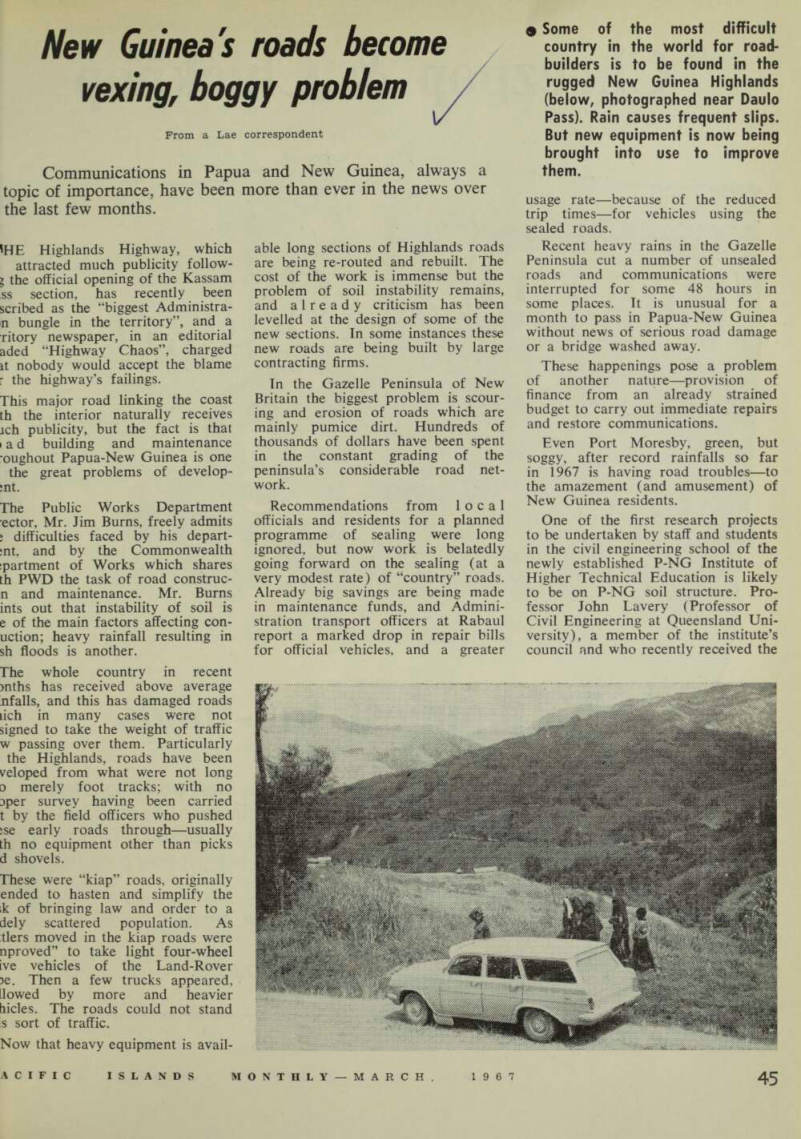
9 Some of the most difficult country in the world for road builders is to be found in the
rugged New Guinea Highlands
(below, photographed near Daulo
Pass). Rain causes frequent slips.
But new equipment is now being brought into use to improve them. usage rate —because of the reduced trip times—for vehicles using the sealed roads.
Recent heavy rains in the Gazelle Peninsula cut a number of unsealed roads and communications were interrupted for some 48 hours in some places. It is unusual for a month to pass in Papua-New Guinea without news of serious road damage or a bridge washed away.
These happenings pose a problem of another nature —provision of finance from an already strained budget to carry out immediate repairs and restore communications.
Even Port Moresby, green, but soggy, after record rainfalls so far in 1967 is having road troubles—to the amazement (and amusement) of New Guinea residents.
One of the first research projects to be undertaken by staff and students in the civil engineering school of the newly established P-NG Institute of Higher Technical Education is likely to be on P-NG soil structure. Pro fessor John Lavery (Professor of Civil Engineering at Queensland Uni versity), a member of the institute’s council and who recently received the
JE for his work in the field of civil gineering, is known to be very en to see research into this field veloped at the institute.
Meanwhile the problem facing ghlands residents probably rdest hit of all —seems to have sn magnified by the decision of th Trans Australia Airlines and isett-MAL to take their Bristol lighters out of territory service. ie airlines claim that these aircraft, lich are more costly to operate in DC3’s, have in the last 12 mths had insufficient work to make :m economic. The decision led to ter accusations by farmer organisa ns in the Highlands, but the air es stood firm, Ihere seems no doubt that the [ministration’s switch to an all-cash ge for its employees cut down istically on the charter work offer ! to airlines. With fewer aircraft the Highlands cheap-rate back irters to shift coffee to the coastal rts are today less frequent.
But with bank-ups of as many as heavy transports on the Highlands ?hway recently, reports are starting come in of pilfering, and some rchants are known to be reverting air movement of stores. So it ms a vicious circle, fhe Administration has called con ences. Works officials forecast ther difficulties with the Highlands »hway, but say periods when the id is closed will be kept to a limum. But as reports continue to ne in of trouble on sections of id previously regarded as “safe”, re is not very much confidence these statements.
Ml this points out the urgent need the Administration to study the •blem on a territory-wide basis, ilure to make real use of the valu e local knowledge of persons out p the Administration is often a ious omission.
Fhe time might be ripe for a review the decision to exclude the private tor from District Planning Com ttees.