UN won't push Fiji around
pp. 27-29 · Read in the full issue
—Mr. Bowden says so
From a Suva correspondent With two of the British Government’s top brass declaring in unambiguous terms that there are no plans for pitching Fiji headlong into the welter of independency, the people of the colony—the people as distinct from the politicians—can rest easily in their beds or on their mats.
WICE within six months, the ruling head of the British lonial affairs has stopped off in i while on a tour of Common alth countries and assured the ony that Britain has no further ms for constitutional change in i.
With the wild men of the United tions Committee of 24 shouting t for immediate independence for i, without in many cases knowing at or where Fiji is, most people in i have been nervously anticipating /isit from the United Nations —to followed the day after by com te independence, and then what? >Jow they can get on with their js. There’ll be no pandering to United Nations, no immediate ctions on a common roll, no sweep changes and no independence. . Bowden says so.
Vlr. Herbert Bowden is Secretary State for Commonwealth and lonial Affairs.
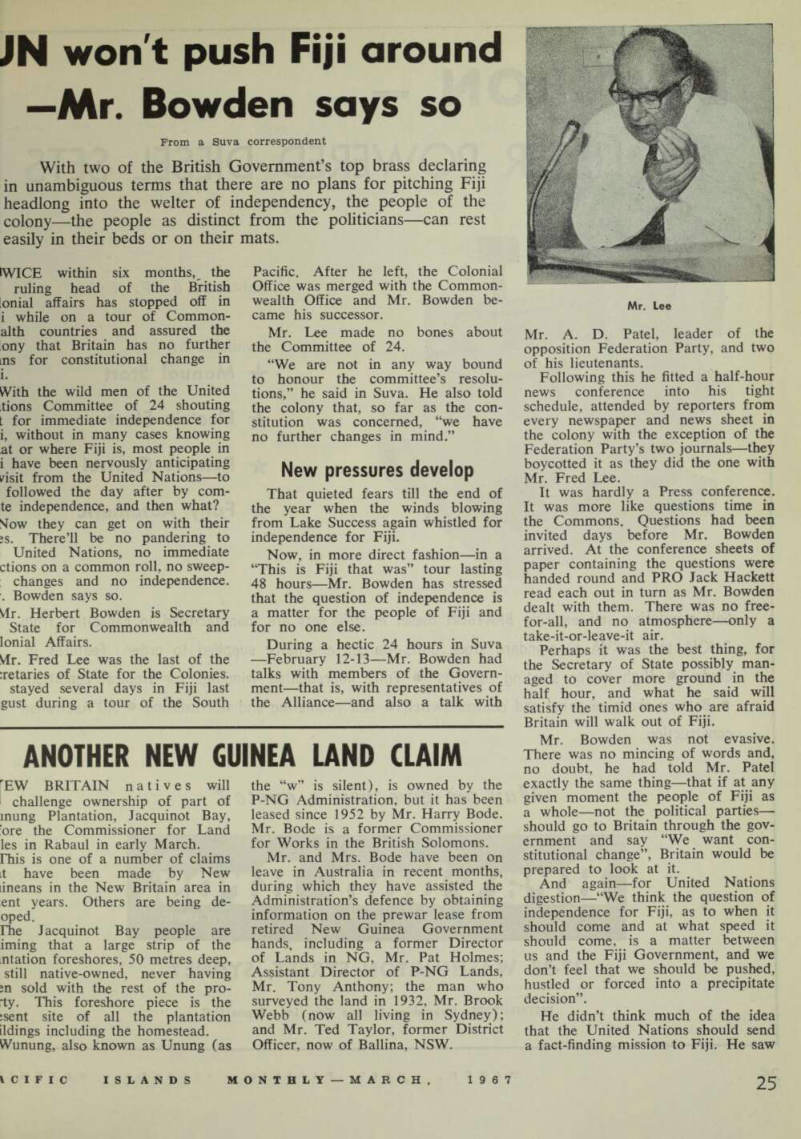
Vlr. Fred Lee was the last of the :retaries of State for the Colonies. stayed several days in Fiji last gust during a tour of the South
Pacific. After he left, the Colonial Office was merged with the Common wealth Office and Mr. Bowden be came his successor.
Mr. Lee made no bones about the Committee of 24.
“We are not in any way bound to honour the committee’s resolu tions,” he said in Suva. He also told the colony that, so far as the con stitution was concerned, “we have no further changes in mind.”
New pressures develop
That quieted fears till the end of the year when the winds blowing from Lake Success again whistled for independence for Fiji.
Now, in more direct fashion—in a “This is Fiji that was” tour lasting 48 hours—Mr. Bowden has stressed that the question of independence is a matter for the people of Fiji and for no one else.
During a hectic 24 hours in Suva -—February 12-13—Mr. Bowden had talks with members of the Govern ment—that is, with representatives of the Alliance—and also a talk with
Mr. A. D. Patel, leader of the opposition Federation Party, and two of his lieutenants.
Following this he fitted a half-hour news conference into his tight schedule, attended by reporters from every newspaper and news sheet in the colony with the exception of the Federation Party’s two journals—they boycotted it as they did the one with Mr. Fred Lee.
It was hardly a Press conference.
It was more like questions time in the Commons. Questions had been invited days before Mr. Bowden arrived. At the conference sheets of paper containing the questions were handed round and PRO Jack Hackett read each out in turn as Mr. Bowden dealt with them. There was no free for-all, and no atmosphere—only a take-it-or-leave-it air.
Perhaps it was the best thing, for the Secretary of State possibly man aged to cover more ground in the half hour, and what he said will satisfy the timid ones who are afraid Britain will walk out of Fiji.
Mr. Bowden was not evasive.
There was no mincing of words and, no doubt, he had told Mr. Patel exactly the same thing—that if at any given moment the people of Fiji as a whole—not the political parties— should go to Britain through the gov ernment and say “We want con stitutional change”, Britain would be prepared to look at it.
And again—for United Nations digestion—“We think the question of independence for Fiji, as to when it should come and at what speed it should come, is a matter between us and the Fiji Government, and we don’t feel that we should be pushed, hustled or forced into a precipitate decision”.
He didn’t think much of the idea that the United Nations should send a fact-finding mission to Fiji. He saw
Mr. Lee
value in such a visit, he said, and ded: “What more can a United itions’ mission tell us than we, the itish Government and the Fiji Gov iment together, can find out?”
Mr. Bowden didn’t seem as scorn of the Committee of 24 as Mr. e, who said he thought they were ing in the wrong century, but the 1 result was the same.
On other matters, Mr. Bowden ;ured Fiji that the UK Govern ;nt would continue with its ancial aid.
He arrived at a figure of £l4 per ad of Fiji’s population in aid last ir as against 2/- a head in India. >st of it was in the £5,000,000 ich, he said, Britain paid for Fiji’s ?ar through the Commonwealth gar Agreement over and above the rid market price. The rest, ,500,000, was a direct grant for /elopment purposes. The same lount, he assured the reporters, uld be forthcoming next year.
He gave reporters the feeling that promises were not the specious ;-of-the-poll promises of the pro sional politician, and that he would what he said.
Mr. Bowden, Welsh-born but like •. Lee a local boy who has made od and come up from the lower lelons of socialism, looks more like sank manager.
While one may have called Mr. e “Uncle Fred”, no one would feel e calling Mr. Bowden “Uncle irbert”.
What he said, the assurances he vt, can all apply, obviously to ier places, to the Gilbert and Ellice
Islands Colony, the Condominium of the New Hebrides, the Solomons and the rest of the shrunken colonial empire.
One thing everybody noticed. Not on any of his pictures, not for a second at the news conference, did Mr. Bowden smile.
Perhaps, it was because he was just recovering from the flu’, or be cause of the oppressive humidity of a Fiji summer day. Or was it perhaps something to do with the job?
Mr. Lee came to Fiji last August, after having toured the Gilberts, and the Ellices, and the Solomons and the New Hebrides. He must have gathered
volumes of experience to help him in the task of running the colonial left-overs.
But he was no sooner back home with his souvenirs unpacked than Prime Minister Harold Wilson abolished his job, shoved the colonies into Mr. Bowden’s portfolio and put Uncle Fred out to grass in the paddocks of the Duchy of Lancaster, which is a sinecure.
What Mr. Bowden perhaps ponder ing over his future, wondering if he will have his job changed when he gets back, and thus harden what is already crystallised in some people’s minds, that these global outings are the perks that go with the job?