Tropicalities
pp. 21-22 · Read in the full issue
The outcome of a recent review of finances in the New Hebrides is being awaited by local citizens with a degree of trepidation. It’s being freely suggested that some form of income-tax may at last be introduced, or at the least, that the already heavy import and export duties might be increased.
review was authorised by the • British Administration in the intly-managed British and French rritory. It was conducted by an ex rt in colonial finance and an onomics expert from Oxford Uni rsity. Both men were brought out 3m England especially for the sur y.
In the first instance information is collected on the New Hebrides onomy and an effort was made to termine the capacity of the economy pay income-tax.
British officers conducting the sur y were closeted in a top floor of z Condominium finance department Vila and their activities were rouded in secrecy.
Apart from official records infor ation was collected from all ;tions including the private sector,
traders, planters and people working in temporary capacities.
The French Administration were aware of the presence of the two British economic inquirers and many French nationals were subject to scrutiny. One of the British officers spent a week visiting stores, traders, and planters in the Santo area.
The survey is not likely to be made public immediately, of course. And some old hands think that nothing will come of the report, even if it does happen to realise the worst fears of the general populace. To start with, any attempt to increase the local financial burden must have the approval of both administrations.
Secondly, with the spread of local government in the New Hebrides, there has been a rapid increase in the financial burden placed on those living in the areas covered by local government ordinances.
There is a head tax, and other charges. For example, in some areas dogs must be licensed for a fee.
But perhaps the old hands are in dulging in wishful thinking. Perhaps the New Hebrides will, after all, join the civilised army of income-tax payers.
New province of
Anglican society
AS predicted in February’s PIM, a new province of the Anglican Society of St. Francis has been formed in the South Pacific.
This province will take in all Franciscan work in Papua-New Guinea and Australia, as well as any further developments by the society in the South Pacific.
This is the first independent pro vince to be established outside Eng land, from where all Franciscan work in these parts has until now been administered.
Elections are now under way for the first Father Minister of the new province and its first chapter, or gov erning body.
The decision to form the inde pendent province was specially cabled from England following talks in Papua between the head of the Order, Brother David, and senior friars in the territory and in Australia.
Now, the eyes
have it
r TALLY blind for many years, 67-year-old Fritz Betham, of Apia, returned from Japan in Feb ruary able to see colours and the shape of things with glasses.
Mr. Betham befriended Yoshichika Iwasa, one of the many Japanese anthropologists to come to Western Samoa in recent years, when he visited Samoa in 1961.
After a Japanese doctor examined Mr, Betham’s eyes and said he might regain his sight if operated on in Japan, Iwasa and other Japanese wishing to promote friendship between Samoa and Japan raised the money to enable Mr. Betham to go to Japan for two operations. He had previ ously been operated on elsewhere without success.
He regained his sight after two operations in November, performed
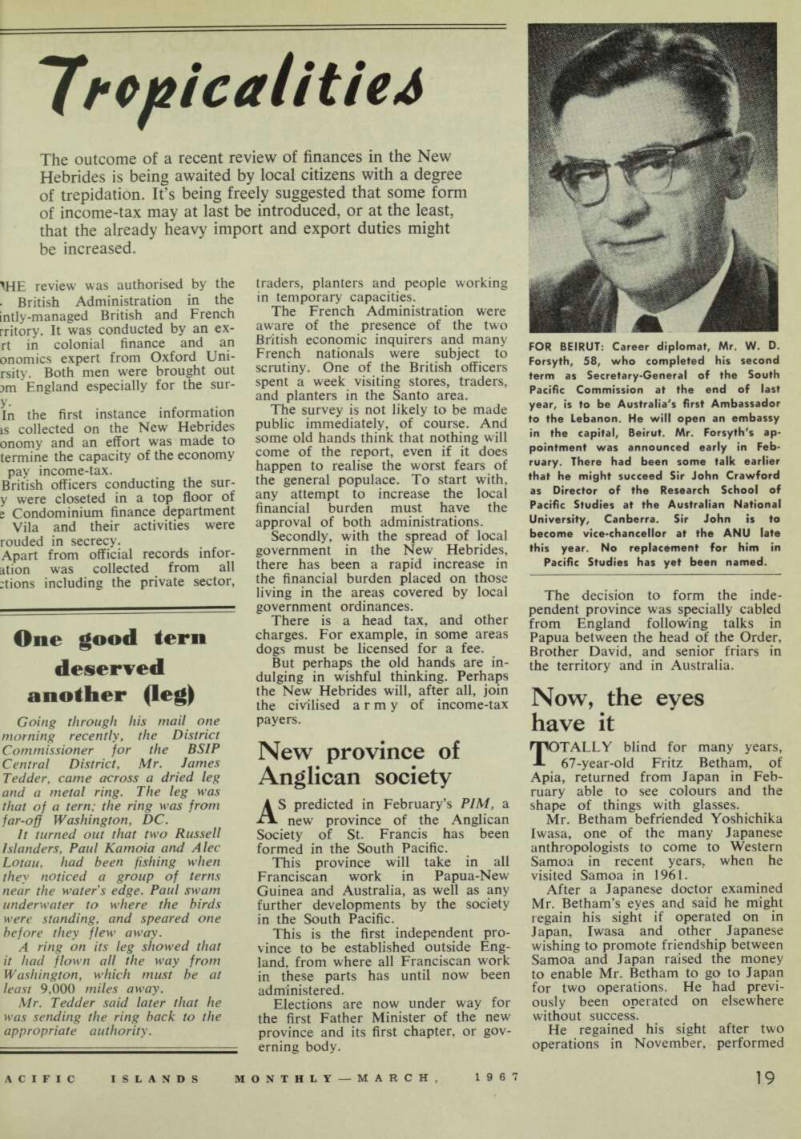
FOR BEIRUT: Career diplomat, Mr. W. D.
Forsyth, 58, who completed his second term as Secretary-General of the South Pacific Commission at the end of last year, is to be Australia's first Ambassador to the Lebanon. He will open an embassy in the capital, Beirut. Mr. Forsyth's ap pointment was announced early in Feb ruary. There had been some talk earlier that he might succeed Sir John Crawford as Director of the Research School of Pacific Studies at the Australian National University, Canberra. Sir John is to become vice-chancellor at the ANU late this year. No replacement for him in Pacific Studies has yet been named.
by Assistant Professor Masatoshi Fukuda and physician Kanjiro Masuda, of the Tokyo L T niversity Hospital’s ophthalmologic depart ment.
The removal of the bandages over his eyes and the recovery of his sight was covered in a special television programme beamed from his hospital room.
Matai —by the
truckload
THE upholders of the dignity of Samoan custom and tradition have had something to worrv about in the recent election campaign for Western Samoa’s Parliament.
The elections were on February 25.
Voting for the 45 representatives of Samoan electorates is restricted to matai.
But holders of traditional titles have the right to create lesser serv ing titles. In some districts a race developed between candidates to see how many new titles they could create among their supporters before the rolls closed.
The situation reached lud’iarous proportions in the Vaisigano No. 1 constituency, represented in the pre
vious parliament by Tufuga Efi, son of late Head of State, Tupua Tamasese.
In the general election of 1964 this district had 125 registered matai. In the by-election in which Tufuga Efi was elected in 1965 the number had increased to 139. This year the dis trict has over 1,000 registered matai.
Apia officials report that trucks were sent out to pick people off the road and take them in for registra tion as matai. A large number of the new matai are women—something that was previously quite rare.
A number of chiefs complained to Prime Minister Mataafa about what they considered to be an affront to the dignity of the /oa-Samoa. But it appears that little can be done about it.
The problem could, perhaps, be solved by applying a remedy sug gested by Mataafa himself some years ago, before most people fore saw the present situation.
Mataafa wanted to give everybody a vote but restrict representation to matai. This was strongly opposed by Tamasese.
An ironic twist to the story is that Tufuga Efi lost his seat because of the collapse of Samoan custom that his father fought so strongly to uphold.
Inch left police
on wrong foot
THE small matter of one inch led to a Port Moresby motorist beat ing a traffic “rap” recently. The man was charged with failing to stop at a “stop” sign His defence in a plea of not guilty was that the Papua and New Guinea Motor Traffic Regulations require letters on “stop” signs to be nine inches high. The letters on the sign he was alleged to have ignored were only eight inches high.
Police withdrew the charge.
In February PIM (p. 33), a Port Moresby correspondent pointed out that signs erected often did not fit the requirements of regulations.
Look! No hands!
A DESERTED trimaran, washed ashore recently in the Lau Islands of Fiji, appears to be the missing Wasakish which went adrift in the Marquesas last July, (see p. 115).
The trimaran came ashore at Nasa qalau, on the north coast of Lakeba, on February 27. Reports from the Lau group gave its name as Welsh Risk.
If the trimaran is the Wasakish, it has done about 2,700 miles unmanned in seven months—surely a record of some kind.