Britain Seeks New Wa Ys Of
pp. 11-12 · Read in the full issue
Running Its Island Realm
• And it would like Australia and New Zealand to help
By the Editor
Britain has been doing some serious “homework” on the possibility of forming the small Pacific groups of islands into viable trading and political associations. And it would very much like Australia and New Zealand to lend a hand in the task.
HIS was revealed in Sydney in February by Mr. Herbert wden, Britain’s Secretary of State Commonwealth Affairs, who is 0 responsible for colonial affairs.
Mr. Bowden spoke frankly of tain’s problems in the South Seas, 1 stressed that Australia and New aland could have a part to play helping Britain in this part of the rid.
Fie told a news conference that tain felt independence could come its colonies only if they could tain themselves, and also if they nted independence. ‘Fiji has a new constitution and think it wise to let the posi i there run as it is,” Mr. Bowden 1. ‘lf there was a general view in for independence then we should r e come to a decision.
But independence is almost im sible in most of Britain’s other sessions in the Pacific. There are people living on one island—Pit ‘n—and what can you do with t?”
New idea
At. Bowden said Britain was ex imenting with a new idea for a nber of small groups within the nmonwealth to form viable assod ms, and this sort of association ;ht be possible within the Pacific a.
We will, of course, consult fully h New Zealand and Australia on it is happening within this area,” said.
Questioned on the details, Mr. vden said he could not say “which itories we are looking at at the ment; I can’t be categorical as it Id upset or disturb people. But are doing our homework and we examining the matter very sely.”
Reporter: Have you in mind a customs union, or a customs and political union?
Mr. Bowden: The association would be a trade and a political one.
A trade one would not be so dif ficult, but a political union would be harder to achieve, and this would be worsened by sparsely dispersed territories.
Reporter: Would help from Aus tralia and New Zealand be vital to such an association?
Mr. Bowden: We would very much like them to take part. It’s a Com monwealth problem.
Asked whether he had discussed this particular matter with the Aus tralian Government since his arrival, Mr. Bowden said he had had a great number of talks with the Govern ment on many matters and it would not be fair to say what had or had not been discussed.
Much UK aid
British colonies, said Mr. Bowden, got a considerable amount of aid from Britain, and Fiji, for instance, “would not last five minutes if Britain did not subsidise its sugar industry. (See also p. 25, for Mr. Bowden’s statements in Suva).
Mr. Bowden was also asked whether he had had an opportunity to discuss Australia’s reason for re fusing Fiji’s application in February for a government-to-government loan of £F3.6 million.
Mr. Bowden replied that he had and he was satisfied Australian min isters realised that the loan “was a very important thing for Fiji— for it would be bad if Fiji’s develop ment plans were upset at the moment for lack of money”.
He believed that other ways of assistance were under discussion and he was content to leave it there, Mr. Bowden’s statement gave added
strength to the view held by Canberra observers that Fiji probably will get its much-needed loan money, but in another form. It may be invited to raise it publicly in Australia.
No precedent
Australia refused the application because she has never previously given a government-to-government loan.
Mr, Bowden’s comments on Britain’s South Seas problems, and the rejection of the Fiji loan (which caused resentment in Fiji) came in a month in which South Pacific affairs got more than their usual space in Australian and New Zealand news papers.
Their usual space in Australia is not much—and, in fact, Mr. Bowden’s comments on Islands matters were not published at all. But Australians did hear about: • A statement in Auckland by the Cook Islands Minister of Internal Affairs, Mr. T. A. Henry (who is a son of the Premier), that the Cooks, Fiji, Tonga and Western Samoa were interested in forming a Pacific common market, and it was hoped that the heads of the four govern ments would come together to discuss it. This followed a meeting of the Pacific Islands Produce Secretariat in Suva which Mr. Henry attended. • A call by crusading Australian clergyman, the Rev. Alan Walker, for Australia to extend greater economic and educational aid to the people of the South Pacific. He made the call after visiting Tonga. He also declared, “Australia once sent
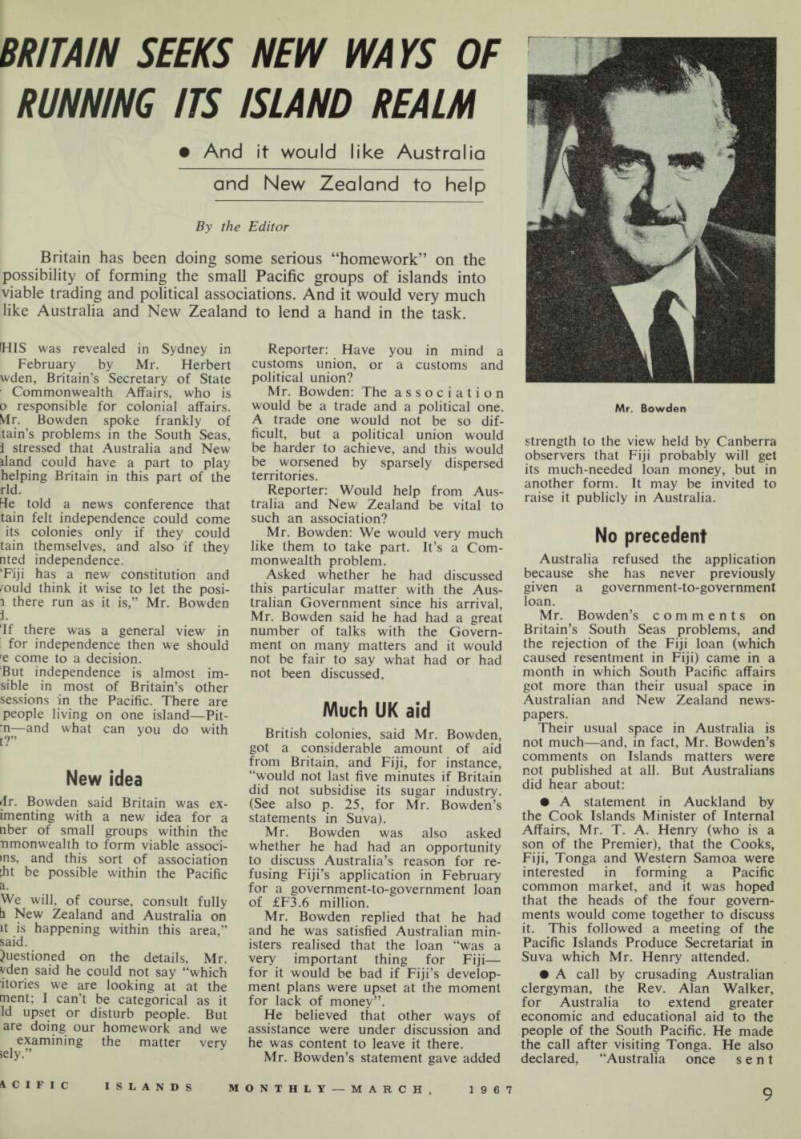
Mr. Bowden
missionaries to Tonga but today Christian Tonga could well send missionaries to semi-pagan Australia.” • A statement by the Australian Prime Minister, Mr. Harold Holt, following a talk with the NZ Prime Minister, Mr. Holyoake, in Te Anau, NZ, that he was “very interested to learn of the constitutional develop ments which have occurred in the territories, formerly Trust territories of New Zealand,” he added: “Some of these territories in this general area are of such interest to us that I thought it would be useful, and I suggested this to Mr. Holyoake, that at some point of time, not neces sarily this year but at a time con venient to us, we should take a look at the people to see how they are faring in the new situations which have arisen from their constitutional processes.”
This rather wandering comment of Mr. Holt’s was blown into a full scale “Australia will lead in the Pacific” story in some Australian newspapers, and from there circulated abroad.
But Mr. Holt said nothing to justify the suggestion that Australia would become suddenly and especi ally interested in South Pacific affairs, and certainly nothing is hap pening in Canberra to support any such contention.
Officers of the Prime Minister’s Department said Mr. Holt had no im mediate plans to visit the Islands, and with his present commitments he probably wouldn’t be able to manage such a visit until next year.
More ASPTAP money
The only concrete Australian de velopment in recent months (apart from the refusal of the Fiji loan) has been the decision to increase the annual contribution to the Australian South Pacific Technical Assistance Plan (ASPTAP) from $50,000 to $lOO,OOO. This increase was fore shadowed early last year, when it was stated that the fund would be in creased as more ways were found to spend it.
The money is being used to give technical aid to the British South Pacific territories, and is a small but worthwhile scheme.
But more help is needed on a larger scale. More important, Aus tralia has to become more involved with the problems of the South Pacific territories and recognise finally that world political patterns have changed.
Where once a viable economy was the factor which decided whether or not a territory could become inde pendent, today small territories are demanding and getting independence
under the patronage of the bigger powers. Without that patronage, without the funds that continue to be given them in various forms of aid, they would go under.
This is Britain’s problem in the South Pacific. With former colonial territories all over the world depend ing on her for aid, she finds herself saddled with scattered South Pacific islands in an area which is rightly an Australian and New Zealand re sponsibility.
Mr. Bowden in February, was in fact, saying (and he carefully chose his words so as not to ruffle feelings) that it was more than time that Aus tralia and New Zealand—and par ticularly Australia—took their respon sibilities seriously.
He was saying that if a customs union could tie these territories to gether then Australia and New Zea land should help organise it. That if money were needed (and it is) then Australia and New Zealand should supply it. That if political guidance were required (and it certainly is) then Australia and New Zealand should give it.
For a man with his reputation for bluntness, it must have been difficult for the British Secretajy for Com monwealth Affairs to make himself sound as friendly as he did.