soon for Fiji Airways
pp. 129-131 · Read in the full issue

New 40-passenger aircraft soon for Fiji Airways
By a Staff Writer
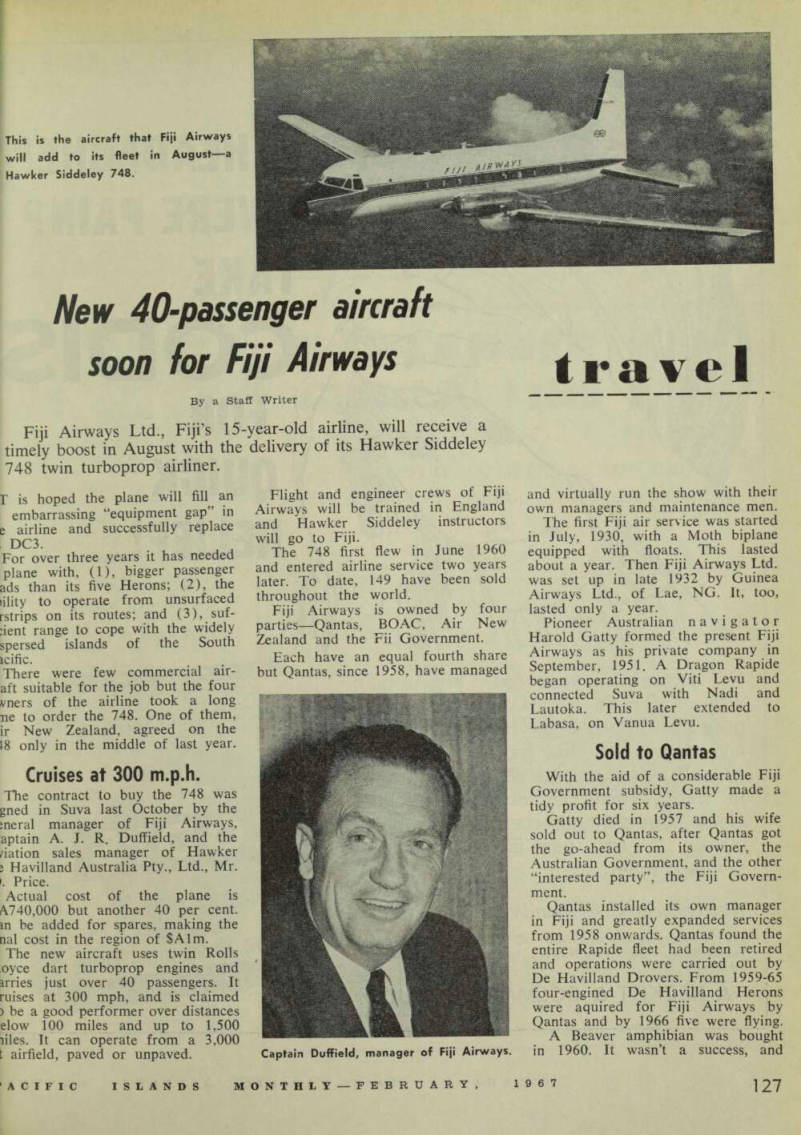
Fiji Airways Ltd., Fiji’s 15-year-old airline, will receive a timely boost in August with the delivery of its Hawker Siddeley 748 twin turboprop airliner.
r is hoped the plane will fill an embarrassing “equipment gap” in e airline and successfully replace DC3.
For over three years it has needed plane with, (1), bigger passenger ads than its five Herons; (2), the lility to operate from unsurfaced rstrips on its routes; and (3), suf fient range to cope with the widely spersed islands of the South tcific.
There were few commercial air aft suitable for the job but the four vners of the airline took a long ne to order the 748. One of them, ir New Zealand, agreed on the 18 only in the middle of last year.
Cruises at 300 m.p.h.
The contract to buy the 748 was gned in Suva last October by the meral manager of Fiji Airways, aptain A. J. R. Duffield, and the nation sales manager of Hawker i Havilland Australia Pty., Ltd., Mr.
K Price.
Actual cost of the plane is A 740,000 but another 40 per cent, m be added for spares, making the nal cost in the region of sAlm.
The new aircraft uses twin Rolls oyce dart turboprop engines and arries just over 40 passengers. It ruises at 300 mph, and is claimed ) be a good performer over distances elow 100 miles and up to 1,500 files. It can operate from a 3,000 t airfield, paved or unpaved.
Flight and engineer crews of Fiji Airways will be trained m England and Hawker Siddeley instruct© will go to Fiji.
The 748 first flew in June 1960 and entered airline service two years later. To date, 149 have been sold throughout the world, Fiji Airways is owned by four parties—Qantas, BOAC, Air New Zealand and the rn Government, Each have an equal fourth share but Qantas, since 1958, have managed
and virtually run the show with their own managers and maintenance men.
The first Fiji air service was started in July, 1930, with a Moth biplane equipped with floats. This lasted about a year. Then Fiji Airways Ltd. was set up in late 1932 by Guinea Airways Ltd., of Lae, NG. It, too, lasted only a year.
Pioneer Australian navigator Harold Gatty formed the present Fiji Airways as his private company in September, 1951. A Dragon Rapide began operating on Viti Levu and connected Suva with Nadi and Lautoka. This later extended to Labasa, on Vanua Levu.
Sold to Qantas
With the aid of a considerable Fiji Government subsidy, Gatty made a tidy profit for six years.
Gatty died in 1957 and his wife sold out to Qantas, after Qantas got the go-ahead from its owner, the Australian Government, and the other “interested party”, the Fiji Govern ment.
Qantas installed its own manager in Fiji and greatly expanded services from 1958 onwards. Qantas found the entire Rapide fleet had been retired and operations were carried out by De Havilland Drovers. From 1959-65 four-engined De Havilland Herons were aquired for Fiji Airways by Qantas and by 1966 five were flying.
A Beaver amphibian was bought in 1960. It wasn’t a success, and
This Is the aircraft that Fiji Airways will add to its fleet in August —a Hawker Siddeley 748.
Captain Duffield, manager of Fiji Airways.
i Airways, after great difficulty, inaged to re-sell it.
Domestic air services were extended Savusavu on Vanua Levu, and to itei and Ura on Taveuni.
Fhe services began to other Islands ritories. Fiji-Tonga, Fiji-Western tnoa, Fiji-BSIP, via Vila and Santo, i lastly, in July, 1964, Fiji-GEIC.
However the Herons were (and, if ;d, still are) capacity-restricted on jse regional routes. To Tonga, the /15 seat capacity squeezed up to , to Samoa nine and to the BSIP d GEIC dropped to eight seats.
Meanwhile BOAC and Air New aland bought into the company in luary, 1960, as equal shareholders, is move was followed, rather latedly, by the Fiji Government in arch, 1965.
This divided ownership makes un imous decisions very hard to get, rticularly when the men behind » scenes live in London, Canberra d Wellington.
The new faster, larger aircraft uldn’t turn up at a more opportune le. Pacific air travel is set for its »gest boost in years with airlines :pping up trans-Pacific flights and )AC starting trans-Pacific services is year.
Round trip
The 748 will give better services r those wanting to fly from Fiji to ;w Guinea or return, and it may possible in a few years to make round trip Fiji-New Hebrides lomons-Nauru-GEIC-Fiji.
A service to Nauru is needed.
While the 748 will not initially be le to land at Apia in Western moa because of airport limitations shouldn’t be too long before these e overcome.
Then there is the question of Pago ago in American Samoa. Fiji Air ays would dearly like landing >hts, particularly with its new achine coming up. However Pago ago services can only follow ap oval of the American Government.
The Fiji Airways fleet in 1967-68 expected to be; one HS. 748, one C 3 (chartered), three Herons and ae Drover.
When Qantas took charge, Fiji irways’ employees numbered 17, ith five pilots; now the score is 07, with 18 pilots. The change to t power from piston engines could ansform the airline into a big acific moneymaker.