Fiji's tourist industry
pp. 123-127 · Read in the full issue
[?]fter the first fine rapture . . .
New zest badly needed in Fiji's tourist industry
By Judy Tudor
Except in Suva where they had a surfeit of cruise ships, the expected bumper tourist December in Fiji did not eventuate because of the long, irresponsible Qantas strike. Before Christ mas, beach resort hotels were virtually empty after wholesale cancellations that were costing the Colony an estimated £4,000 a day in lost overseas income.
N the long term, however, the . cynical attitude of some of Fiji’s atel operators, who appear to be lore interested in making a fast ack than in building up a reputation )r service, will do the industry lore harm than the 28 days’ airline rike.
The impression now gained by a ;teran of many visits to Fiji is that lat first fine rapture that gave the dlony a head-start in the Pacific jurist business has, for the moment, nyway, evaporated; that Fiji, erhaps, is entering the inevitable ark side of the vicious) circle of iternational tourism; that it has just bout reached the point where it has ecome the resort of the mob; where le discriminating who were attracted y its freshness and friendliness in le first place, are ready to seek new astures; where local standards slump nd the tourist is regarded as an nattractive anonymity, only there to e fleeced.
Yet, for good or evil, Fiji has never ceded its tourist more than it does ight now.
a ■ W* I
The world price for sugar, the Colony’s chief overseas income earner, has not been lower since 1932 and experts calculate that it will remain that way for the next two years. Furthermore, Fiji sugar-pro ducing areas have had two years of drought with consequent loss of pro duction.
Copra prices paid by the local Coconut Board rose in January but are std not S p ec tacular; banana pro duction was hit by a tropical storm (hat , ashed growing areas jn De C . em ber .„ ‘ _... . , ..
All that Fiji primary production needs to make the picture even more dismall is a real hurricane and, as there has been none for two years there is a real chance of something g°° d * n department between now ana Apnl, All this being so, Fiji is looking to
tourism to fill the economic gap and the stomachs of its ever-increasing population—and looking to it, in many ways, like a drowning man might look at a floating straw.
Five years ago, Fiji tourism was regarded as a profitable sideline in the economy of the Colony. Today, all sorts of economic hopes are being based on it, very often without the accompanying basic planning that will turn pipe-dreams into reality.
One of the greatest tourist successes in Fiji has been duty-free shopping on a long list of luxury items. Tourists swarm off every ship and plane, demanding to spend their money on cameras, radios, watches, etc. and short-term visitors are frequently interested in nothing else.
As in Aden, the country means nothing; these people see no further than the first shop full of duty-free goods.
New hotels
Also on the credit side, Fiji is getting at least three new hotels this year, each of which will supply new blood and some initial new pep to the industry.
The largest of these is the resort now taking definite shape at Yanuca
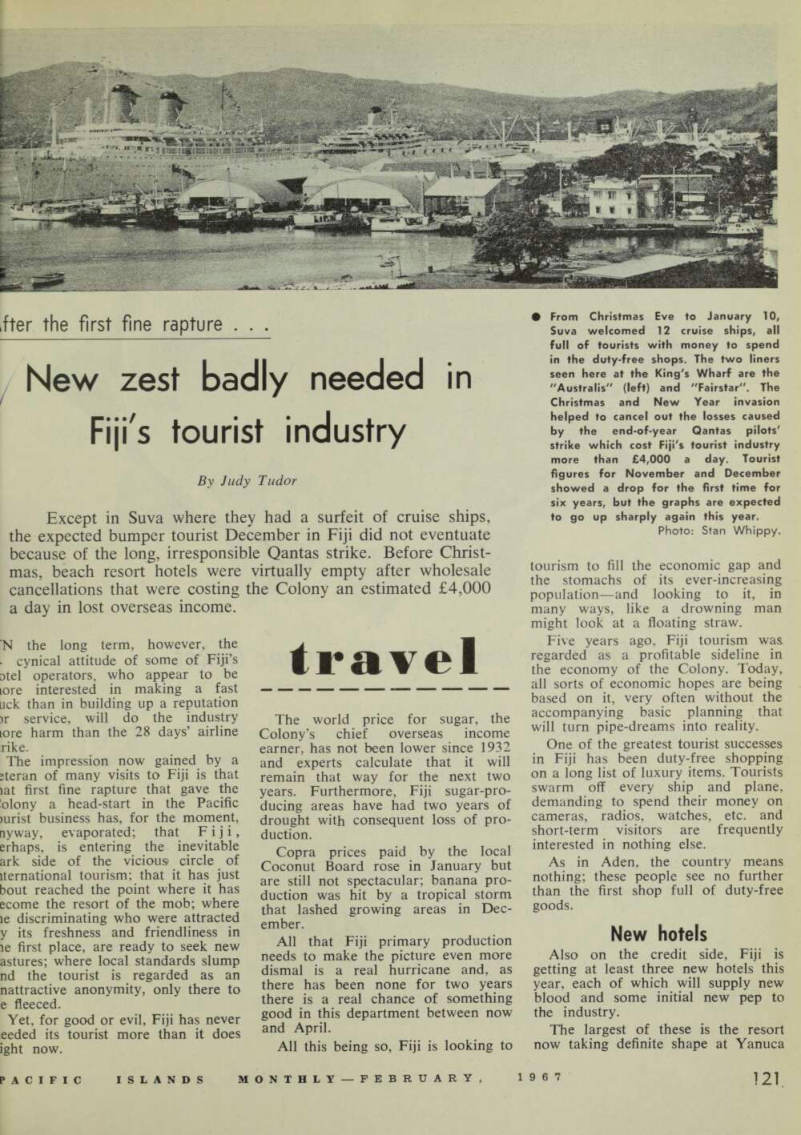
From Christmas Eve to January 10, Suva welcomed 12 cruise ships, all full of tourists with money to spend in the duty-free shops. The two liners seen here at the King's Wharf are the "Australis" (left) and "Fairstar". The Christmas and New Year invasion helped to cancel out the losses caused by the end-of-year Qantas pilots' strike which cost Fiji's tourist industry more than £4,000 a day. Tourist figures for November and December showed a drop for the first time for six years, but the graphs are expected to go up sharply again this year.
Photo: Stan Whippy.
land, eight miles on the Nadi side
f Sigatoka.
This is the largest single hotel terprise yet undertaken in Fiji and owned by the same American group at owns the Nadi Macambo.
It is expected that it will take its st guests about September this ar, and indications are that when ey move in they will be getting mething of world standard.
The name of the new hotel had not en announced in early January though educated guesses were that would be the “Royal Fijian”. Other lesses are that the cost of staying ere will be “£lO a day before you t”.
How much it costs isn’t very im »rtant so long as customers get lue for money—which a lot of istomers in Fiji today do not.
Foundations down
Yanuca is obviously being built r the carriage trade, American at at, and this in itself will be a easant change in the present trend Fiji, which is towards attracting e kind of people who, in another ood, patronise Queensland’s Gold oast.
On Queen’s Road, near Suva, the Lndations of the Bay of Islands otel were completed in January, lis hotel is being built by architect ilin Philp and a local group, along le the western reaches of Suva arbour.
As the name of the area indicates, is a picturesque one of calm waters
studded with heavily wooded islands (which provide shelter for Suva small-ships during the hurricane season).
As Mr. Philp has a flair for design ing buildings that fit their environ ment, his new hotel will no doubt take full advantage of its aquatic site.
Still unstarted in early January was a projected hotel alongside the present Grand Pacific Hotel in Suva.
It is to be built by Motels of Aus tralia and Trust Houses Ltd. of the UK, in a somewhat unexpected partnership.
UK Trust Houses run into scores all over England—beginning with the well-known Brown’s off Piccadilly in London—all with a late Victorian
flavour and ranging in standard from good to mediocre.
A Trust House usually conjures up visions of Sunday dinners of roast beef and Yorkshire pudding; and large-sized English “teas” that include slices of thin bread and butter, straw berry jam, plum cake and even boiled eggs.
Perhaps both Fiji and Trust Houses Ltd. will each learn something from the new venture into the tropical South Seas.
The plan is for a 135-suite hotel, and a new £400,000 company, Trave lodge (Suva) Ltd., has been set up to take care of it.
Food dearer
High on the list of debits in Fiji tourism, as it stands at present, are the overall poor quality of local cooking; paucity of places, outside of hotels, where you can get anything to eat at all; and poor service in many hotels because of inefficient control of staff.
Although Australians and New Zealanders are fairly used to being served inedible food outside their own homes, Americans are not. Much of the food that they get in Fiji must seem to them, therefore, to be part of a British anti-American plot.
In the two years since PIM last said anything on this subject, the only
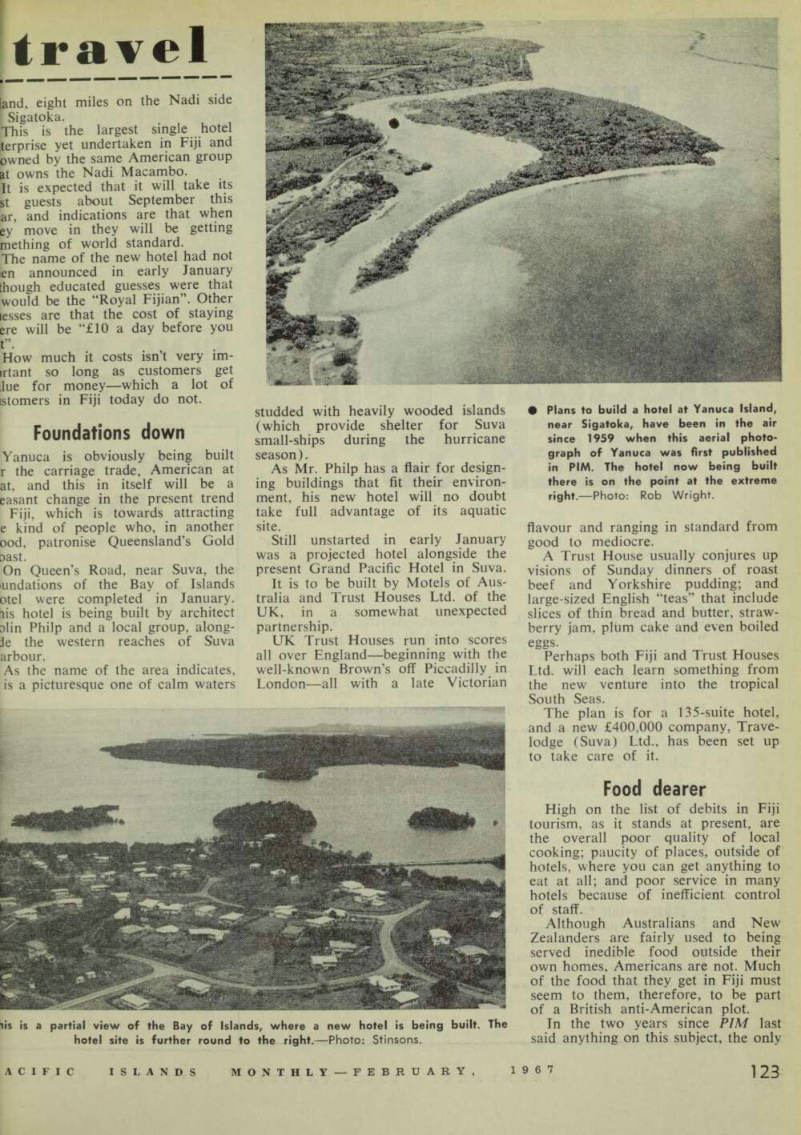
[?]is is a partial view of the Bay of Islands, where a new hotel is being built. The hotel site is further round to the right.— Photo: Stinsons.
• Plans to build a hotel at Yanuca Island, near Sigatoka, have been in the air since 1959 when this aerial photo graph of Yanuca was first published in PIM. The hotel now being built there is on the point at the extreme right,— Photo: Rob Wright.
ig that has changed is the cost of ing in the Colony. That has gone while the standard of cooking remained stationary or has de orated —although, of course, there [occasional exceptions to this and is sometimes possible to get good d at modest cost, usually at the st publicised places.
Jttle effort is made to use local ds attractively, and when they are d. their cost is exorbitant. In uary when sweet pineapples could bought for 6d along the roadside ir villages, one slice of pineapple yed in a hotel could cost several lcs that amount. n mid-year, when Fiji could swim local orange and mandarin juice, el juice still comes out of the jorted can. It costs as much to a hotel banana in Fiji as it does London. \nd, in a country whose popula i is 50 per cent. Indian, there has : yet been one Suva citizen enter sing enough to set up a good, active, air-conditioned curry taurant which, with the right itment, could be a sure-fire tourist imick. fhere is, in fact, some of the most 1-awful curry in the world served Fiji and when someone does get iund to producing it for public isumption in the way it can be iduced, it no doubt will be done by Rumanian or a Lithuanian or some ier foreigner who has somehow naged to squeeze in through the i immigration net.
Tutside of the hotels, there are tually no restaurants of tourist ndard; while the snack bars, in ces like Suva, are either attached the big stores (and shut down en they do, including lunch-time),
or they can barely cope with the requirements of local office workers.
Even Papua-New Guinea, which is regarded as way down at the bottom of the list in the tourist sense, can do better than this with places like the Hibiscus or Room at the Top, in Port Moresby, where you can sit quietly with friends over a meal and a bottle of wine until late.
But perhaps the biggest problem of all in catering for overseas tourists is the tropical malaise that afflicts domestic staffs in Fiji—and elsewhere in the Pacific, of course.
These people are happy, pleasant, obliging and friendly, but they need constant supervision by key personnel with unlimited enthusiasm for their jobs and with a missionary zeal in carrying them out.
When key personnel, themselves, lose their steam and give up, in efficiency results and establishments that open with a bang can soon be reduced to a tired whimper.
The training, or recruiting overseas, of top hotel staff is going to be a number one priority if Fiji is not to become just another second-rate tourist trap.
Tourism in Fiji has already lost its simple amateur status.
What it needs most now is some
hard-headed professionalism—some
thing that is rarely home-grown.
Fiji is one of the biggest banana pro ducers in the Pacific, but local bananas bought in the hotels are by no means cheap. —Photo: Stan Whippy.