For Islanders
pp. 99-101 · Read in the full issue

A Flood Of Books
Learning English
Such a variety of books directed at Islands school pupils and their teachers is now coming from publishing houses that it is often difficult for teachers and parents to keep abreast.
iND yet the output may be x expected to increase still further > the Islanders become literate in nghsh.
The widening fields of employment i the Islands increasingly demand icility in the use of English, so 3oks on the teaching and learning F English are in great demand.
The varying ages and circumstances F those learning English as a second mguage present problems for achers, but many new and revised
textbooks are available on all aspects of language teaching.
Meeting the needs of two widely separated age groups learning English are two series. The first, The Pacific Series, planned by New Guinea teachers, is a new course designed to teach English to young children on the Primary T Syllabus in Papua-New Guinea and other Pacific territories whose mother tongue is not English, Complete with teachers’ notes, activity books, phonic cards, flash
cards, composition pictures and bright colourful readers, this series provides a wealth of active-participation material and method.
The subject matter is well-related to the children’s environment. The course is in three sections: Prepara tory year; first year (St. 1); and second year (St. 2).
OUP produce it at various prices. * * ♦ Another series, The Oxford Pro gressive English Alternate Course, is directed towards an older age group and those who, for a variety of reasons, have not reached an adequate standard of English.
There are four books based on an earlier proved series. They are comprehensive and thoroughly teach able in matter and method, the dif ficulties of students learning English as a foreign tongue being sympathetic ally appreciated and resolved.
The subject-matter of the reading texts chiefly concerns the way of life in Britain. There is no Pacific area flavour.
The teachers’ handbooks are an excellent feature of the series.
Also by OUP at various prices. * * * The series Peoples of the Pacific gives, in small compass, a good introduction to the peoples of Papua- New Guinea, Samoa and the Maoris of NZ, are well-illustrated, have clear maps, and would provide plenty of material for the lower primary classes.
The series is published by Longmans, Green and edited by Ernest Schubert.
A. H. and A. W. Reed’s Pacific Social Studies Readers deal with NZ, Fiji, Hawaii, Tahiti, Cooks and Samoa, each book containing a legend, an account of modern times.
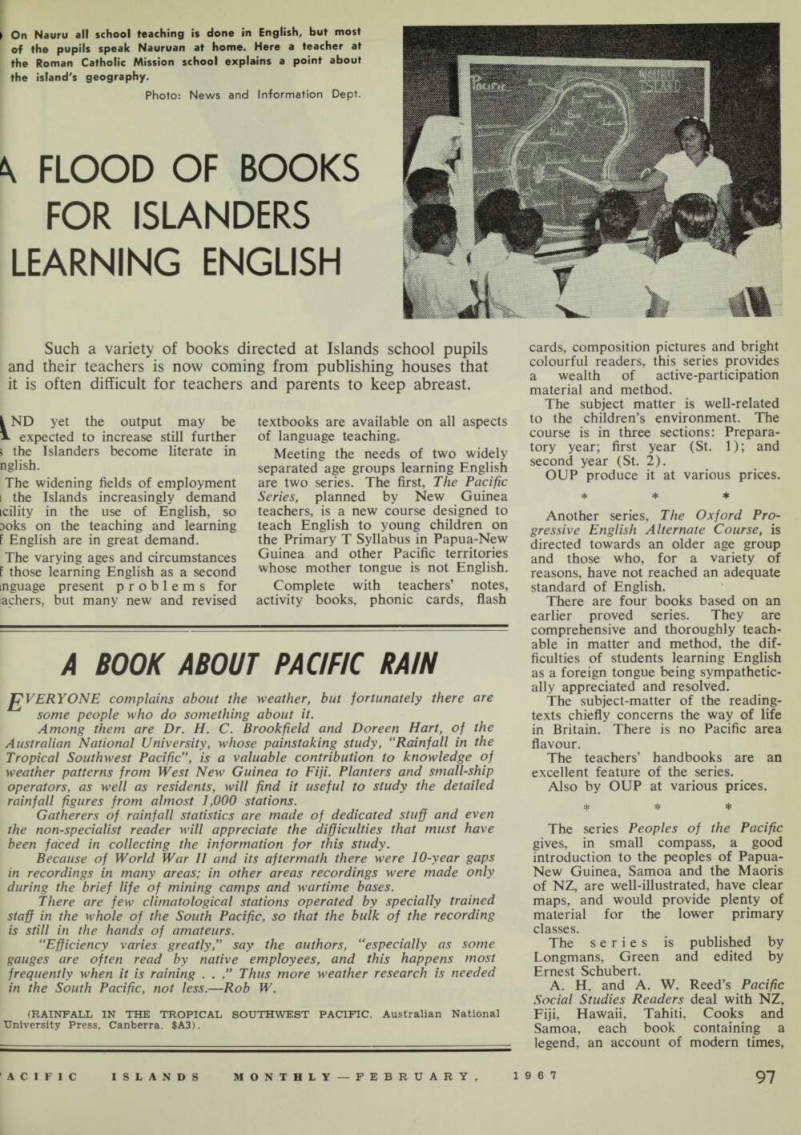
On Nauru all school teaching is done in English, but most of the pupils speak Nauruan at home. Here a teacher at the Roman Catholic Mission school explains a point about the island's geography.
Photo: News and Information Dept.
ustrations, pupil activities and a mmary of facts. For juniors.
The Peoples series deals objectively ith the peoples; the other series yes a sense of kinship. jAround the topic of Dress is jven an account of life in several icific Islands. It is interesting read g for junior primary pupils. Dress part of the life in the Pacific Series
' Oup, 40C.
* * * The successful teaching of written imposition calls for lively motiva m, thorough discussion of the intent, and guidance in the use of itable words, phrases and structures be employed.
In The Outline Composition Book )UP, 60c), L. A. Hill gives students actice in writing composition in this ntrolled manner, using likely situa m-topics and a wide selection of eful phrases and words.
This book is preceded by others aling with “controlled composition” id leads to Free Composition Book -a graded course by the same author bich should produce admirable re- Its (OUP, 85c). * * * Bringing the fresh air of fun into e classroom, a large collection of mes adapted to the purpose of nguage teaching makes interesting ading, and shows that learning need )t be divorced from enjoyment.
A handy book containing 1,040 lall pictures provides a ready means teaching new words and flash sting certain aspects of vocabulary, lickly, usefully and competitively, be books, both published by OUP, e W, R. Lee’s Language-Teaching ames and Contests ($1.07) and L. . Hill’s A Picture Vocabulary for zachers (93c) and for Pupils (50c), * * * The provision of material on which i draw for practising sounds and laracteristic phonetic features of token English is well-arranged and bulated in A Practice Book of nglish Speech, and the availability I the bulk of the practice words on •amophone records increases the iefulness of this book. By Peter lacCarthy (OUP, $2.07). * * ♦ A sound introduction to the )ecialised English used in offices, usiness and administration is given i Clerical English Book 2 by G. .. Pittman (OUP, $1.15).
It also includes commercial ractice and simple economics; a lost useful book.
The author states that there is othing in the book that should be eyond the comprehension of any
student who has completed a mini mum of five years’ study of English.
This is a reasonable statement. * * * An interesting book indicative of the wide field of educational releases is Maori Lessons for the Cook Islands, by Taira Rere (NZ Islands Education Division). It is written “especially for people whose mother tongue is Maori”.
The book deals not only with the language, but with the culture of the the Maori people and should lead to a strengthening of pride of heritage.
It is directed towards teacher trainees. * * * To meet the demand for stories to be read for pleasure—the few exercises at the end will not spoil this—OUP produce a series entitled New Oxford Supplementary Readers, graded at six levels of language difficulty.
Grade 3 would enjoy Snow White and Other Stories; Grade 4, The Young Film-Makers; and so on.
The series is intended for learners of English in many countries, with a number of titles in each grade. It would appeal to children’s imagina tion and sense of adventure.
Prices vary, but about 30c.
The whole question of the effective use of the “reading-passage”, one of the constituents of non-mother-tongue teaching, is dealt with in Teaching and Reading Passage by D. C. Miller
(Oup, $1),
* * * Various phases of the life and times in Britain during the past 2,000 years—typical titles being A Round head Soldier and A Viking Raider— are given in “Peoples of the Past” series, suitable for middle and upper primary pupils.
This well-produced series easily creates an awareness of the link with the past for those of European descent. Additional titles relating to the Pacific area would be welcome.