patrol work, old style
pp. 97-98 · Read in the full issue
The Month's New Reading
Vivid account of New Guinea patrol work, old style
It’s an interesting commentary on the difficulties of the problem that the more knowledgeable a man is about New Guinea affairs, the less inclined he is to predict a timetable for the country’s political progress.
[N his autobiography Behind the L Ranges, J. P. Sinclair says luntly that “no one can state with ertainly what the future holds for le people of New Guinea, or for ie Australians who live there”. It i merely a hope of the Australians lat when self-government does come i New Guinea there will be a place ar them.
In the meantime, says Sinclair, uistralia is totally committed to the jrritory and has to do all it can to elp, “for there is little doubt that ;lf-government will come long before ie people in some of its primitive arts are ready for it”.
He does not pretend to know how ie more primitive people will lanage in the next few years of astened political advancement—what
the future holds for those living in what he calls the waste corners of the territory, geographically isolated, far from markets and often lacking in good arable land.
He does not know how the com bination of impossible communica tions, scanty population and bad terrain can be overcome.
Problems
He asks, “Should people be left alone, to maintain their way of life undisturbed? Should we concentrate our limited staff and resources on the development of the richer, more genial parts of the territory? What economic crops could be introduced that might overcome the formidable barriers to advancement that exist?”
Problems like this worry Sinclair still, as they have frequently in the past when he has found himself dealing with the affairs of primitive Highlanders or Kukukuku. He has sat for hours, he admits, worrying about the answers.
Sinclair has spent a big portion of his time in New Guinea helping to bring some civilisation to some of the waste corners, and he knows the problems.
He’s always been what is known as “a good field man” and the bush is his love, even though these days he is stationed in Lae, one of the bigger (if sometimes no more civilised) centres. No doubt he likes the independence of the bush, for he is an independent character, with great resource.
Sinclair’s autobiography deals with his early postwar patrols among the Kukukuku and the Duna, and it’s a fascinating and valuable record of the duties of a New Guinea patrol officer, written by one of the best of them.
Here is the patrol officer’s work in detail; here is an account of the patience, the intelligence and the capacity for hard work of men who have made it their business to find out what is behind the ranges of New Guinea.
Although it is a personal story, many well-known names are here —D. J. Clancy, B. B. Corrigan, A. L.
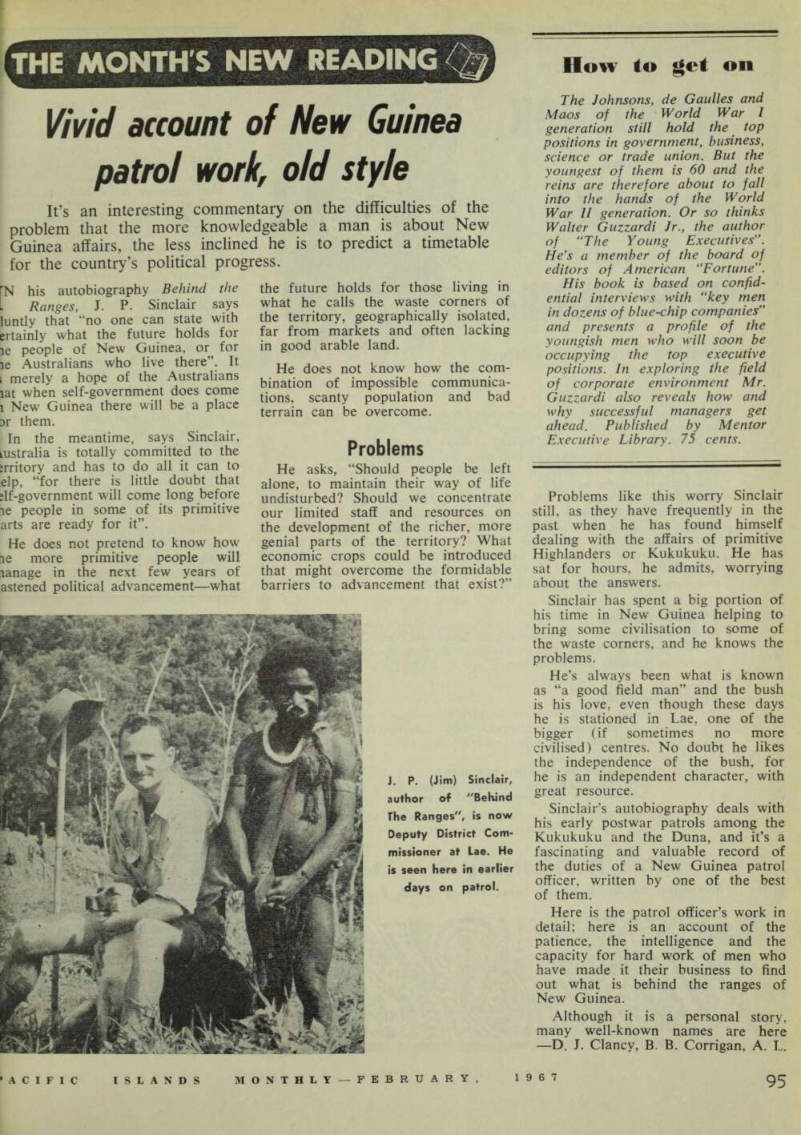
J. P. (Jim) Sinclair, author of "Behind The Ranges", is now Deputy District Com missioner at Lae. He is seen here in earlier
days on patrol.
Hurrell, W. W. Crellin, P.
Maloney, the Leahys, the Champion lan Downs, R. R. Cole.
It is the detail which makes tl book of special interest. It is in tl detail that we see why Sinclair is< good native man.
He writes extremely well, withcc exaggeration or unnecessary woro and his book quickly reflects tl purposefulness with which the po< war men went about their patn work.
As he says, the patrol work str goes on, but motor vehicles, he= copters, powered dinghies and me: patrol posts have reduced the nee for the long traversing patrols the kind he describes.
Most of the exploring has no been done. The Old New Guinea gone—helped on its way by men lii Sinclair.
An index, and many photogrape of the high quality we have come expect from J. P. Sinclair, mai Behind The Ranges a book for biu ing.—SI. (BEHIND THE RANGES. Melbouri University Press. $4.75.)