Fiji's New Government Faces
pp. 27-35 · Read in the full issue

Three major industries under strain
Some Massive Problems
By R. W. Robson
Fiji’s new Government, set up under the colony’s new constitution had been functioning for over three months at the end of January. My outstanding impressions of it are: —
• The single-minded purposeful ess with which porfolio-holders (so ar, they are called Members of the Executive Council—but they really re Ministers) have applied them ;lves to the little nation’s problems. • The difficult—almost appalling -problems with which Fiji is con •onted. Three are outstanding.
Three major headaches
The first problem, of course, is ver-population. There are now just n a half-million people in this rit i s h colony—around 250,000 idians, around 200,000 Fijians, the dance Europeans, part-Europeans id Chinese.
This is now more than the country m support, in comfort. Despite a /ely birth control campaign, the idians have a birthrate of just ider 40 per thousand per annum, id the Fijians about 30 per ousand. A well-balanced birthrate, ider modern hygienic conditions, is )-24 per thousand.
Consequently, the problem of eding Fiji’s half-million grows ever ore acute.
The second problem therefore is onomic. Fiji must produce more od, or more goods and services dch can be sold abroad in exchange r essential needs.
So the new Administration is now applying itself, almost frantically, to plans for the development of new industries, or background for same.
It is being cruelly handicapped by two overriding factors—namely, Fiji’s limited natural resources and the apparent reluctance of overseas in vestors to put new capital into any thing other than the tourist hotel industry (of which more later).
The third problem follows our in ability to solve the first two problems.
This is unemployment. There are not enough jobs for the oncoming mass of young people. That, in turn, creates social unrest. And social unrest, inevitably, breeds political trouble.
Little planning
The new Ministers are dealing with innumerable minor problems. But the majority, as can be understood, lead back to the colony’s three major headaches—too many people to be carried by the economic structure, at its present stage of develop ment; the country’s limited natural resources; and the fact that the development of those resources, any way, cannot be speeded up to take care of the present population without the introduction of much additional capital, and developmental know-how.
Much blame for this situation rests with the British Colonial Office, which governed Fiji for some 90 years. Until 1945, little attempt was made to plan the country’s politico economic future.
Too much need not be made of that—it was typical of colonial administration generally.
But immediately World War II was over, various thoughtful non-official observers noted the phenomenal birthrate of both Indians and Fijians, and saw what was coming.
Their representations to the Gov ernors and the Colonial Office were most urgent. I know I was frequently in Fiji, and I read much of their memoranda.
Bureaucratic pussy-cats
From 1930 onwards, I personally met all the Fiji Governors. Most of them could be written off as bureau cratic pussy-cats, ineffectual and in capable of positive planning.
But two of them, in my opinion, were impressed by the need for forthright, early action, to take care of the rapidly growing population.
They did their best—and their best produced valuable down-to earth plans and recommendations like the Bums and the Eve Reports—but nothing worthy of note was achieved.
Under the British system, each Governor (who needed at least two years to grasp Fiji’s needs) was in turn retired, complete with knight hood and pension, to an England that now was bedevilled with new ideo logies and the collapse of her once vast colonial empire, and could not care less about Fiji.
Fiji had five Governors inside two decades.
The new Fiji constitution, under which the Jakeway-Mara Govern
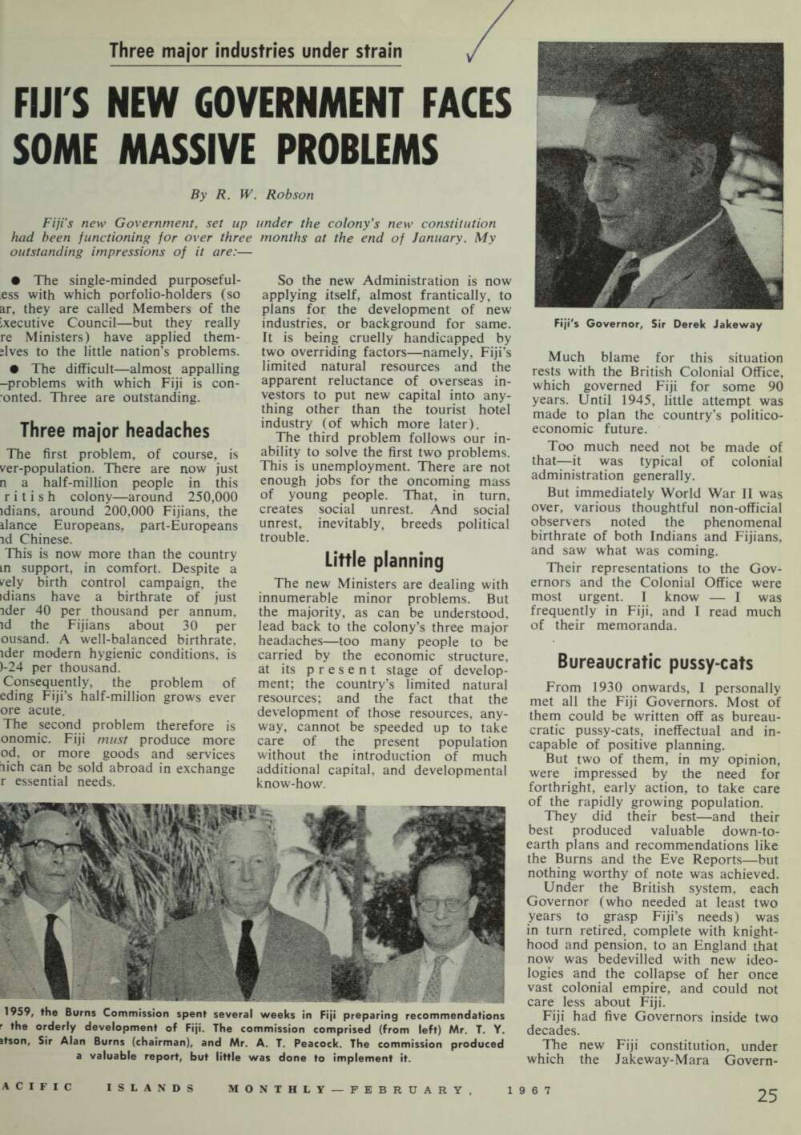
1959, the Burns Commission spent several weeks in Fiji preparing recommendations [?]the orderly development of Fiji. The commission comprised (from left) Mr. T. Y. atson, Sir Alan Burns (chairman), and Mr. A. T. Peacock. The commission produced a valuable report, but little was done to implement it.
Fiji's Governor, Sir Derek Jakeway
ment now is urgently at work, should have been introduced a couple of decades ago.
It was urgently sought, then, by Fiji interests, but there was no in dication that the idea even penetrated the heads of the Whitehall bureau crats.
The new Ministers should remember those facts. The colossal tasks with which they now are faced, could have been handled much more easily in the mid-fifties.
Not much more can be done with Fiji’s No. 1 problem—over-popula tion. Data from every Indian im plantation around the Indian Ocean, including India itself, indicate that the Indian reproduction rate is usually double that of Western Europeans.
It is no use putting pressure on ;he Fijians to reduce their birthrate, vhile that of the Indians remains so ligh. Already, there is sharp resent nent in the Fijian villages against the vay in which the Indian population las overtaken and outnumbered that )f the indigenous people.
Anyway, whatever way they come, here are half-a-million people; and he new Government’s prime respon ibility is to provide means by which hey can be fed, trained and imployed.
Leadership
A survey in January indicates that he people generally are happy about he way in which the Ministers have et themselves to work.
The colony was fortunate in having vailable for leadership a man like latu Mara—young, highly respected y all races, and with an alert, con tructive mind based on an English Jniversity education.
He has an impressive grasp of 'iji’s basic problems, accepts the eed for racial co-operation, and is ager for progress.
But Mara does not suffer fools ladly. So far he has shown ex tnplary patience in his encounters dth the few agitators and mal ontents which a section of the idian community sent into the new 'ouncil.
The country was fortunate, also, i having a young and strong rovernor in Sir Derek Jakeway at lis critical time of change-over. He, Iso. as a background guiding force, displaying patience and wisdom t handling his new team of Fijians, idians and Europeans, and in help ig them to shape policy.
Up to this writing—and contrary ► some expectations—the Jakeway lara combination is working very ell. That is reflected also in a good,
co-operative spirit among the departmental heads.
There have been important changes there. A new Chief Secretary in Mr.
G. P. Lloyd has replaced both Mr.
P. D. Macdonald and Mr. J. S.
Thomson (who acted for a long time and whose transfer to another colony was strongly opposed by Fiji); and Mr. R. H. T. Beaumont, long-time Police Commissioner (who was ill in New Zealand in January) has retired.
Despite the changes, the new government is functioning smoothly and impressively
Old industries tired /7
D . . „ But the economic situation calls for everything the new Ministers have ? a lee . wa / t 0 make up, and the development of new industries simply must be undertaken.
Take a glance at the old industries.
Hitherto, Fiji has moved and had its being on sugar production. The CSR Company of Australia intro duced the sugar industry, and main tains it efficiently. But among the world’s many crazinesses today is a vast over-production of sugar. The world price now is below the cost of production in even the cheapest labour countries, . As everyone knows, the Fiji sugar industry keeps going only because it is British—Britain, in association with US , A and certain other interests, buys «r!u rge * P r 9P? r , tlon °f Fiji s sugar, Without Britain s support today, the sugar industry would die—and Fiji Copra production is Fiji’s second industry—a long way back. The wor ld copra market is a chancy thing, but usually there is a offering which keeps coconut plant ing alive> could be P more coconut planting in Fiji—but it must be high-grade copra, and that in
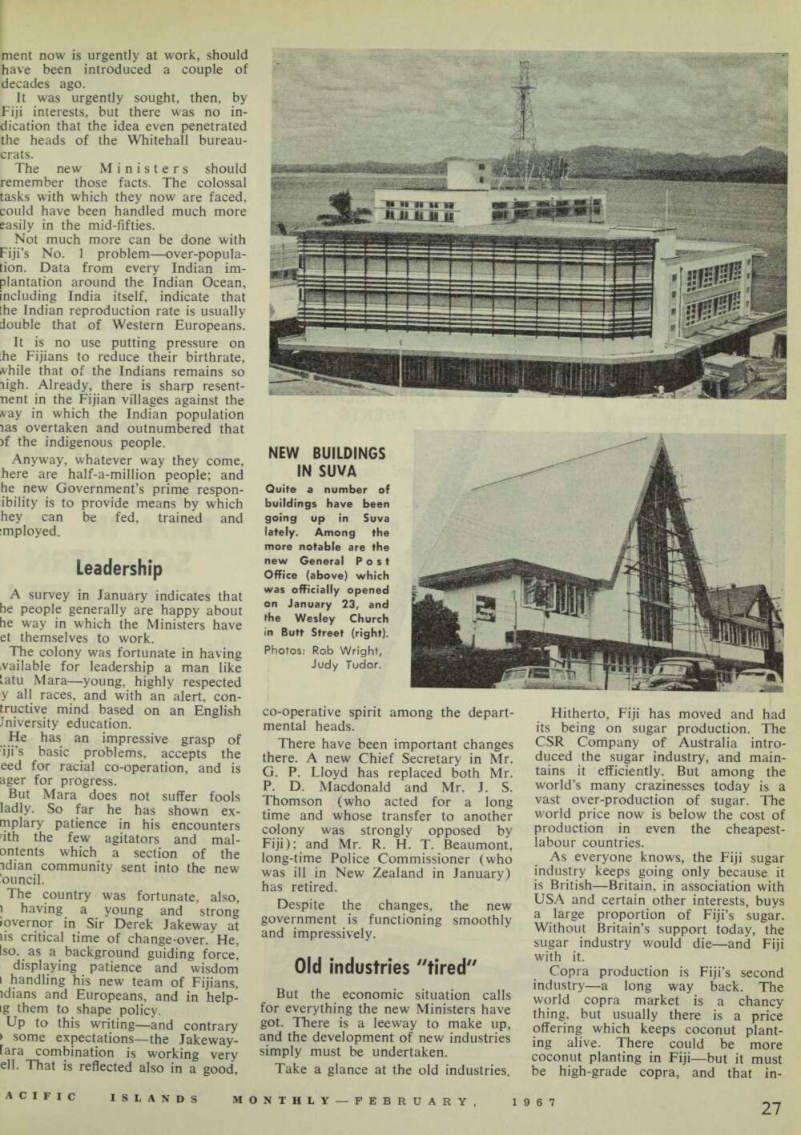
New Buildings
In Suva
Quite a number of buildings have been going up in Suva lately. Among the more notable are the new General Post Office (above) which was officially opened on January 23, and the Wesley Church in Butt Street (right).
Photos: Rob Wright,
Judy Tudor.
volves far more technical training of Fijians and Indians than now is provided.
Next is gold-mining. Here is another headache. Over 6,000 people live at the Emperor gold-mining town of Vatukoula. There are vast reserves of good telluride ore there, but deep down; and the gold-mining company (Australian) for years has been re covering only enough gold to keep the industry functioning and pay a very modest dividend. Further development would not pay, with gold at its present fixed price. The company has been marking time for over 10 years.
Lately, the Government imposed new taxation (provident fund). The company has let it be known that it cannot carry the new costs. Either the Government must subsidise the industry to keep Vatukoula in existence (in the hope of a better gold price) or the mines may close down.
The new Government is still sweat ing over that one.
There are a few little, old in dustries, but in this situation they are not important.
Sugar is sick, copra is sluggish, ?old is semi-paralysed.
Tourism, pro and con
The government and people now ire turning eagerly to the vigorous lew tourist industry, established in he last 10 years, and, as evidenced >y the increasing number of first-class lotels, still growing.
The trouble is that no one knows ictually what it is worth. Tourists •ay their fares in Australia, or America, or New Zealand—Fiji gets lone of that—but they arrive in Fiji /ith money to spend on goods, ac ommodation, sightseeing. How much oes the average tourist leave behind?
Tourism now may be bringing in 5 million a year. If so, the industry akes second place to sugar. Un uestionably, tourism is helping Fiji’s nances just when they really need elp; it could double in value in the ext year or two; but it is no ermanent solution to Fiji’s employ lent problem.
New tourist hotels have been built icently at Ba and Nadi (Northern); ladi Airport (Tanoa); Suva (Out gger); and Taveuni. More are eing built at Yanuca (a very big reject); Savu Savu; Bay of Islands, ear Suva; and on an island off autoka (Castaway). Another big
one is announced for Suva city, near the GPU. These operations provide work for hundreds of artisans and labourers —but that kind of building is easing off.
Tourist money is spent mostly on hotels and transportation and on im ported goods bought from city re tailers. It is welcomed by the trader and the tax-gatherer, but it does not directly help the rural dwellers.
So the new Government, while en couraging tourism, is turning rather feverishly to an examination of other possible industries. (See “New zest badly needed in Fiji tourist industry”, P- 121).
New industries?
First in that category is afforesta ;ion. Far-reaching activities now are ifoot to earmark, in most of the irincipal islands, large areas classified is unfit for agriculture, but suitable : or tree-planting.
This calls for surveys, establishment )f camps, growth of trees for plant ng out, training of tree-planters. It :ould be a big and important indusry, ibsorbing a lot of labour, and creat ng an important national asset.
But afforestation like extended oconut planting, cattle-farming, :offee and cocoa cultivation, all of yhich are practicable and possible— leeds years of time and millions of noney, for successful establishment.
All are agreed that improved and xtended land communications must o hand-in-hand with agricultural nd pastoral development; and the
new Government promises better highways and more access roads.
There are hundreds of little valleys in Fiji which could support peasant families but which, even if available under existing land laws, are not accessible.
At present there is in Fiji a team of some 10 transportation experts (provided from overseas by UN and similar instrumentalities). They are making a thorough examination of the country, at little expense to Fiji.
Their report will guide the Government in the steps to be taken, in a scientific and effective way, to improve Fiji’s transportation systems.
Transportation comes under the administration of Mr. Charles Stinson, one of the most energetic and farsighted Ministers, and Suva’s former mayor. He believes that Fiji’s future development must include the early provision of a first-class arterial road between Suva and the Nadi-Lautoka area
Wanted: money and peace
7 r So far, so very good. If Fiji can get ahead with the economic development it wants, it can feed and house its half-million people adequately.
But here are the obstacles in its path, and all the ardent new Ministers recognise them:— • A great deal of money, for capital works, must be provided— much more than is now in sight, • If a solution of Fiji’s major problems is to be found, Fiji must have at least five years of racial cooperation and political peace. Otherwise, essential money and technical aid will not come in from overseas.
Skilled emissaries from Fiji have been knocking respectfully at chancellery doors in Canberra,
London and New York, but the money is not in sight— not in sufficient volume, anyway. Fiji, to really get going on essential capital works, needs from £2O to £3O million, It could come. There is much good will in the world for Fiji. But both governments and finance institutions cock a wary and thoughtful eye on Fiji’s political structure and history, How safe would the investment be? ... , .
rl|l3nS aim Indians
... in *“ at respect, is not easy to a ? ses s- There are those two un predictable races the Fijians, who for L th . e most P art stlll clm g lovingly to their communal villages, show little inclination for hard work and in dividual enterprise—and own most of and the Indians, who can exercise all the technical skills of Euro P ea n s a °d work hard but cannot get nearly enough land.
In politics, the Fijians generally accept the lead ership of their chiefs, who are conservative, content with things as they are, and work harmoniously with the Europeans. A respectable, and growing section of Fiji-born Indians also work agreeably with British officialdom—the new Indian Ministers have made a very good impression. But a large—no one really knows how large—section of the Indians are vociferously anti-European; and, whenever they get a chance, they howl alarmingly in the market place for “an independent Fiji based on a common roll”, which, of course, would place political power in the hands of the Indians.
So money-owners with millions available for investment are not rush ing into Fiji. They are interested,
Mr. Stinson
Most motorists in Viti Levu wish fervently that the excellent new section of tar sealed road recently completed in the Lami area of Suva, and near to the Bay of Islands, could be extended right round the island, thus eliminating many of the hazards and much of the discomfort encountered on the gravel roads, with alternating sections of dust and mud.— Photo: Rob Wright.
but they want to see more clearly the shape of things to come.
Memories of events in many, many ex-colonies are sharp in their minds.
What is Britain going to do with these remnants (Fiji is a remnant) of her once vast colonial empire?
That is what we all want to know.
That is why the new Fiji Government is being closely watched.
If Britain stands behind the new constitution —as she has promised— and the restless, ragged minority of Indian political agitators is kept in place, the new government could achieve something, and Fiji could become a sound investment and a happy little nation.
But a quiet period, for economic organisation and the establishment of harmonious racial relations, is vital.
That is what the potential investors are looking for. But it could be a period of belt-tightening. There is a lot of poverty in Fiji.
Union of Melanesia?
If only Britain, Australia, United States and New Zealand—with France, if she’d come, but without her, if not —would lift their eyes above Fiji, and survey the South Pacific, they surely could create a better Islands world than now exists.
Why cannot over-populated Fiji, the under-populated Solomons, the over-populated Gilbert and Ellice, and the under-populated New Hebrides, jointly representing enormous undeveloped natural re sources, be thrown together in one political union of some kind?
The control of that region, the training of its peoples for the jconomic development of such a anion, the creation of opportunities for the now thwarted Indians of Fiji and the crowded Micronesians of the 3ilberts, could be a worthwhile task for the South Pacific Commission, which has spent most of the last quarter-century twiddling its academic humbs more or less uselessly in Nfoumea.