Tropicalities
pp. 18-21 · Read in the full issue
While plaintive post-mortems were still going on in January in some territories over where things had gone wrong at the Second South Pacific Games in Noumea in December, we were happy to note that some people were already getting a move on for the Third Games in Port Moresby in 1969.
THE fastest mover of them all was Fiji’s 11-year-old swimmer Olive Pickering, who won a silver and a bronze medal in the individual events in Noumea, plus two silvers in the relays.
Soon after the Noumea Games ended, Olive came to Australia to train under Casino coach John Brown and to take part in the New South Wales championships at Sydney’s Drummoyne Pool. She was soon setting a lively pace.
In the championships, Olive established a Fiji open record for the 200 metres medley with a time of 2m. 47.25. in her qualifying heat for under-12 women.
This was 2.35. better than the gold medallist’s time for the event in Noumea; 5.35. better than Olive’s own silver medal-winning time in Noumea; and 7.35. faster than her nearest rival in the Drummoyne Pool.
Her time in the final—2m. 51.55. was not quite so good, but good enough to win the event.
NSW record
Olive also won the under-12 100 metres freestyle in Im. 6.95., which established a New South Wales record.
In the under-12 100 metres back stroke, she came second in Im. 19.45. —l.4s. slower than the winner.
Olive later put in some outstanding performances in the NSW country championships, and finished up with five gold and four silver medals to take back to Fiji. (She could not leave Sydney as planned on January 31 because her passport was lost).
Several Sydney sports writers be came almost ecstatic over Olive’s performance. These included Aus tralia’s former Olympic champion.
Dawn Fraser, who predicted an out standing future for her.
Coach John Brown went as far as to say that Olive could be “one of the fastest swimmers in the world
Getting a move
on for the
Moresby Games
inside three years”—which should make her pretty hard to beat in Port Moresby.
Meanwhile, it was announced in Port Moresby that reclamation work would begin at the end of the month on the 28-acre Sir Hubert Murray Reserve, which is expected to be the main site for the Third South Pacific Games in 1969.
The District Commissioner of the Central District, Mr. R. T. Galloway, said that when established, the reserve would provide badly-needed sporting and recreation facilities for the public, and that it could be one of the most beautiful sporting com plexes in the world.
Few other sporting centres, he said, had such a picturesque setting, with a protected harbour on one side and high hills on the other.
Mr. Galloway said that trees were being grown by the P-NG Depart ment of Forests for transplanting when the reclamation work was com pleted and the landscape design was ready.
Every square foot of the reserve, of which three-quarters would be reclaimed land, would be planned to contain all the essentials of a world class park, including traffic access and parking areas.
Death note : 1967 was only a few hours old when one of Noumea’s leading Rugby players, Jean Pierre Bernanos, was shot dead by his wife.
Bernanos, a pastrycook, played Rugby for New Caledonia at the recent South Pacific Games. His wife shot him at point blank range after she returned from an all-night party.
Disillusionment
over pensions
EVERY now and then we Ir some disillusioned words fn some of Papua-New Guinea’s of public servants on the subject pensions and inflation.
The refrain is always much same.
“I am due for retirement im couple of months,” one of them ft us recently, “but I must keep
working.
“I have not got a home, anoi
aid not live on my miserable asion.
“What a fool I was ever to have ;en on superannuation. It seemed fine idea long years ago, and I ide sacrifices at times to keep up ! payments.
“But year by year, under inflation, i value has run out of the £’s I r e d—and now I can’t live on it.”
Hundreds of men and women, who /e the best years of their lives to vice in P-NG have learned the ne hard lesson —that what was rth, say, £l,OOO when they first inned for it 20 years ago is now [y £5OO, or less, in purchasing sver.
Fhis, of course, is true of all cash ings.
Which leads us to ponder on the t that although Australia spends [lions of dollars in P-NG each ir, it has never made any real ;mpt to compensate its public vants for the losses they have fered through something for which y are in no way responsible—
nely, inflation.
lostalgia for old
inding “grounds”
T his final Press conference in l Sydney on January 27 before ving on his non-stop, 15,000-mile around Cape Horn to England, managed to ask noted English ditsman Sir Francis Chichester if would like to have visited Lord iwe and Norfolk Islands during month-long stay in Sydney.
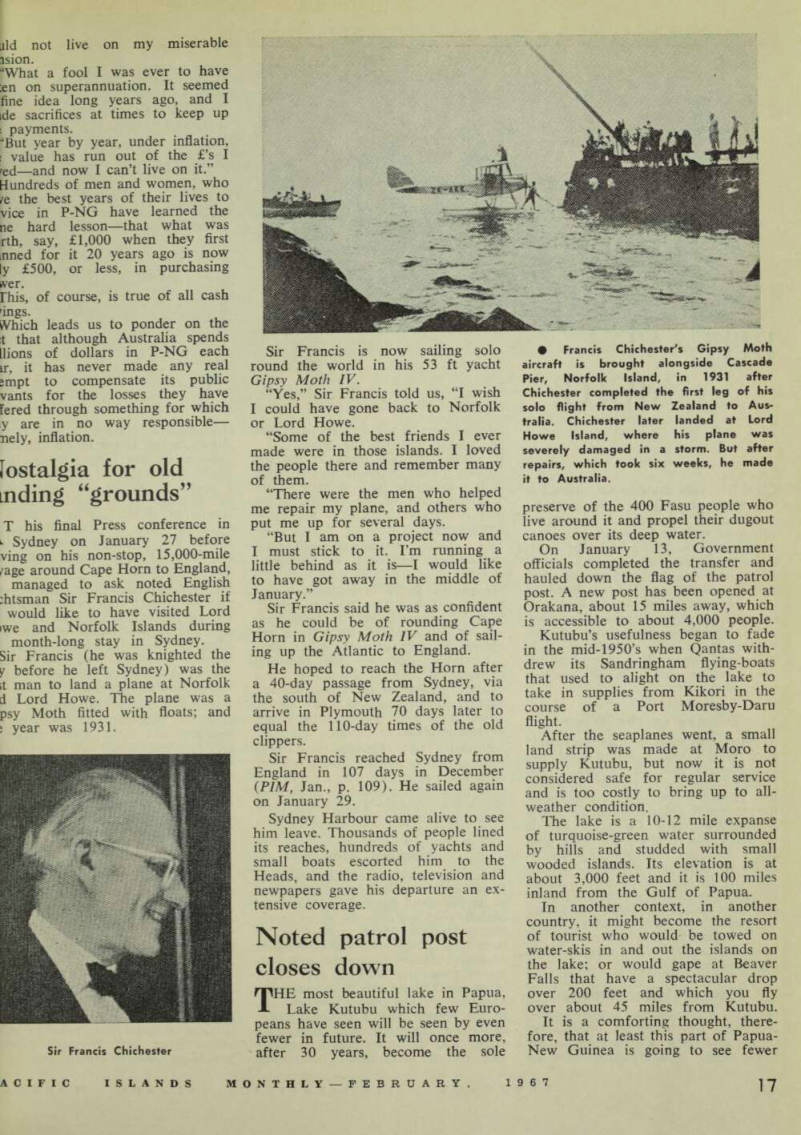
Sir Francis (he was knighted the y before he left Sydney) was the ;t man to land a plane at Norfolk d Lord Howe. TTie plane was a psy Moth fitted with floats; and ; year was 1931.
Sir Francis is now sailing solo round the world in his 53 ft yacht Gipsy Moth IV.
“Yes,” Sir Francis told us, “I wish I could have gone back to Norfolk or Lord Howe.
“Some of the best friends I ever made were in those islands. I loved the people there and remember many of them.
“There were the men who helped me repair my plane, and others who put me up for several days.
“But I am on a project now and I must stick to it. I’m running a little behind as it is—l would like to have got away in the middle of January.”
Sir Francis said he was as confident as he could be of rounding Cape Horn in Gipsy Moth IV and of sail ing up the Atlantic to England.
He hoped to reach the Horn after a 40-day passage from Sydney, via the south of New Zealand, and to arrive in Plymouth 70 days later to equal the 110-day times of the old clippers.
Sir Francis reached Sydney from England in 107 days in December ( PIM, Jan., p. 109). He sailed again on January 29.
Sydney Harbour came alive to see him leave. Thousands of people lined its reaches, hundreds of yachts and small boats escorted him to the Heads, and the radio, television and newpapers gave his departure an ex tensive coverage.
Noted patrol post
closes down
THE most beautiful lake in Papua, Lake Kutubu which few Euro peans have seen will be seen by even fewer in future. It will once more, after 30 years, become the sole
preserve of the 400 Fasu people who live around it and propel their dugout canoes over its deep water.
On January 13, Government officials completed the transfer and hauled down the flag of the patrol post. A new post has been opened at Orakana, about 15 miles away, which is accessible to about 4,000 people.
Kutubu’s usefulness began to fade in the mid-1950’s when Qantas with drew its Sandringham flying-boats that used to alight on the lake to take in supplies from Kikori in the course of a Port Moresby-Daru flight.
After the seaplanes went, a small land strip was made at Moro to supply Kutubu, but now it is not considered safe for regular service and is too costly to bring up to all weather condition.
The lake is a 10-12 mile expanse of turquoise-green water surrounded by hills and studded with small wooded islands. Its elevation is at about 3,000 feet and it is 100 miles inland from the Gulf of Papua.
In another context, in another country, it might become the resort of tourist who would be towed on water-skis in and out the islands on the lake; or would gape at Beaver Falls that have a spectacular drop over 200 feet and which you fly over about 45 miles from Kutubu.
It is a comforting thought, there fore, that at least this part of Papua- New Guinea is going to see fewer
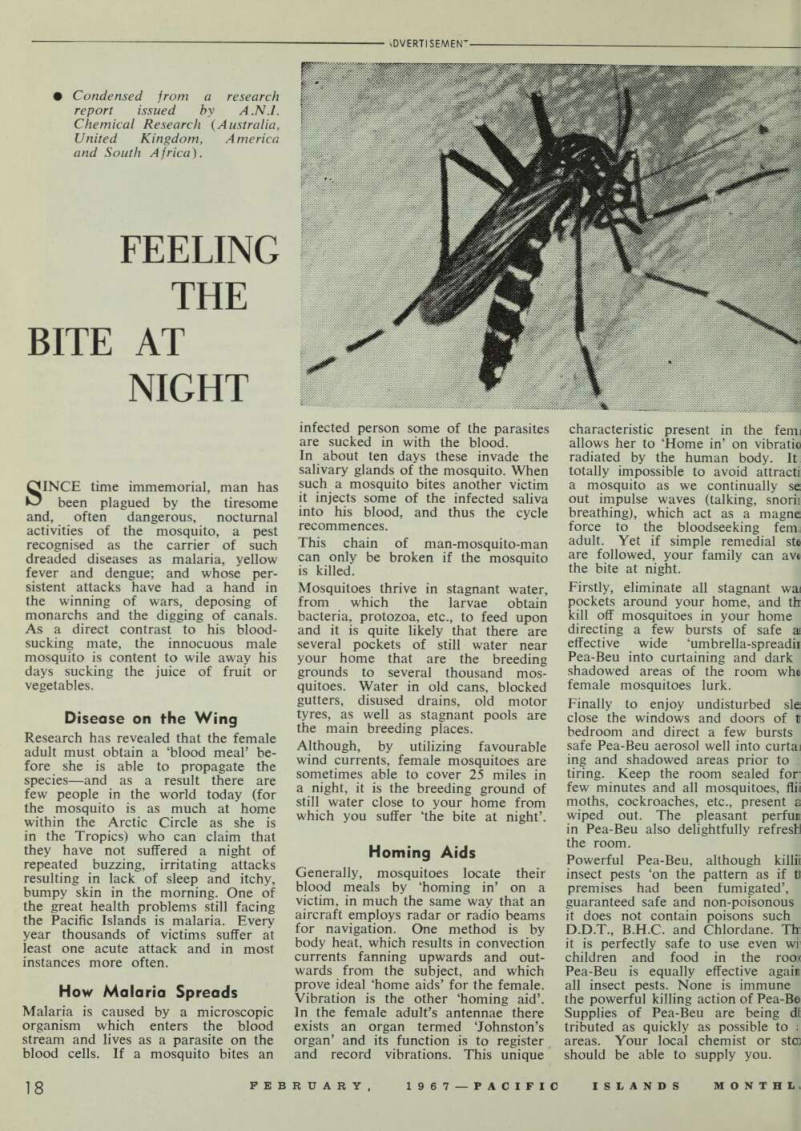
Sir Francis Chichester
Francis Chichester's Gipsy Moth aircraft is brought alongside Cascade Pier, Norfolk Island, in 1931 after Chichester completed the first leg of his solo flight from New Zealand to Aus tralia. Chichester later landed at Lord Howe Island, where his plane was severely damaged in a storm. But after repairs, which took six weeks, he made it to Australia.
ivellers rather than more and is ilikely to take part in the great, omised tourist boom.
Ivan Champion and the late Jack ides are believed to have been the st Europeans to see Lake Kutubu len they flew over it in 1936. Ivan d his brother Claude later led /eral expeditions to it on foot and became an advanced police post in 37.
It was from there that patrols set it to discover the hundreds of imitive people living in the great ateaus of what today is known as ; Southern Highlands District.
Jews that doesn’t
et reported
|NCE or twice previously in these * columns, we have had occasion remark on, and even marvel at, j way the otherwise excellent news ters put out by the various Islands ministrations sometimes manage to ss recording the most startling news ms in their territories.
The latest instance of this to come der our notice concerns Colony formation Notes, the weekly neoed newsletter of the Gilbert and lice Islands Colony, which failed record an extremely important solution passed by the GEIC Ivisory Council last October.
The resolution suggested that the EIC Resident Commissioner should given the powers now exercised by 2 British High Commissioner for e Western Pacific in Honiara, so at he (the Resident Commissioner) >uld be directly responsible to the )mmonwealth Office in London.
This would mean a maior alteration the constitutional set-up which has isted in the Gilbert and Ellice
Islands ever since they came under the British Crown in 1892.
The text of the resolution stated: “That in view of the advance of the Colony in constitutional affairs, the link of the colony with the rest of the world by air service, and the need for direct consultation between the Colony Government and the Secretary of State, this council recommends that the powers and prerogatives of the High Commissioner should be re-examined by the Secretary of State; it being the council’s opinion that his statutory functions should now be transferred to the Resident Commissioner.”
Back to the days
of St. Francis
THE Anglican Society of St.
Francis, which has been working in Papua-New Guinea for the past eight years, is about to embark on a new experiment in those parts.
A few of its friars, who will live in a house to be built in the Port Moresby suburb of Hohola, are to go out and work in ordinary jobs.
As Franciscan friars have no money or other possessions of their own, the wages earned by each of them will go into a common pool and it is hoped that their house will be self-supporting.
Brother Geoffrey, who is in charge of the Franciscans’ territory work, says: “This venture, which seems so new, is in reality a return to St.
Francis’ own days, when brothers went out to earn their living. We are setting up the house in Hohola so that we can be closely identified with ordinary people who have to run their homes and work for their living”.
If the Hohola experiment is suc cessful, it may be introduced to other parts of Papua and New Guinea.
Meanwhile, other friars of the Franciscan houses already established at Koki and Jegarata, near Popon detta, will continue in the society’s traditional work of preaching, teach ing and social work.
The Hohola experiment is one of two important developments expected within the society this year.
The other is a plan to form an independent South Pacific province of the order. This would be the first self-governing province to be formed outside England, from where territory Franciscan life is at present admini stered.
The new province would take in Franciscan work in Australia and any future developments in the South Pacific, as well as Papua-New Guinea.
It would have its own elected Father Minister (or head) and governing body.
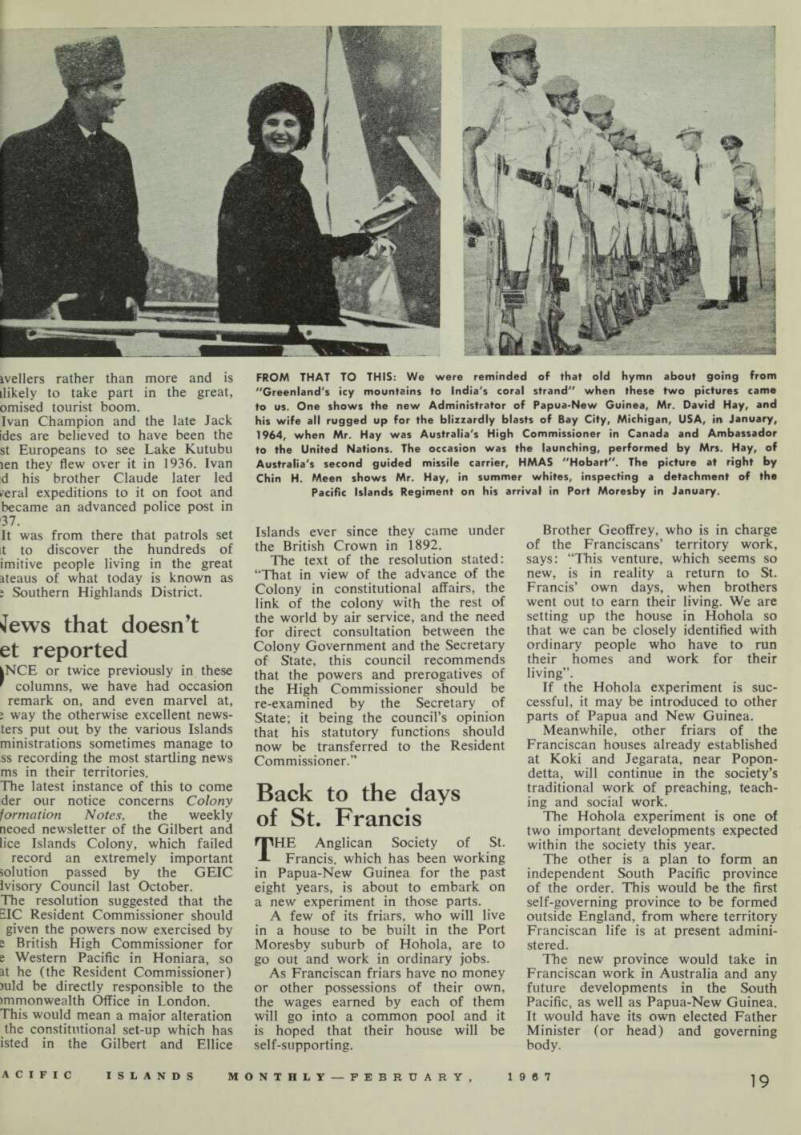
FROM THAT TO THIS: We were reminded of that old hymn about going from "Greenland's icy mountains to India's coral strand" when these two pictures came to us. One shows the new Administrator of Papua-New Guinea, Mr. David Hay, and his wife all rugged up for the blizzardly blasts of Bay City, Michigan, USA, in January, 1964, when Mr. Hay was Australia's High Commissioner in Canada and Ambassador to the United Nations. The occasion was the launching, performed by Mrs. Hay, of Australia's second guided missile carrier, HMAS "Hobart", The picture at right by Chin H. Meen shows Mr. Hay, in summer whites, inspecting a detachment of the Pacific Islands Regiment on his arrival in Port Moresby in January.