Development
pp. 143-145 · Read in the full issue
Business and
[?]onga lifts [?]ost export [?]estrictions
m Dorothy Lavin in Nukualofa 1966 finished on a healthy e for Tonga, with the king
n’s revenue reserves standing
their highest level since 1961,
pile the considerable loss in enue incurred over the six
nths mourning period for the
j Queen. has also been a record year for expenditure with large sums of tiey being channelled into the new jen Salote Wharf, the coconut re iting scheme and the WHO water environmental sanitation scheme 11 projects that in time will help financial well-being of the king i. The new five-year development i, now under way, will mean her improvements, is a result of this healthier ncial outlook, import restrictions e been lifted from all but a few as.
Tiose still under licence include , motor vehicles, cycles and oters, alcohol, textiles, fresh vege les and wearing apparel, and >tas for these will be increased 100 per cent, of 1964 import ires against 80 per cent, during >6. However, exchange control I continue in the meantime, fhe refrigerated fishing vessel :eina has been operating with ae success, providing a much ded boost to the country’s diet h a more plentiful supply of fresh , and the year has shown a con jrable increase in exports of both onut products and bananas, Vnd what else to report as 1966 ses? fo commemorate the first anni sary of the death of Queen Salote, special series of postage stamps 5 issued in December. But these isisted of the residue of the n-Pacific and South-East Asia om e n’s Association Conference
series overblocked with metallic foils. It is expected that a further special issue will be made for the King’s coronation in July. The pro moters obviously are not missing a trick.
A crying need in the kingdom has been increased education in the technical and agricultural fields.
Owing to a grant this year of $14,000 by technical aid (ASPTAP) Tonga College at Atele has received con siderable equipment to improve these fields of education.
Mr. R. A. Johnson has been made available by Australia to supervise the running of the course of tech nical training, and the Tongan Gov ernment is financing the erection of a new block at the college to house metalwork, woodwork and technical drawing, with staff facilities. The PWD has made an excellent effort and the block will be ready when school re-opens in 1967.
A tractor and farm implements have been provided on the agricul tural side and two of the Tongan staff have completed a year’s train ing at Gatton College in Queensland for their agricultural teaching diplomas.
In 1967, it is hoped that further aid from Australia will provide more scientific equipment for the planned new science block.
With Tonga’s five-year develop ment plan well under way, 1967 should produce further improvements in her financial position, as well as a better standard of living all round.
Decimal currency
Tonga will convert to decimal currency on Monday, April 3.
The new unit of currency will be the pa’anga, equal to one Aus tralian dollar, and it will come in denominations of one-half, one, two, five and ten pa’anga. Each note will carry a photogravure of the late Queen Salote on the front, and a typical Tongan scene on the reverse.
All notes will be the same size, with different colours and scenes dis tinguishing denominations.
Tonga, for the first time, will have its own coinage, in denominations of one pa’anga, fifty seniti, and twenty, ten, five, two and one seniti. They are being minted at the Royal Mint in London, with designs planned by
the Decimal Currency Committee of Nukualofa.
An intensive publicity campaign throughout the kingdom will educate the public in the new currency, but it is expected that it will be some time before the present currency ceases to be legal tender.
Cooks banana
industry to extend
ONE of the current plans for in creasing Cook Islands exports and reducing the adverse trade balance with New Zealand is the extension of large-scale banana plant ing to the island of Aitutaki.
The proposed monthly target figure lies between 7,000 and 10,000 cases for the New Zealand market.
A soil survey has shown that Aitutaki is suitable for producing good quality bananas. A New Zealand market and a regular shipping service have been assured.
One of the major problems to be faced is that of labour shortage. Up to 10,000 cases of bananas have to be cut and packed within 24 hours to meet a shipment. This operation requires 833 packers alone, each completing 12 cases per day.
Aitutaki’s present labour force is an estimated 870 men and women.
Schoolchildren might have to help on shipping days.
Many banana planters are dis satisfied with current returns, and this applies to other Pacific territories besides the Cook Islands.
This point was raised during the November sessions of the Cook Islands Legislative Assembly, when the “Proposed Banana Replanting Scheme For Aitutaki” was being debated.
Mr. Apenera Short, Minister of Co-operatives, said that the current payment to banana growers was not enough, but that good bananas must first be produced before negotiations for better prices could be resumed.
The Premier, Mr. A. R. Henry, said that the biggest problem was money, but he was satisfied that the scheme would work and would become an economic life-saver for the Cook Islands. The Government had therefore decided to extend large scale banana planting to Aitutaki.
During his recent visit to New Zealand he had attended a function
at the Jaycees’ Club in New Plymouth, and the club had donated £5,000 for the development of Cook Islands’ harbours and a further £5,000 for the Banana Replanting Scheme.
Mr. William Estall, a member for Aitutaki, said that a compensation plan for the Aitutaki banana planters was needed to protect them against losses in the early stages of the re planting scheme. This was to cover shipments that fell short of the target figure and could not be exported to New Zealand. The planters would be paid from the fund, the fruit sold in Rarotonga, and the proceeds put back into the fund.
Other speakers stated that the people of Aitutaki, and their Island Council, fully supported the replant
ing scheme, that the first nurseries had already been established and the plants were growing well.
For the scheme to be successful a minimum of 500 acres would have to be planted and the fruit grown under expert management. If the target figures are reached, monthly shipping calls would be made, and improvements to the reef passage and loading area should follow to enable fruit to be loaded in all weather con ditions.
The scheme will cost £NZ53,050 to operate. Advances to growers will total £35,750, capital expenditure £10,300, and the establishment of 55 acres of nurseries will cost £7,000, At 300 cases per acre, between 30 and 50 acres will need to be cut per shipment.
Before the scheme can proceed problems of land ownership and occupational rights will have to be resolved, and the essential acreage will have to be guaranteed. The scheme will require an estimated 800 tons of fertiliser yearly, based on 680 plants per acre and an eventual 550 acres under cultivation.
Ten acres of nurseries will be established this year and 45 acres next year to provide a total production of 382,500 shoots. The first 10 acres are expected to produce 40,000 plants by August, 1967.
The banana industry is also being revived on Rarotonga.
McEachern to
stand trial
NEW GUINEA businessman Leonard Francis McEachern, in the Port Moresby District Court on December 12, was committed for trial on 14 charges alleging forging, utter ing and falsifying company records.
He was allowed $2,000 bail on condition he did not leave P-NG.
McEachern was arrested in P o Moresby on December 9 after had failed to appear at an earll court hearing.
McEachern, who lives in P* Moresby, is a former director Sandy Creek Gold Sluicing Ltd., ai Cosmopolitan Hotel Ltd., Rabaul.
The charges are that he forg and uttered a proxy to vote on beh: of Sandy Creek at a general meet! of Cosmopolitan Hotel Ltd., Rabaul, in April, 1964. Twelve otH charges allege he forged, uttered ai falsified company records in t affairs of the two companies II tween July, 1963, and October, 19* while he was manager of the O' mopolitan Hotel.
Second nickel co.
for N. Caledonia
THE French Government t decided to allow a second nicl company to go into business in Nt Caledonia.
Announcing this in Noumea December, the French Minister t Overseas Territories, General Billoti said that the company would ha French, New Caledonian and foreii interests, but the foreign intere; would be in the minority.
The company would enable Nt Caledonia’s economic resources to developed to the maximum; it won give anew start to the economy the north of the island; and it woe provide employment for those in tl north who were now out of work..
General Billotte added: “I ask N« Caledonians not to be led astray propaganda which is not alwa inspired by the general interest the territory”. He did not elaborai The decision to allow a seco< nickel company into the field follow • Persistent reports some montf back that the world’s biggest nicH producer. International Nickel Cos
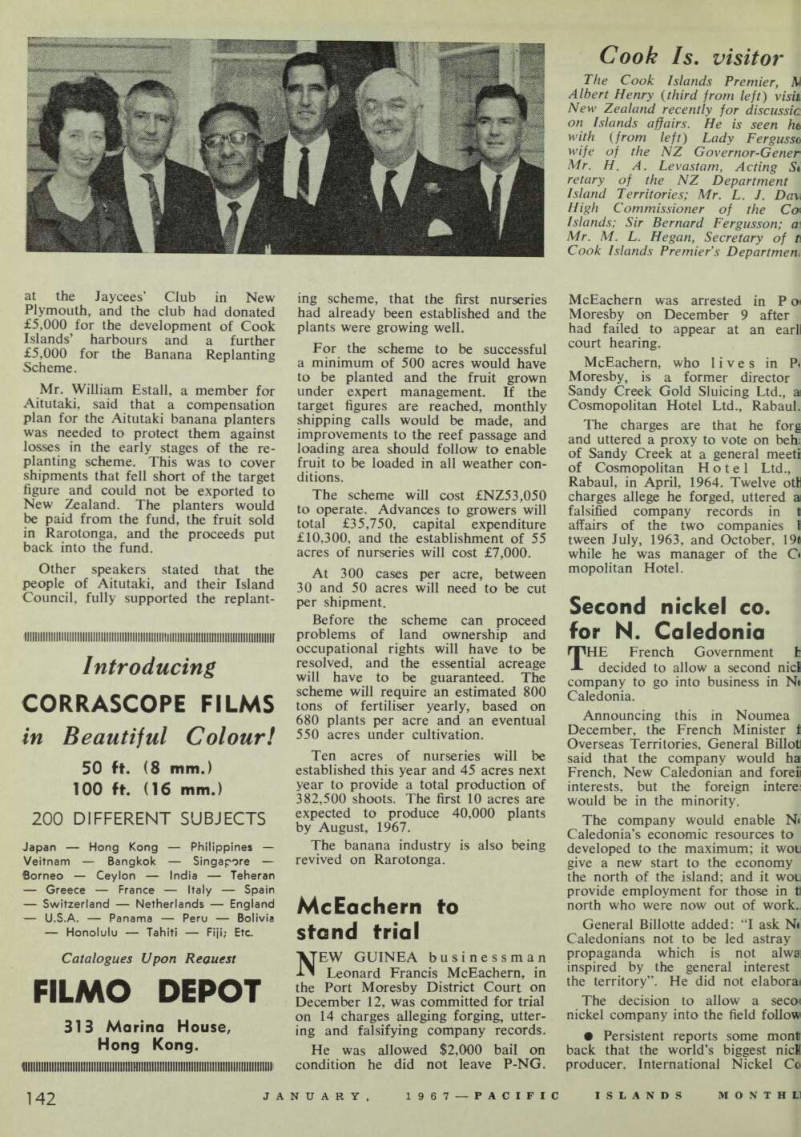
Cook Is. visitor
The Cook Islands Premier, M Albert Henry (third from left ) visit New Zealand recently for discussic on Islands affairs. He is seen he with (from left ) Lady Fergusso wife of the NZ Governor-Gener Mr. H. A. Levastam, Acting St retary of the NZ Department Island Territories; Mr. L. J. Daw High Commissioner of the Ccn Islands; Sir Bernard Fergusson; an Mr. M. L. Hegan, Secretary of P.
Cook Islands Premier’s Department
ration, of Canada, was negotiating begin operations in the country. • General de Gaulle’s statement Noumea in September that the ources of the country were re ved for France alone. • Years of dissatisfaction among w Caledonians over the operations the French company, Societe le ckel, which has had monopolistic itrol of the territory’s nickel in stry for the past century.
New Caledonians claim that Societe Nickel is inefficient and that its ations with its employees are palling. Recently, a dispute be 2en the Societe and union leaders I to a 27-day strike —the longest in : country’s history—at the mining itres of Thio, Poro and Kouarou, d almost brought the entire nickel lustry to a standstill ( PIM , Oct., II and Nov., p. 143).
Nickel accounts for well over 90 r cent, of New Caledonia’s exports.
opra prices should
;main firm
[7ORLD copra prices looked better » in December than they had in j previous month. The month ened up with the Philippine FM irket about $5 better than the erage for November.
In Port Moresby on December 21 j chairman of the P-NG Copra arketing Board, Mr. lan McDonald, id he expected copra prices would uain fairly firm over the next few jnths.
He added: “It is possible that one the reasons for the firming in price the fact that copra supplies to irope and the US declined sharply ring October. Most of the decline is to Europe but both copra and conut oil imports into the US also dined sizeably.
“There appears still to be a con lerable tonnage of copra and coco it oil stored under Custom bond, uch of which is expected to be re ised in January and this could Feet prices at that time.
“There is still a considerable quantity of soyabean, soyabean oil and meal in the US and in Europe and despite reduced production of soyabean and also cottonseed there does not appear to be much change in overall stocks held.
“An interesting angle as far as edible oils and oil seeds are concerned is the fact that livestock numbers, particularly in Eastern Europe, have continued to expand this year and this will no doubt mean a demand for meal, and consequently for oil seeds generally.”
Copper prospector
AN American mining company, the American Smelting Co., has been granted a six-month permit to prospect for copper in the Bainings area of the Gazelle Peninsula, of New Britain.
The company proposes to prospect around an area which was declared a mining reserve by the Administra tion about four months ago after locals took rock samples to Mr. Roy Ashton, MHA. Mr. Ashton found the samples contained copper.
Japan looks at
NG cocoa
JAPAN may commence regular purchases of large quantities of New Guinea cocoa beans if an in vestigation now being carried out in New Britain proves that supplies can be maintained.
Representatives of Japan’s largest cocoa buying organisation, the Fuji Oil Company of Osaka, began a
tour of cocoa fermentaries in the Gazelle Peninsular of New Britain in early December.
The Fuji company makes cocoa butter, which is the basis of choco late. The company has already carried out an extensive analysis of cocoa samples from the Gazelle Peninsular and has commented favourably on the results.
Rabaul cocoa agent, Mr. Cyril Holland, said Fuji’s managing director and general manager would spend several days in the Gazelle Peninsular studying cocoa blocks and fermentaries.
He said they had expressed par ticular interest in cocoa fermented by the Tolai cocoa project.
If they were satisfied with what they saw their annual purchases could be substantial, he said.
Oil palm tests
for New Guinea
GROWTH rate and yield from oil plants now being cultivated by agricultural officers in 12 pilot plots in different districts of Papua-New Guinea will indicate the extent of future development of the palm as an economic crop in areas other than New Britain, where the industry is now being established.
P-NG Agricutural officers have established six-acre pilot plots in the Bougainville, New Ireland.
Morobe, Northern, Central and Gulf districts as well as in New Britain.
Department of Agriculture agro nomist, Mr. N. Mendham, said in Port Moresby in December that seed for the plantings had been imported from Malaya.
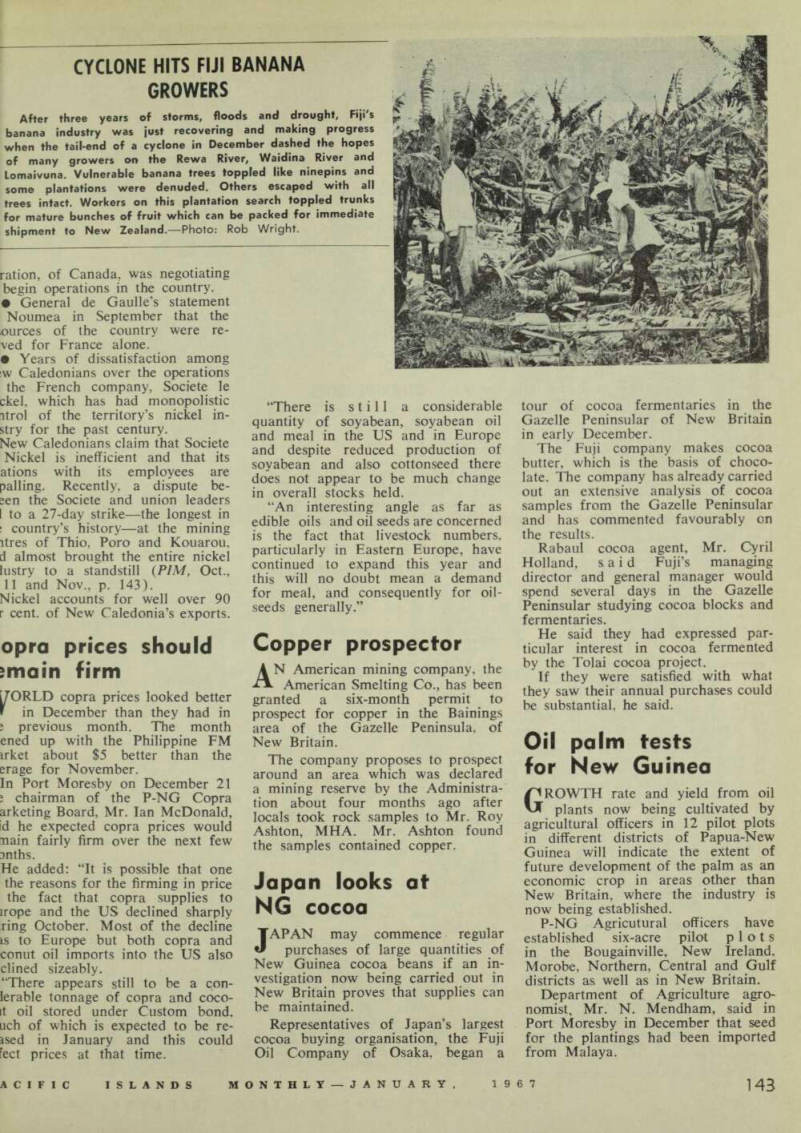
Cyclone Hits Fiji Banana
Growers
After three years of storms, floods and drought, Fiji's banana industry was just recovering and making progress when the tail-end of a cyclone in December dashed the hopes of many growers on the Rewa River, Waidina River and Lomaivuna. Vulnerable banana trees toppled like ninepins and some plantations were denuded. Others escaped with all trees intact. Workers on this plantation search toppled trunks for mature bunches of fruit which can be packed for immediate shipment to New Zealand. —Photo: Rob Wright.